Hunter Brown, an Astros pitcher and Cy Young finalist, is eligible for a Prospect Promotion Incentive (PPI) pick in the 2026 draft due to his performance and prospect status, earning the team an extra pick despite not winning the award. This incentive is part of MLB's efforts to reduce service time manipulation, rewarding players who meet specific criteria with additional draft picks.
The latest Producer Price Index (PPI) report shows wholesale prices fell in August, defying expectations and suggesting that tariffs implemented during President Trump's administration have not significantly increased prices, contributing to a decline in inflation and boosting small business optimism.
US wholesale inflation unexpectedly declined in August for the first time in four months, suggesting companies are holding back on price increases despite tariffs, which may influence the Federal Reserve's decision to cut interest rates next week amid economic uncertainty.
Wholesale prices unexpectedly declined by 0.1% in August, providing the Federal Reserve with potential room to cut interest rates at its upcoming meeting, amid signs of easing inflation and a cautious economic outlook.
Treasury yields rose after data showed higher wholesale inflation in July, leading traders to reduce expectations of a September interest rate cut by the Federal Reserve, amid mixed economic signals and upcoming Fed speeches.
China's July factory-gate prices fell more than expected, with PPI down 3.6% year-on-year and CPI unchanged, highlighting ongoing deflation concerns due to sluggish domestic demand, trade uncertainties, and structural economic challenges. Despite some signs of easing deflationary pressures, analysts remain cautious about the sustainability of recovery without demand-side stimulus and reforms.
In June, the wholesale inflation measure remained unchanged, indicating minimal impact from tariffs on prices, with the producer price index flat and core PPI slightly up, while annual inflation remains above the Fed's target, influencing monetary policy considerations.
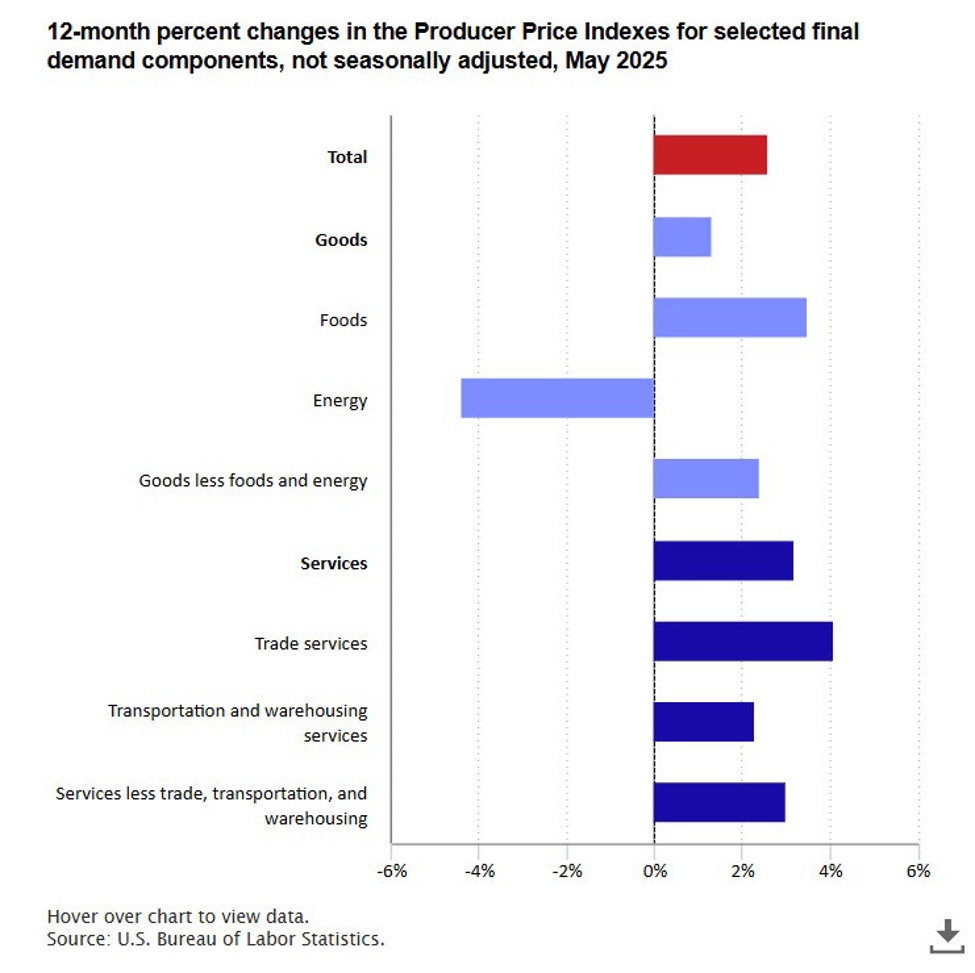
US Producer Price Index (PPI) data for June showed no month-over-month change at 0.0%, below the 0.2% estimate, and a year-over-year increase of 2.3%, slightly below the 2.5% forecast. Core PPI also came in lower than expected. Despite the softer inflation signals, US stock markets responded positively to the data. The report details price changes across goods and services, with some categories rising and others falling, indicating mixed inflation pressures.
China's producer price index (PPI) fell by 3.6% in June, marking the worst deflation in nearly two years due to weak domestic demand and ongoing trade tensions, especially with the US. Consumer prices saw a slight increase, but overall economic activity remains subdued, prompting calls for further stimulus measures.
The Producer Price Index (PPI) has seen significant upward revisions, particularly in the services sector, which constitutes 67% of the PPI. This has led to a notable acceleration in inflation, with the overall PPI for final demand rising by 3.0% year-over-year in November, the fastest since February 2023. Core PPI, excluding food and energy, also accelerated to 3.4% year-over-year. The revisions highlight that inflation in services has been much higher than previously reported, while goods prices are also re-accelerating.
The Producer Price Index (PPI) data for March showed significant seasonal adjustments, with the not-seasonally adjusted PPI jumping by 7.9% annualized, the highest since June 2022. The three-month rates for PPI all increased, indicating a trend of higher lows and higher highs, which could impact future inflation data. The seasonal adjustments in March were notably larger than in previous years, likely influenced by pandemic-related distortions. The volatility in PPI data and the potential for self-correction in seasonal adjustments may lead to surprises in the coming months.
Despite concerns about inflation, the Fed's preferred inflation gauge, the PCE, may not be as bad as feared in March, providing some relief to the stock market which is looking to rebound after a significant slide.
The stock market experienced a 422-point drop in the Dow due to hot inflation data, with the Producer Price Index (PPI) now taking center stage as investors closely monitor market volatility and its impact on various sectors.
The Producer Price Index (PPI) for February rose 1.6% annually, driven by a surge in energy prices, exceeding economists' expectations. Core PPI, which excludes food and energy, rose 0.3% for the month. The increase in energy prices also impacted the Consumer Price Index (CPI), which rose to a 3.2% annual increase, driven by higher gas prices. While the Federal Reserve closely monitors core inflation, the recent reports keep the Fed on alert and may impact future monetary policy decisions.