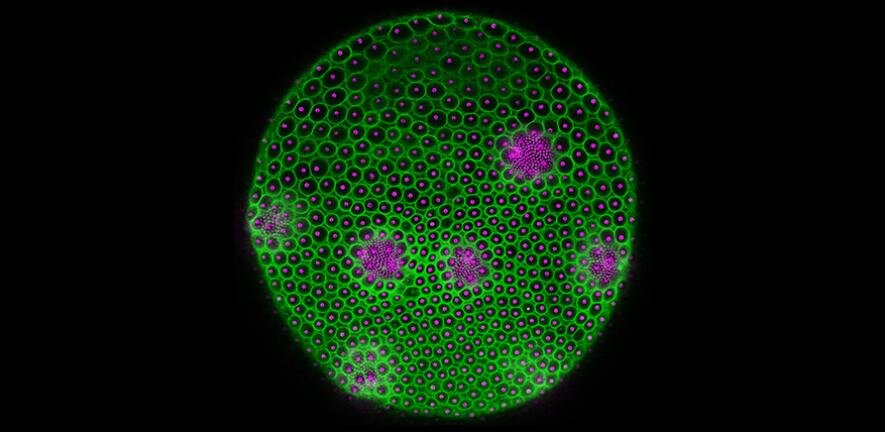
Researchers used advanced imaging and machine learning to uncover the intricate, foam-like structure of the extracellular matrix in Volvox algae, revealing how simple cells coordinate to form complex, spherical multicellular organisms despite noisy individual behaviors, providing new insights into developmental biology.
New research challenges the long-held belief that increased oxygen levels triggered the Avalon explosion, which marked the rise of multicellular organisms on Earth. Analyzing ancient rocks, scientists have found that oxygen levels were actually lower than today when these life forms emerged. This finding suggests that low oxygen levels may have promoted the development of these organisms, reshaping our understanding of the origin of life on Earth. The study calls for a revision of textbooks and encourages further research to reconsider previous results in light of this new information.
A new study challenges the long-held assumption that higher oxygen levels triggered the rise of multicellular organisms in Earth's oceans. Researchers from the University of Copenhagen, Woods Hole Oceanographic Institute, and other institutions analyzed ancient rock samples and found that oxygen concentrations during the era when multicellular organisms appeared remained 5-10 times lower than today. This discovery suggests that increased oxygen levels did not drive the evolution of advanced marine organisms. Instead, the researchers propose that lower oxygen levels may have provided a favorable environment for the development of multicellular life. The findings call for a revision of our understanding of the factors that influenced the origin and development of life on Earth.
A new study challenges the long-held belief that increased oxygen levels triggered the emergence of complex multicellular organisms during the Avalon explosion, a precursor to the Cambrian explosion. Researchers from the University of Copenhagen, Woods Hole Oceanographic Institute, and other institutions analyzed ancient rock samples from Oman and found that oxygen concentrations in Earth's oceans remained 5-10 times lower than today during the time when these organisms appeared. The findings suggest that oxygen did not play a major role in the development of advanced life forms, prompting a need to revise our understanding of life's origins. The researchers propose that lower oxygen levels may have actually aided the development of these organisms, similar to how low oxygen levels control stem cells in humans and animals.
Fossils of seaweed found in black shale in China's Hubei Province indicate that habitable marine environments were more widespread during the Cryogenian Period than previously known, offering a deeper understanding of how life survived on "Snowball Earth." The findings suggest that it was more of a "Slushball Earth" where the earliest forms of complex life endured even at mid-latitudes previously thought to have been frozen solid. The world's oceans were not completely frozen, and habitable refuges existed where multicellular eukaryotic organisms could survive.