The National Cancer Institute is conducting a preclinical study of ivermectin as a potential cancer therapy, with results expected in months, a move that has drawn opposition from some scientists who say there is no solid evidence and warn about misinforming patients, even as officials and influencers promote the idea.
A large-scale study demonstrates that administering ivermectin, a common antiparasitic drug, to communities reduces malaria cases by 26% by making human blood deadly to mosquitoes, offering a promising new tool to combat malaria especially where resistance to traditional methods is rising.
Several states are proposing or have enacted laws to make ivermectin available over the counter, despite the FDA not approving its use for COVID-19 and warnings about potential risks. The move is driven by political and public interest, but remains controversial due to safety concerns and lack of clinical evidence for COVID treatment.
Dr. Pierre Kory, a pulmonary critical care physician and president of the Front Line COVID-19 Critical Care Alliance, challenges the official narrative on COVID-19 vaccine safety, claiming that data doesn't support the statement that vaccines are safe and effective. He suggests that excess fatalities and disability claims have increased after people started taking the COVID-19 vaccines, and he has seen more patients with problems developed after vaccination. Kory also criticizes the suppression of information counter to the vaccine safety message and alleges that the pharmaceutical industry influences medical journals to favor vaccines. He advocates for the use of ivermectin as a successful treatment for COVID-19 and accuses a global disinformation campaign of trying to destroy early effective treatment drugs in order to promote the vaccine campaign.
Dr. Roach advises against using ivermectin as it has been found ineffective against COVID-19 and similar viruses, with potential for toxicity at high doses. People with a history of chronic fatigue syndrome (CFS) are at higher risk for developing long COVID symptoms, making prevention through vaccination, social distancing, and hand hygiene crucial. While the effectiveness of Paxlovid in preventing long COVID is uncertain, getting vaccinated has been shown to reduce the risk of developing long COVID symptoms.
US households can now order four free Covid tests from the government through COVIDTests.gov. The CDC and FDA recommend one dose of the updated vaccine for everyone six months and older, with some children eligible for up to three doses. Hospitalizations and deaths have been rising, and two new variants, Pirola and Eris, are being monitored. Four prisoners in Arkansas settled a lawsuit after being given ivermectin without consent, winning $2,000 each. Novavax has shipped millions of updated Covid vaccines, with availability expected by the end of the week. GOP politicians have raised concerns about the safety of the updated vaccines, but health authorities maintain they are safe and effective. The CDC offers the Covid vaccine for free through the Bridge Access Program. Most hospitalizations are among those 65 and older, with a low percentage having received the recommended booster. Covid hospitalizations are declining for the second week in a row. New York City has stopped reporting vaccination data, and experts warn of a possible uptick in cases. New research suggests the existence of "long colds" with symptoms similar to long Covid.
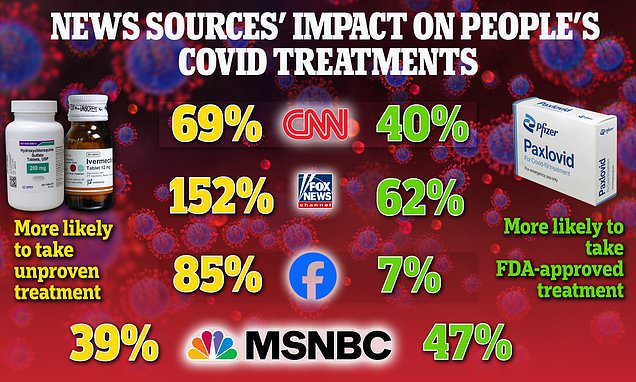
Approximately 6% of Americans turned to unproven treatments like ivermectin and hydroxychloroquine to treat their COVID-19 infections, despite the lack of evidence supporting their effectiveness. A survey found that individuals who relied on Facebook, CNN, Fox News, and MSNBC for information were more likely to use non-evidence-based treatments. Conservatives, those who trusted social media, scored higher on the American Conspiracy Thinking Scale, and trusted former President Trump were also more likely to endorse these unfounded medications. The study highlights the influence of misinformation and mistrust in healthcare institutions on treatment choices.
A nationwide survey in the United States found that approximately 6% of adults who had previously contracted COVID-19 reported using either ivermectin or hydroxychloroquine as treatments, despite the lack of evidence supporting their effectiveness against the virus. The study also revealed that individuals who endorsed vaccine misinformation, trusted social media, scored higher on the American Conspiracy Thinking Scale, or trusted former President Trump were more likely to turn to unproven treatments. Additionally, those who received information from cable news sources or Facebook were more likely to use non-evidence-based treatments. Political affiliation was not the sole indicator, as factors such as vaccine misinformation and conspiratorial thinking also contributed to the likelihood of using these drugs.
A study published in the JAMA Health Forum found that 1 in 20 Americans who contracted COVID-19 used non-evidence-based treatments, such as ivermectin and hydroxychloroquine, due to beliefs in vaccine-related misinformation. The study surveyed nearly 13,450 adults in the U.S. and focused on those who endorsed COVID-19 vaccine-related misinformation, distrusted hospitals, medical professionals, and scientists, and exhibited a greater belief in conspiracy theories. Despite the FDA's denouncement of these medications for COVID-19 treatment, prescriptions for them increased during the first year of the pandemic. The study also found that trust in social media and Donald Trump was associated with higher usage of these drugs, while trust in physicians and hospitals was associated with lower usage.
A federal appeals court has revived a lawsuit against the FDA, filed by three doctors, claiming that the agency overstepped its boundaries by aggressively discouraging the use of ivermectin for COVID-19 treatment. The doctors argue that the FDA's messaging harmed their reputations and that the agency should inform, not prescribe. The court found that there was a basis for the lawsuit to proceed, stating that the FDA has the authority to inform but not endorse or advise. Ivermectin has been a subject of debate, with some doctors prescribing it for COVID-19 treatment, while critics dismiss it as "cattle" or "horse medication." The drug is approved for human use to treat parasites and other conditions, but self-administering it can be dangerous.
A federal appeals court has revived a lawsuit against the FDA over its campaign against the use of ivermectin to treat COVID-19. Three doctors sued the FDA, claiming that the agency's anti-ivermectin messaging went beyond its authority. The court ruled that the lawsuit can continue, stating that the FDA's messaging crossed the line between informing and advising. The FDA's campaign emphasized that ivermectin should not be used to treat COVID-19, despite its approval for other uses. The drug's effectiveness for COVID-19 treatment remains controversial, with limited high-quality evidence supporting its use. The World Health Organization and the National Institutes of Health have also recommended against its use. The doctors claim that their reputations were harmed by the FDA campaign.
The Wisconsin Supreme Court has ruled that a hospital cannot be forced to administer ivermectin to a COVID-19 patient. The ruling overturned a lower court order that required Aurora Health Care to administer the deworming drug to a patient who was placed on a ventilator due to COVID-19 complications. Ivermectin, an anti-parasitic medication typically used on livestock, grew in popularity among conservatives after it was hailed by some as a miracle cure for COVID-19. However, the FDA has not approved ivermectin for the treatment of COVID-19, and a National Institutes of Health panel found trials failed to show a clinical benefit from treating COVID-19 with ivermectin.
The Wisconsin Supreme Court has ruled that a hospital cannot be forced to give ivermectin, a deworming drug, to a patient with COVID-19. The decision upholds a lower court's ruling against a man who sued Aurora Health Care when doctors refused to treat his uncle with ivermectin. Ivermectin has become popular among conservatives as a miracle cure for COVID-19, but the FDA has not approved it for use in treating the virus and warns that misusing it can be harmful, even fatal. The Wisconsin lawsuit is one of dozens filed across the country seeking to force hospitals to administer ivermectin for COVID-19.