Tag

Darkmatter

All articles tagged with #darkmatter

Primordial Black Holes: Hidden Threats in Planets and Everyday Objects

Originally Published 1 year ago — by SciTechDaily

Featured image for Primordial Black Holes: Hidden Threats in Planets and Everyday Objects
Source: SciTechDaily

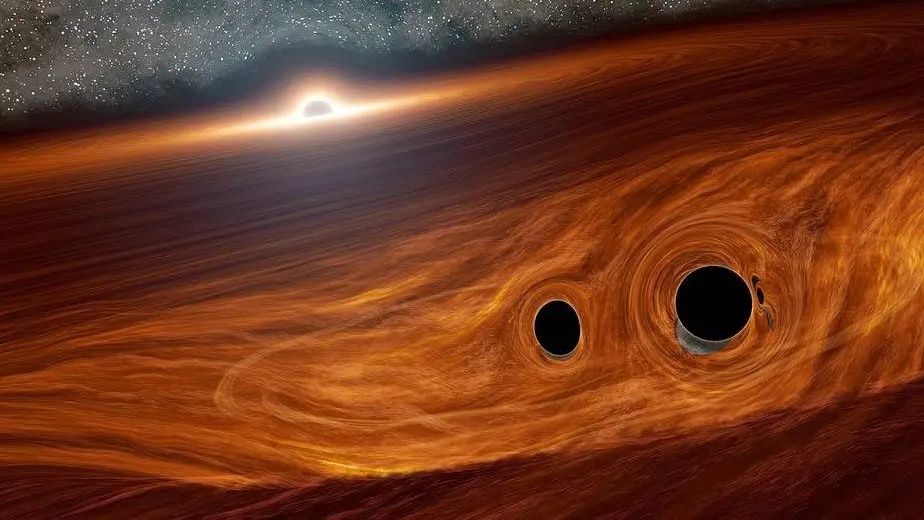
A new theoretical study suggests innovative methods to detect primordial black holes, proposing that these elusive objects could leave signatures such as hollow planetoids in space or microscopic tunnels in earthly materials. The research, co-led by the University at Buffalo, highlights the potential of these low-cost methods to advance our understanding of dark matter, despite the low probability of detection. The study emphasizes the need for creative approaches in the field of astrophysics, as traditional methods have yet to yield direct evidence of primordial black holes.

Could Black Holes Be Lurking in Everyday Objects?

Originally Published 1 year ago — by Dazed

Featured image for Could Black Holes Be Lurking in Everyday Objects?
Source: Dazed

Scientists theorize that primordial black holes, potentially formed after the Big Bang, could be tunneling through Earth unnoticed. These tiny black holes might help explain cosmic mysteries like dark matter. Although the likelihood of detecting them is low, researchers suggest searching ancient structures for evidence. Discovering these black holes could advance our understanding of the universe and future energy harvesting technologies.

Are Primordial Black Holes Lurking in Our Solar System?

Originally Published 1 year ago — by Indian Defence Review

Featured image for Are Primordial Black Holes Lurking in Our Solar System?
Source: Indian Defence Review

Physicists propose that primordial black holes (PBHs), potentially formed in the early universe, could interact with planets by consuming their cores, leaving them hollow. This theory, if validated, could provide new insights into dark matter and challenge existing models of planetary formation. PBHs might pass through solid objects undetected, complicating their detection but offering a novel approach to studying dark matter's elusive nature.

New Supervoid Insights Challenge Our Understanding of the Universe's Expansion

Originally Published 1 year ago — by Phys.org

Featured image for New Supervoid Insights Challenge Our Understanding of the Universe's Expansion
Source: Phys.org

Researchers propose that a local supervoid, a region of below-average density, could help resolve the Hubble tension, the discrepancy in measurements of the universe's expansion rate. This void, known as the KBC void, may create additional redshifts due to peculiar velocities, affecting local Hubble constant measurements. The study suggests that this void could explain observed deviations in cosmic expansion and bulk flow, challenging the standard Lambda-Cold Dark Matter model.

Reevaluating Emergent Gravity: A Worthy Concept Despite Challenges

Originally Published 1 year ago — by Ars Technica

Featured image for Reevaluating Emergent Gravity: A Worthy Concept Despite Challenges
Source: Ars Technica

Emergent gravity, a theory suggesting gravity is an emergent property rather than a fundamental force, has faced challenges in explaining cosmic phenomena like dark matter. While it offers an innovative perspective by linking gravity to thermodynamics and quantum information, it has struggled to match the predictive power of general relativity and dark matter models. Despite its current shortcomings, emergent gravity remains a valuable concept for exploring new physics, potentially leading to future breakthroughs in understanding the universe.

"Early Cosmic Structures Resembled Bananas, Research Indicates"

Originally Published 2 years ago — by The New York Times

Featured image for "Early Cosmic Structures Resembled Bananas, Research Indicates"
Source: The New York Times

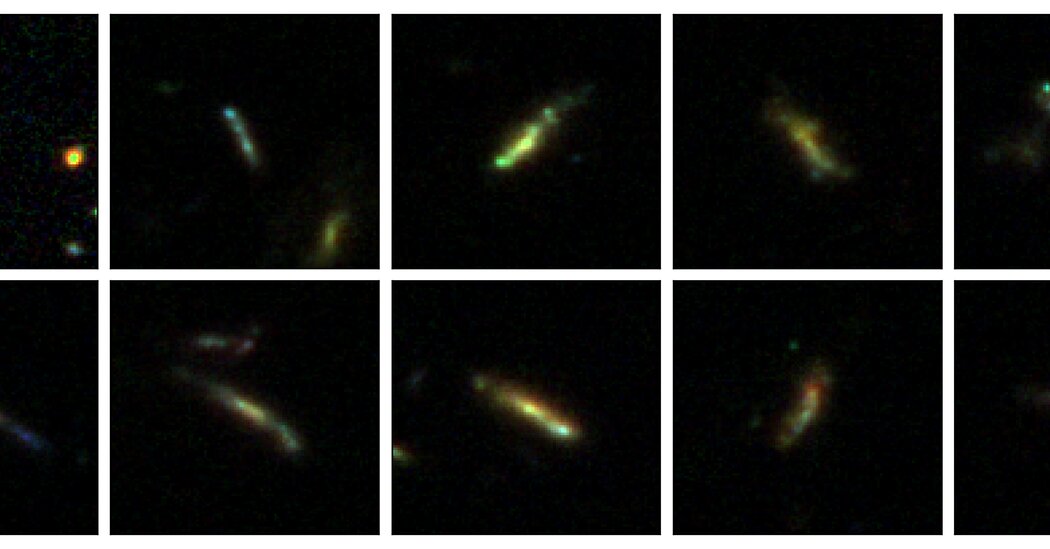
A new study analyzing images from the James Webb Space Telescope has revealed that galaxies in the early universe were elongated and shaped more like bananas, rather than the orbs and spidery discs we see today. This unexpected finding, which deviates from previous assumptions based on Hubble telescope observations, could significantly impact our understanding of galaxy formation and the role of dark matter. The research, led by Viraj Pandya of Columbia University, suggests a revision of the gravitational frameworks that describe how galaxies are born and evolve, and it may provide new insights into the enigmatic nature of dark matter.

"Decline in Cosmic Clumpiness Puzzles Astronomers"

Originally Published 2 years ago — by ScienceAlert

Featured image for "Decline in Cosmic Clumpiness Puzzles Astronomers"
Source: ScienceAlert

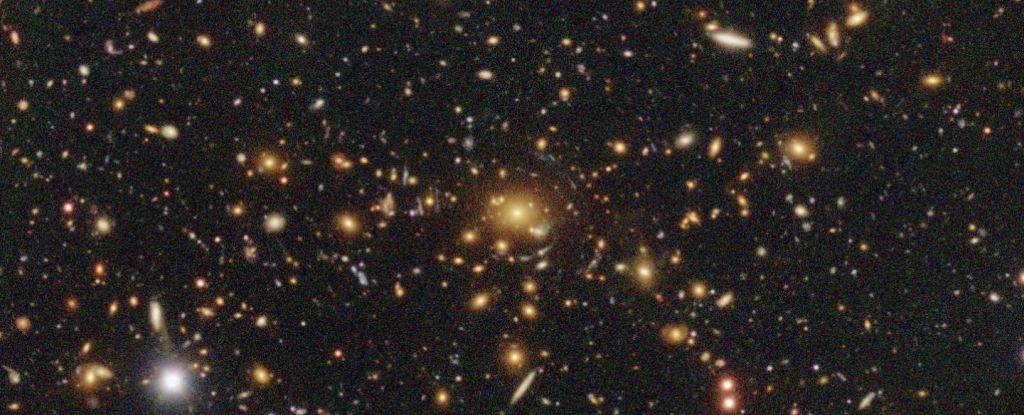
Recent observations have shown that dark matter is less clumpy in the current Universe than it was shortly after the Big Bang, challenging the standard cosmological model. This discrepancy, known as the sigma-eight (S8) tension, has been confirmed by multiple experiments, including a six-year weak gravitational lensing survey by the Hyper Suprime-Cam on the Subaru Telescope. The findings, which are not likely due to error, suggest there may be a fundamental aspect of the Universe that we do not yet understand, potentially related to our models of dark matter or cosmological expansion. This issue is detailed in five separate papers in Physical Review D, and future, more powerful surveys may provide further insights.

"Debunking the Black Hole-Sun Conundrum: Scientists Explain"

Originally Published 2 years ago — by Space.com

Featured image for "Debunking the Black Hole-Sun Conundrum: Scientists Explain"
Source: Space.com

Astrophysicist Matt Caplan and colleagues have proposed a theory that dark matter could be composed of atom-sized primordial black holes formed in the early universe. While it's highly unlikely that one of these black holes is inside the Sun, the researchers suggest that some stars, particularly in less massive environments like dwarf galaxies, might contain these black holes at their cores. These "Hawking stars," named after Stephen Hawking who theorized about primordial black holes, could potentially be identified by their unique red giant phase, which is accretion-powered rather than fusion-powered, making them puffier and dimmer. The team plans to use asteroseismology to observe candidate stars that may harbor these ancient black holes, offering a new avenue in the search for dark matter.

"Dark Matter: The Cosmic Key to Unraveling the Mystery of Magnetic Fields"

Originally Published 2 years ago — by SciTechDaily

Featured image for "Dark Matter: The Cosmic Key to Unraveling the Mystery of Magnetic Fields"
Source: SciTechDaily

Researchers at SISSA theorize that dark matter mini-halos could be indicators of primordial magnetic fields, potentially solving the mystery of the origin of cosmic magnetic fields. These mini-halos, resulting from the gravitational effects of primordial magnetic fields on dark matter density perturbations, could provide evidence that magnetic fields were formed within a second of the Big Bang. The study, published in Physical Review Letters, suggests that detecting these dark matter mini-halos would support the idea that magnetic fields are a primordial phenomenon, offering new insights into the early universe.

"Probing Cosmic Origins: Dark Matter's Role in Unveiling Magnetic Fields"

Originally Published 2 years ago — by Phys.org

Featured image for "Probing Cosmic Origins: Dark Matter's Role in Unveiling Magnetic Fields"
Source: Phys.org

Researchers from SISSA have proposed that primordial magnetic fields could be indirectly detected through their influence on dark matter, leading to the formation of mini-halos. These mini-halos, if observed, would suggest that magnetic fields originated in the early universe, potentially within a second after the Big Bang. The study, published in Physical Review Letters, indicates that while there is no direct interaction between magnetic fields and dark matter, gravitational effects can induce dark matter density perturbations, which in turn could reveal the primordial nature of cosmic magnetic fields.

"Mysterious Spacetime Ripples Could Herald Universe's Dawn, Baffling Astronomers"

Originally Published 2 years ago — by Space.com

Featured image for "Mysterious Spacetime Ripples Could Herald Universe's Dawn, Baffling Astronomers"
Source: Space.com

Astronomers from the NANOGrav collaboration are investigating the origins of faint gravitational waves detected in the Milky Way, which may be from merging supermassive black hole binaries or exotic cosmological processes from the early universe, such as cosmic strings, phase transitions, or domain walls. These findings could provide insights into the universe's infancy and the ongoing search for dark matter and dark energy. The complexity of the signals and the limitations of current detectors like LIGO pose challenges, but upcoming missions like LISA and AEDGE are expected to enhance gravitational wave detection capabilities. The research has been accepted for publication in the journal Physical Review D.

"Exploring the Possibility of Black Holes Within the Sun: A New Frontier in Dark Matter Research"

Originally Published 2 years ago — by SciTechDaily

Featured image for "Exploring the Possibility of Black Holes Within the Sun: A New Frontier in Dark Matter Research"
Source: SciTechDaily

Researchers, including a team from the Max Planck Institute for Astrophysics, have proposed the existence of "Hawking stars," which are stars with small primordial black holes at their centers. These stars could potentially live as long as normal stars and might be indistinguishable from them at the surface level. The study suggests that such stars could provide insights into dark matter and the early universe. Asteroseismology could be used to detect these stars, and upcoming projects like PLATO may help in discovering them. The research opens up the possibility of using Hawking stars to test the existence of primordial black holes and their role in the composition of dark matter.

"Supergalactic Enigma Unraveled by Cosmic Detectives"

Originally Published 2 years ago — by SciTechDaily

Featured image for "Supergalactic Enigma Unraveled by Cosmic Detectives"
Source: SciTechDaily

Scientists have resolved a longstanding mystery regarding the distribution of galaxies in the Local Supercluster by using the SIBELIUS simulation. The study found that the segregation of elliptical and disk galaxies within the supergalactic plane occurs naturally due to environmental differences, with dense regions fostering mergers and the formation of elliptical galaxies, while isolated areas allow disk galaxies to maintain their structure. This finding supports the standard model of dark matter and enhances our understanding of galaxy evolution.

"Large Hadron Collider's Intensified Hunt for Elusive Dark Photons at CERN"

Originally Published 2 years ago — by Interesting Engineering

Featured image for "Large Hadron Collider's Intensified Hunt for Elusive Dark Photons at CERN"
Source: Interesting Engineering

The CMS experiment at the Large Hadron Collider (LHC) has released initial results on dark photons, particles that could help unravel mysteries like dark matter. These particles, not predicted by the standard model, are noted for their unusual longevity, surviving over a billionth of a second. The findings from the LHC's Run 3 experiment could provide significant insights into the nature of these exotic particles.