Tag

Celestial Mechanics

All articles tagged with #celestial mechanics

astronomy1 year ago

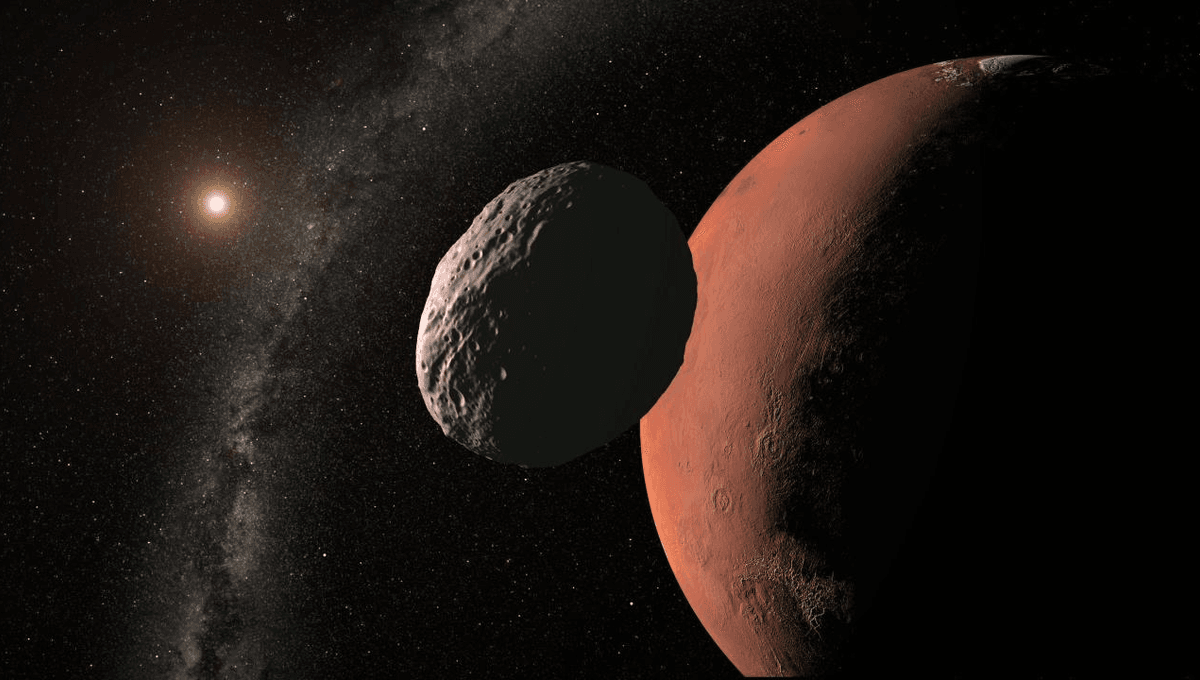
"Discovery of New Moon Orbiting Mars"

Astronomers have confirmed the existence of a new trojan asteroid, 2023 FW14, in the orbit of Mars, making it the 17th trojan asteroid discovered around the Red Planet. Unlike other trojans, this new companion might be in an unstable orbit, leading to intriguing possibilities about its past. The confirmation of the asteroid as belonging to the Martian trojan comes from the Gran Telescopio Canarias (GTC), and its spectrum provides important insights into its origin. This discovery provides valuable information about our understanding of celestial mechanics and the reliability of theoretical models.

science-and-astronomy2 years ago

"Unveiling the Enigmatic Origins of our Solar System through a Rare Iron Meteorite"

Scientists have analyzed a rare iron meteorite that fell to Earth from a fireball over Sweden in 2020, determining the orbit of its parent body. This is the first iron meteorite for which such an orbit has been calculated. Iron meteorites provide valuable insights into the early solar system and the elements that formed the planets. The research could help in understanding the distribution of chemical resources in space and aid future space missions for mining metal-rich asteroids. Additionally, calculating the orbit of the meteorite's parent body contributes to our understanding of celestial mechanics and could have implications for planetary defense.

astronomy2 years ago

"Unveiling the Enigmatic Alien World Lurking Beyond Our Solar System's Periphery"

A new study suggests that there is a possibility of one or more planet-size bodies being captured in the Oort cloud, a vast collection of icy objects at the edge of our solar system. While the chances of a rogue planet from our own system being in the Oort cloud are about 0.5%, it is slightly more likely that a Neptune-like planet from another solar system was snagged by the sun's gravity and ended up there. However, it is also possible that the Oort cloud is composed of smaller icy objects, making it difficult to determine what exactly is lurking in the distant reaches of our solar system.