
Tag

Atlas Experiment

All articles tagged with #atlas experiment

science1 year ago

Exploring New Physics Through Higgs Boson Interactions

Scientists at CERN's ATLAS experiment are investigating the interactions between Higgs bosons to search for physics beyond the Standard Model. Despite the rarity of Higgs boson pair production, which has not yet been observed, researchers are using simulations and machine learning to analyze potential signals. While no discrepancies with the Standard Model have been found, the study sets stronger constraints on new physics phenomena. Future upgrades to the LHC may increase collision data, potentially revealing new insights into Higgs boson interactions.
science-and-technology2 years ago

Unveiling the Secrets of Dark Matter: Groundbreaking Methods at the Large Hadron Collider

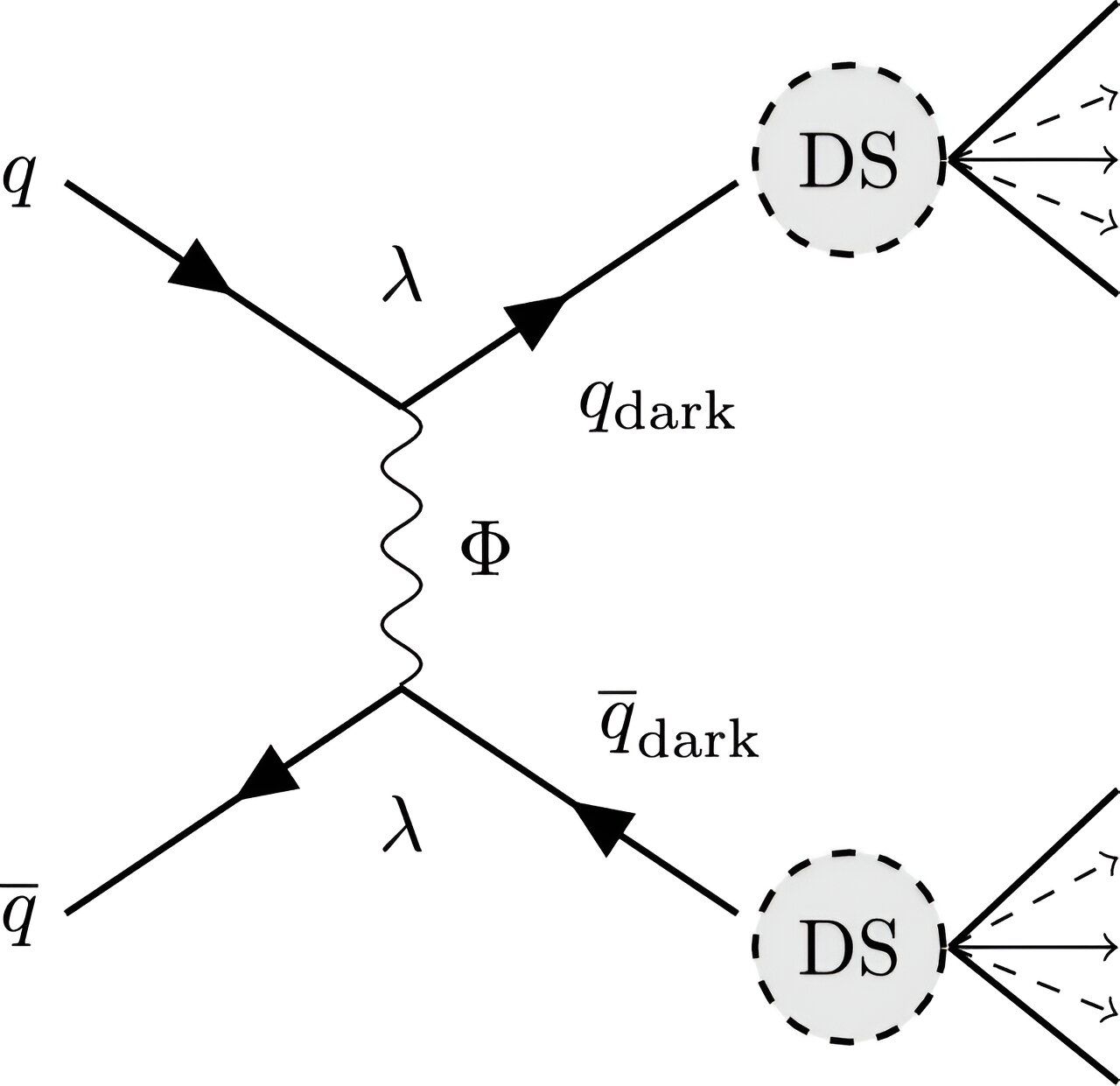
Researchers at CERN's ATLAS experiment on the Large Hadron Collider have introduced a new approach to search for Dark Matter through semi-visible jets, marking a significant paradigm shift in the field. By exploring the production of dark matter particles inside a jet of standard model particles, they have opened up new directions in the search for dark matter. This innovative method provides stringent upper bounds and sets the stage for further studies in understanding the elusive nature of dark matter.

science-and-technology2 years ago

Revolutionizing the Search for Dark Matter: Pioneering New Methods

Researchers at the ATLAS experiment at CERN have pioneered a new way of searching for dark matter by exploring a new detector signature known as semi-visible jets. These jets arise when hypothetical dark quarks partially decay into standard-model quarks and partially into stable dark hadrons. The imbalance of energy or missing energy in the detector, often aligned with one of the semi-visible jets, makes the search challenging. This new approach opens up new directions in the search for the existence of dark matter.

physics2 years ago

Advancements in Quantum Entanglement: Observing Top Quarks and Accelerating Creation

Physicists at CERN's ATLAS experiment have observed entanglement between pairs of top quarks, demonstrating that entanglement can occur at energies much higher than typical laboratory experiments. This finding suggests that particle-physics facilities like the Large Hadron Collider can be used to study quantum mechanics and quantum information. The top quark's spin was inferred by measuring the spins of its decay products, and the degree of entanglement was deduced from the angular separation between the charged leptons formed in the collision. This result opens up possibilities for studying other quantum information concepts and interdisciplinary collaboration in the search for physics beyond the Standard Model.

science-and-technology2 years ago

Record Precision Achieved in Measuring Higgs Boson's Mass at Large Hadron Collider

The ATLAS experiment at CERN has achieved a record precision measurement of the Higgs boson's mass, reporting a value of 125.11 billion electronvolts with minimal uncertainty. This measurement, derived from a combination of diphoton and four-lepton channels, is crucial for understanding the fundamental structure of the Universe and testing the Standard Model. The advanced calibration techniques and powerful reconstruction algorithms used in the analysis contributed to this unprecedented level of precision.

physics2 years ago

"ATLAS Experiment Uncovers Quantum Proton Billiards' Strong Interaction Secrets"

The ATLAS experiment at the LHC accelerator has measured the fundamental properties of strong interactions between protons at ultra-high energies by studying elastic scattering in proton-proton collisions. By analyzing the distribution of the scattering angle, the researchers were able to draw conclusions about the spatial structure of the colliding particles and the properties of their interactions. The measurements were made possible by using a dedicated measurement system and a special magnet configuration to minimize angular divergence. The results provide insights into the total cross-section and the interference between strong nuclear and Coulomb interactions, challenging pre-LHC theoretical models and advancing our understanding of fundamental particle interactions.