Tag

Accretion Disc

All articles tagged with #accretion disc

astronomy-and-astrophysics1 year ago

"Flat Protoplanets: A Surprising Twist in Gas Giant Formation"

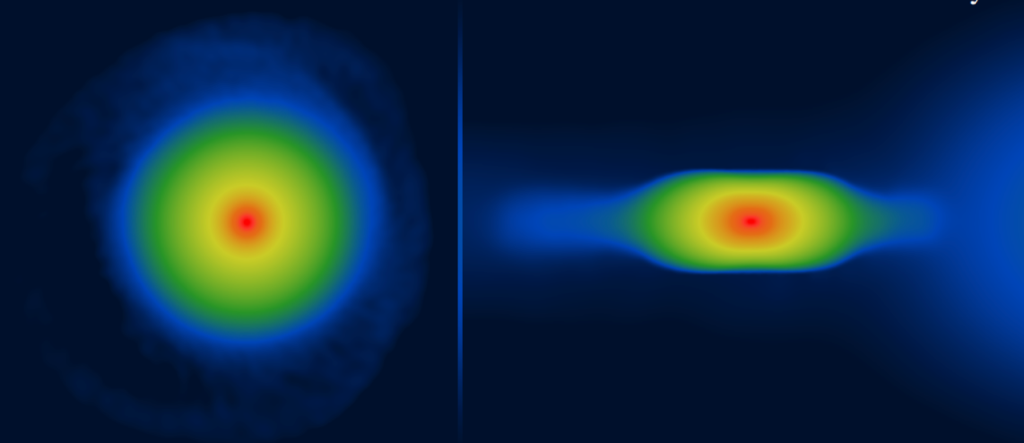
New modelling suggests that protoplanets formed within fragmentary protostar accretion discs may take on a strongly oblate spheroid shape rather than a spherical one, based on simulations run by researchers at the University of Central Lancashire. This research not only enhances our understanding of our own solar system's formation, including Earth's oblate spheroid shape, but also aids in interpreting observations from telescopes like Hubble and James Webb as we study actively forming star regions like the Orion Nebula, potentially refining simulations and reevaluating previous observational interpretations.
astronomy1 year ago

"Space Telescope Observes Massive Black Hole Unleashing Ultra-Fast Winds"

The European Space Agency's XMM-Newton telescope has detected ultra-fast winds emanating from the accretion disc of a supermassive black hole in the spiral galaxy Markarian 817. These powerful winds, observed for about a year, could potentially hinder the formation of new stars within the galaxy, indicating that black holes may have a greater impact on reshaping their host galaxies than previously believed, according to astronomers.

astronomy2 years ago

"First-Ever Observation of an Extragalactic Star's Disc Marks Cosmic Breakthrough"

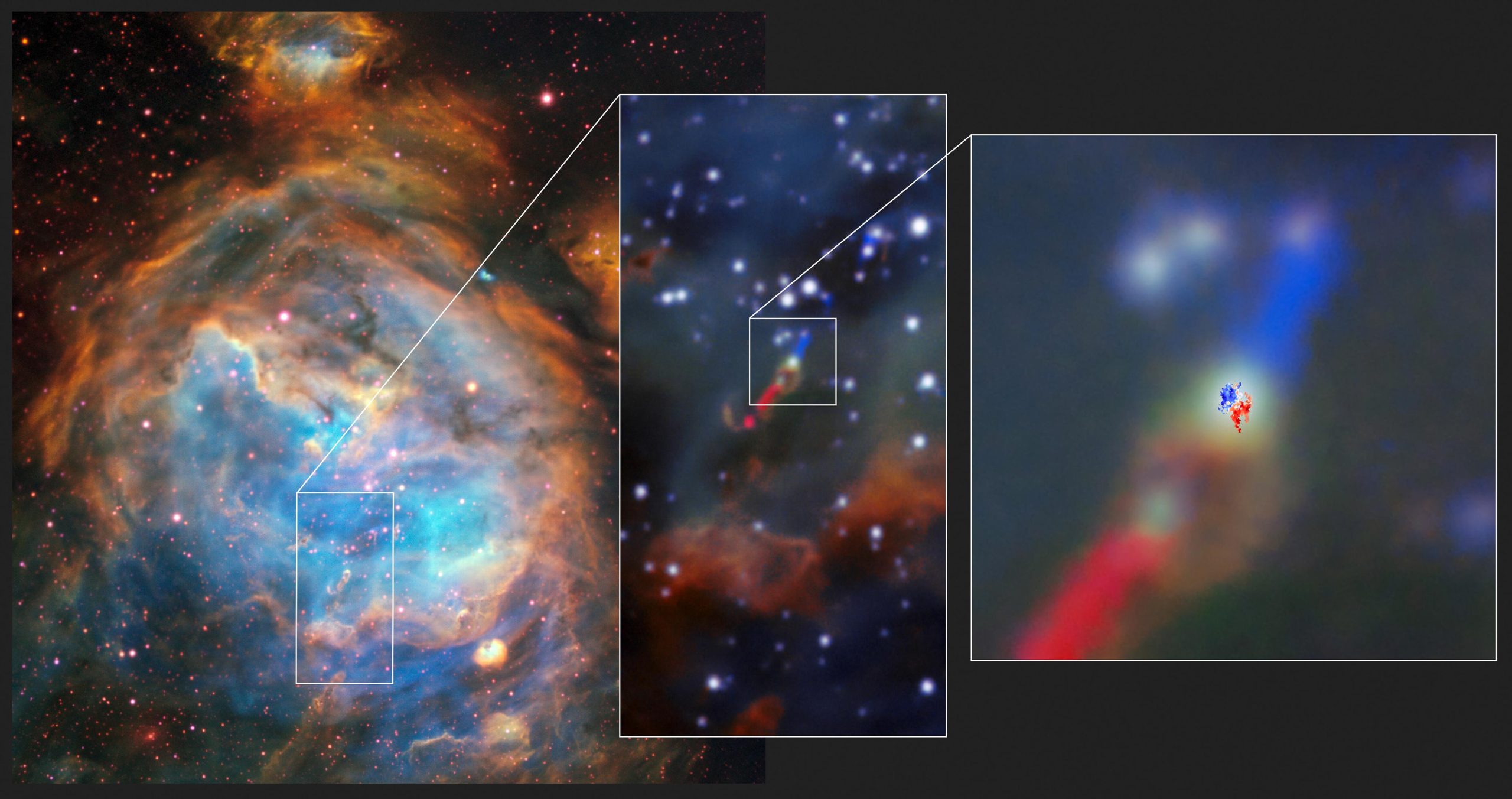
Astronomers have discovered the first evidence of a rotating disc of material around a massive young star in a neighboring galaxy, the Large Magellanic Cloud, using the Atacama Large Millimeter/submillimeter Array (ALMA). This breakthrough provides insight into the formation of high-mass stars and suggests that they form in a similar way to lower-mass stars. The discovery, led by a team including Rice University's Megan Reiter, sheds light on the early universe and offers a glimpse into how stars and planets formed in the past.

astronomy2 years ago

Unveiling the Astonishing Feeding Habits of Black Holes

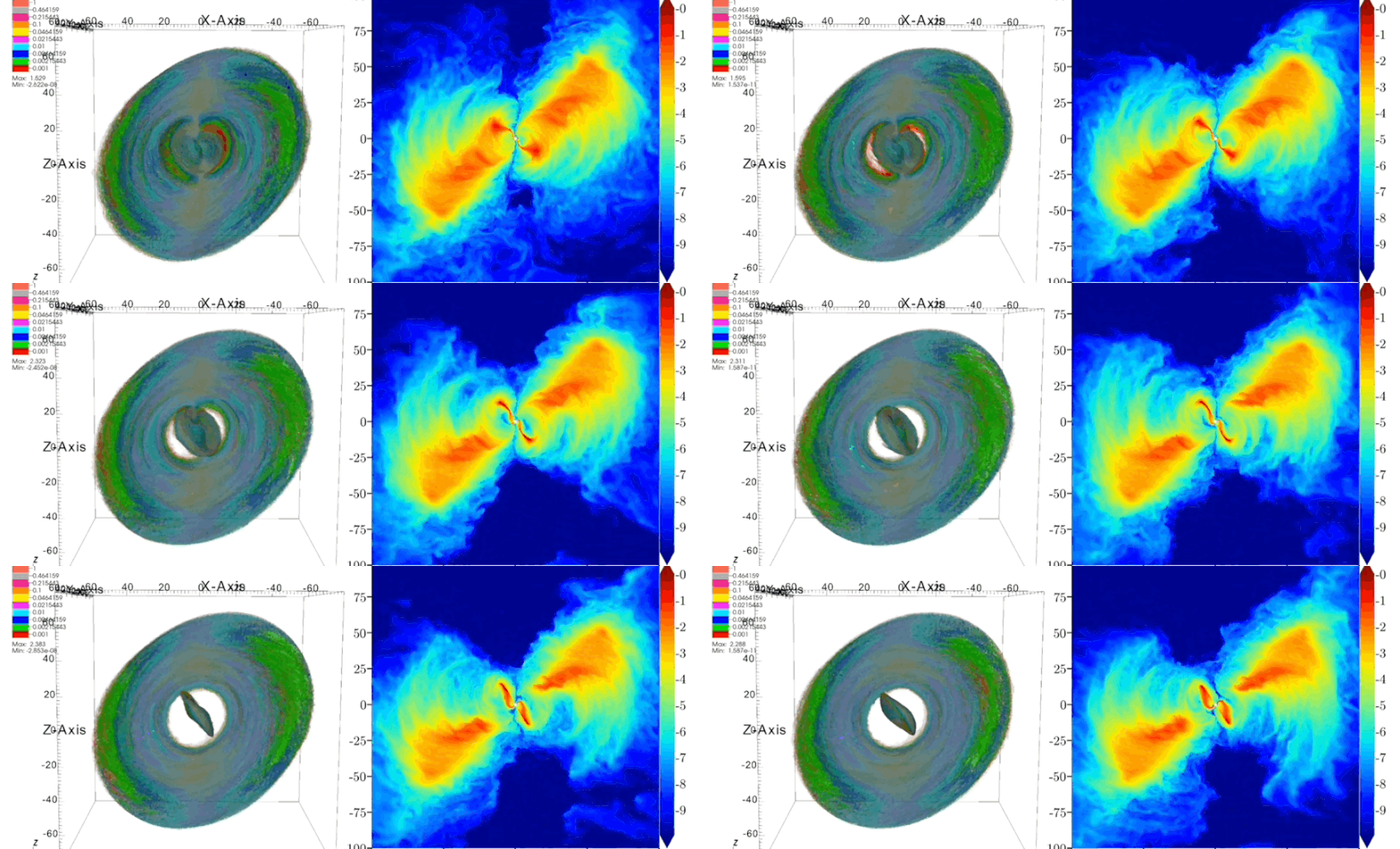
A 3D model of a black hole's feeding pattern suggests that twists in spacetime caused by the black hole's rotation could explain the erratic behavior of quasars known as "changing-look" quasars. The model shows that the accretion disc surrounding the black hole can split into inner and outer sub-discs due to frame-dragging, causing collisions and shocks that feed matter into the black hole at a faster rate. This process could potentially explain why quasars can switch their radiation on and off within short periods of time, challenging previous assumptions about accretion disk behavior.

astronomy2 years ago

"Double Black Hole System Causes Massive Cosmic Burst"

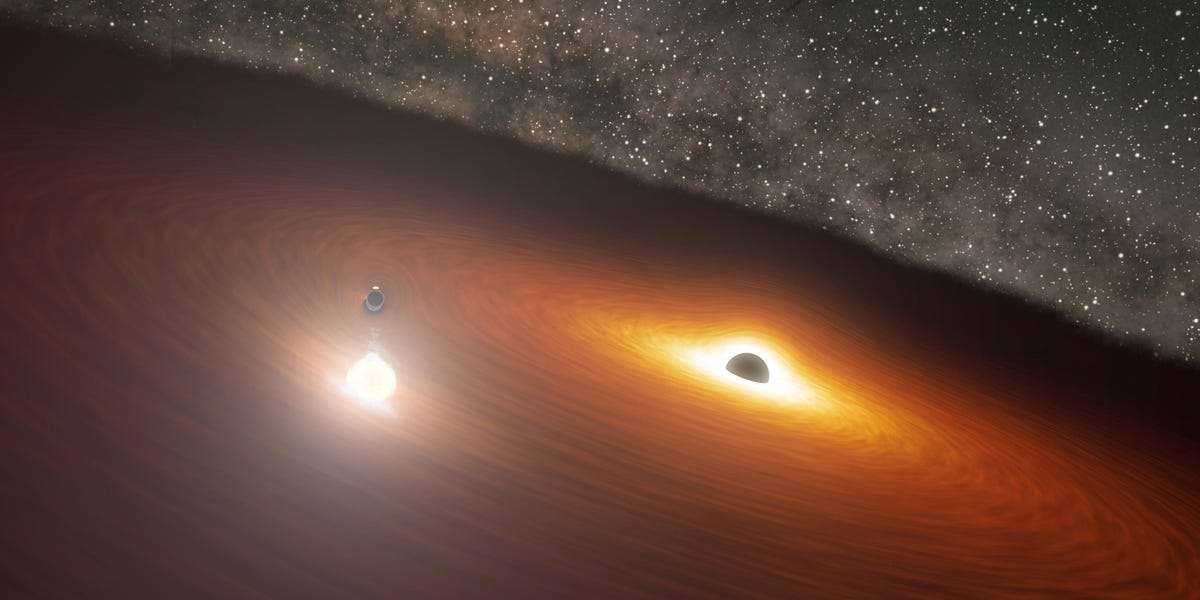
A brilliant cosmic burst 100 times brighter than our galaxy was observed coming from a binary system consisting of two black holes in galaxy OJ287, located 5 billion light-years away. The smaller black hole, with a mass of about 150 million suns, orbits its larger companion, with a mass of 18 billion suns, at near the speed of light. The burst occurred when the smaller black hole crashed into a disk of gas surrounding the larger black hole, energizing an explosive jet of radiation that ejected from the smaller black hole. This is the first time astronomers have observed a flare directly from the smaller black hole in OJ287, providing observational proof of its existence.