
Supernova measurements provide new insights into universe's expansion rate.
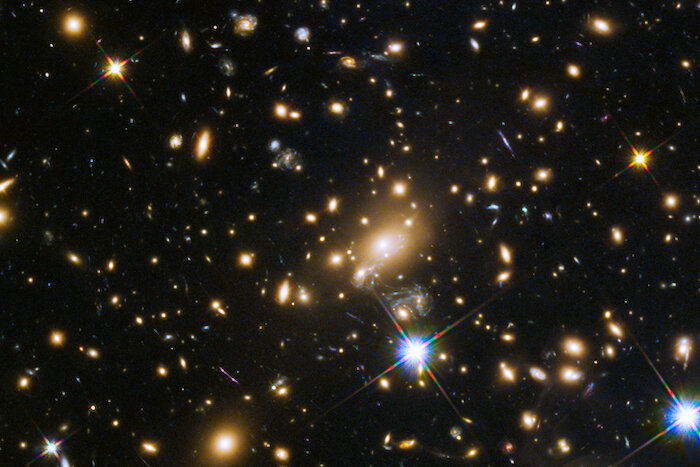
A team led by University of Minnesota Twin Cities researchers has used a first-of-its-kind technique to measure the expansion rate of the universe, providing insight into a longstanding debate in the field and could help scientists more accurately determine the universe's age and better understand the cosmos. The researchers were able to calculate this value using data from a supernova discovered by Kelly in 2014—the first ever example of a multiply imaged supernova. The researchers' findings don't absolutely settle the debate, but they do provide more insight into the problem and bring physicists closer to obtaining the most accurate measurement of the universe's age.
- First-of-its-kind measurement of the universe's expansion rate weighs in on a longstanding debate Phys.org
- A reappearing supernova offers a new measure of the universe's expansion Science News Magazine
- A distant supernova defies our understanding of the cosmos's expansion New Scientist
- Astronomers Use a Powerful Supernova to Potentially Solve a 60-Year-Old Question Inverse
- How fast is the universe expanding? New supernova data could help nail it down Space.com
- View Full Coverage on Google News
Reading Insights
0
6
3 min
vs 4 min read
85%
686 → 104 words
Want the full story? Read the original article
Read on Phys.org