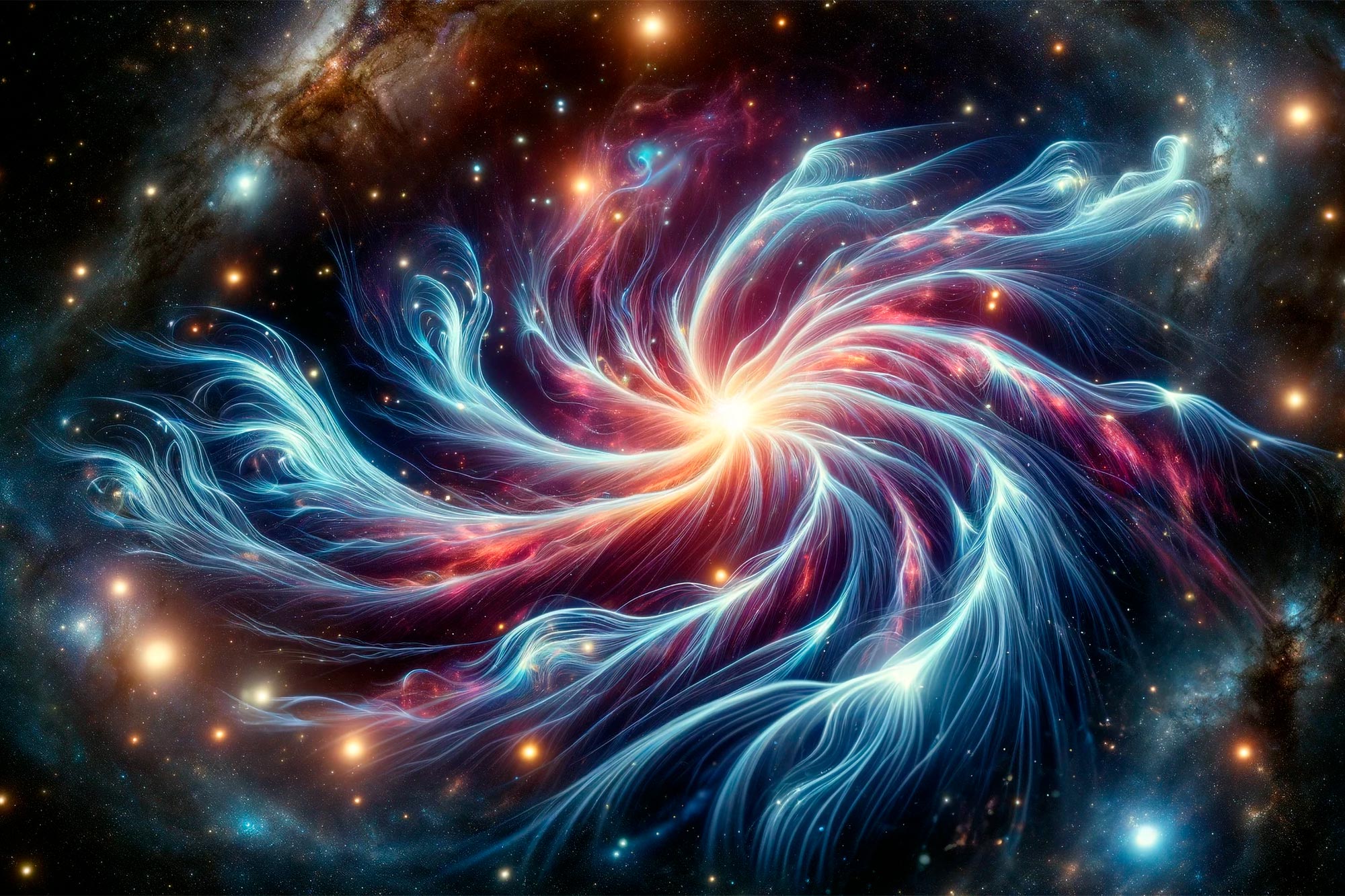
Astronomers using the MUSE instrument on the ESO's Very Large Telescope have discovered that galactic winds, which limit galaxy growth and star formation, are a universal phenomenon in galaxies over 7 billion years old. These winds, formed from massive star explosions, were mapped using magnesium atom emission signals. Future studies aim to measure the extent and matter content of these galactic winds.
Scientists and philosophers propose a new "law of nature" that expands on Charles Darwin's theory of evolution. They argue that evolution is a universal process that applies to various systems, both living and non-living, at different scales. The proposed law, called "the law of increasing functional information," states that evolving systems form from interacting building blocks and create diverse combinations. Evolution occurs when these combinations are selected for useful functions or purposes. The scientists highlight examples from the formation of elements in stars to the development of traits in organisms. The new law aims to explain why the universe becomes more diverse and complex over time.
A group of scientists and philosophers have proposed a new law of nature that expands on Charles Darwin's theory of evolution. The "law of increasing functional information" suggests that complex natural systems, both living and non-living, evolve towards greater patterning, diversity, and complexity. This law applies to various systems, including atoms, minerals, planetary atmospheres, planets, and stars. The authors argue that evolution occurs when different configurations of interacting building blocks are subject to selection for useful functions. The proposed law provides a new perspective on the evolution of diverse systems in the cosmos and may offer insights into the development of unfamiliar systems, such as organic chemistry on Saturn's moon Titan.