

Tag

Transmission Electron Microscopy

All articles tagged with #transmission electron microscopy

science-and-technology1 year ago

"Creating One-Dimensional Gas by Trapping Krypton Atoms in Nanotubes"

Scientists at the University of Nottingham have successfully trapped krypton atoms inside carbon nanotubes, forming a one-dimensional gas, using advanced transmission electron microscopy. This breakthrough offers new insights into atomic behavior and interatomic forces, allowing for the direct observation of krypton atoms transitioning to a one-dimensional gas state. The research has significant implications for understanding the dynamics of atoms in real-time and direct space, and the team plans to further explore temperature-controlled phase transitions and chemical reactions in one-dimensional systems.
science-and-technology2 years ago

"Electron-induced Atom Ejection: Unveiling the Power of 2D Materials"

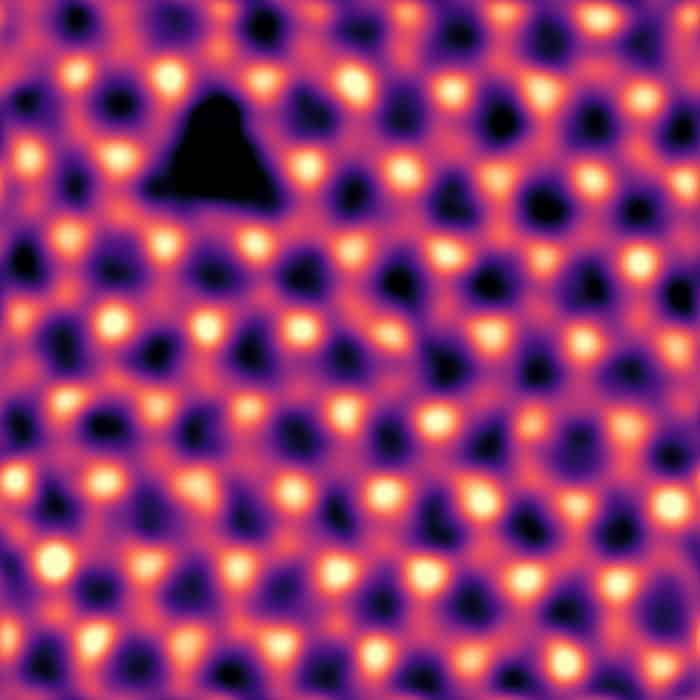
Physicists have discovered that a beam of electrons can remove single atoms from a two-dimensional sheet of hexagonal boron nitride (hBN) in a controlled manner, contrary to previous predictions. The researchers also found that a higher-energy version of the technique could selectively remove nitrogen atoms from the hBN lattice, which is unexpected as nitrogen is heavier than boron. The vacancies left behind by the missing nitrogen atoms could have applications in quantum computing, communication networks, and sensors. The researchers used aberration-corrected scanning transmission electron microscopy (TEM) to isolate the vacancies and found that operating the TEM in near ultrahigh vacuum conditions reduced lattice damage. This discovery opens up possibilities for manipulating other materials at the atomic level using electron beams.

science2 years ago

New Experiment Suggests Controversial Ice Variant May Be Natural

Scientists from the Chinese Academy of Sciences have claimed to have created fairly pure cubic ice, or Ice Ic, using transmission electron microscopy. The ice that formed was primarily cubic ice, with a smaller amount of the more regular, hexagonal ice (Ice Ih) alongside it. The findings could have implications in everything from climate change to materials science. Further investigations are required to confirm the existence and properties of cubic ice, including how its defects might influence its behavior.