Tag

Hexagonal Boron Nitride

All articles tagged with #hexagonal boron nitride

Cavity engineering reshapes superconductivity at a buried interface
science1 day ago

Cavity engineering reshapes superconductivity at a buried interface

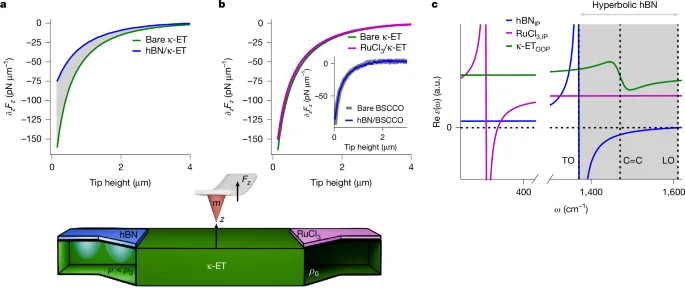
Researchers build a resonant hyperbolic cavity by placing hexagonal boron nitride on the molecular superconductor κ-(BEDT-TTF)2Cu[N(CN)2]Br and observe a resonant coupling between hBN’s hyperbolic modes and the C=C stretching mode linked to superconductivity, causing a strong, spatially selective suppression of the local superfluid density at the hBN/κ-ET interface (about 50% in several devices) at 2 K. Non‑resonant controls (RuCl3/κ-ET and hBN/BSCCO) show little or no effect, indicating the suppression is tied to the resonant cavity. The work demonstrates a ground-state modification via dark cavity engineering and suggests a general approach to tailoring electronic phases without external driving.
"Breakthrough: Two-Dimensional Waveguides Uncovered by Research Team"
science-and-technology2 years ago

"Breakthrough: Two-Dimensional Waveguides Uncovered by Research Team"

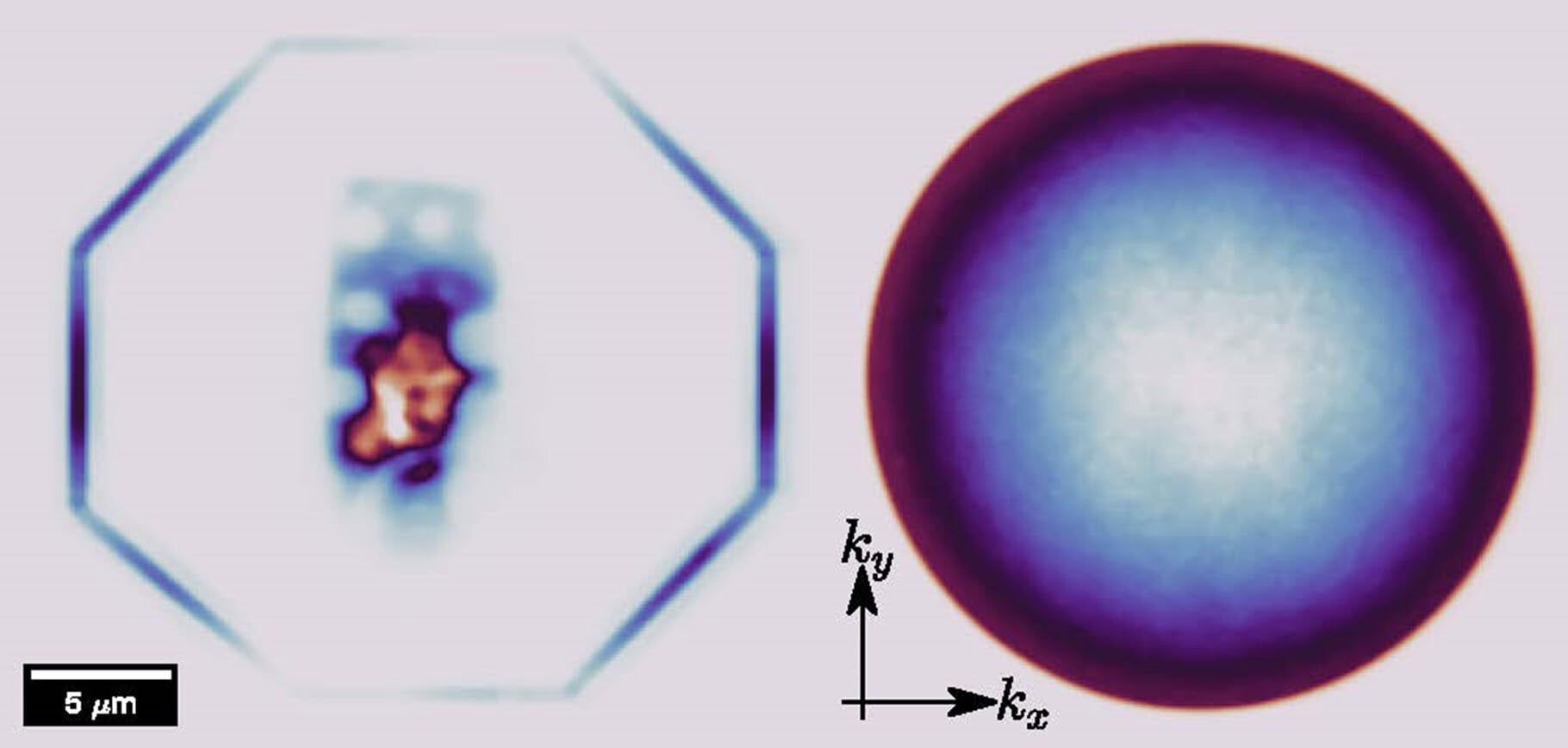
The U.S. Naval Research Laboratory and Kansas State University have discovered slab waveguides based on the two-dimensional material hexagonal boron nitride, which can be used to enhance spectroscopy of encapsulated 2D materials. These waveguides, reported in the journal Advanced Materials, have the potential to impact the development of atomically thin electronic and optical devices, offering a way to study elusive dark excitons optically and providing a step towards interfacing 2D materials with existing platforms without damaging them.

"Unlocking the Potential of Quantum Matter: Mastering the 'Golden Rules' of Atomic Block Construction"
science-and-technology2 years ago

"Unlocking the Potential of Quantum Matter: Mastering the 'Golden Rules' of Atomic Block Construction"

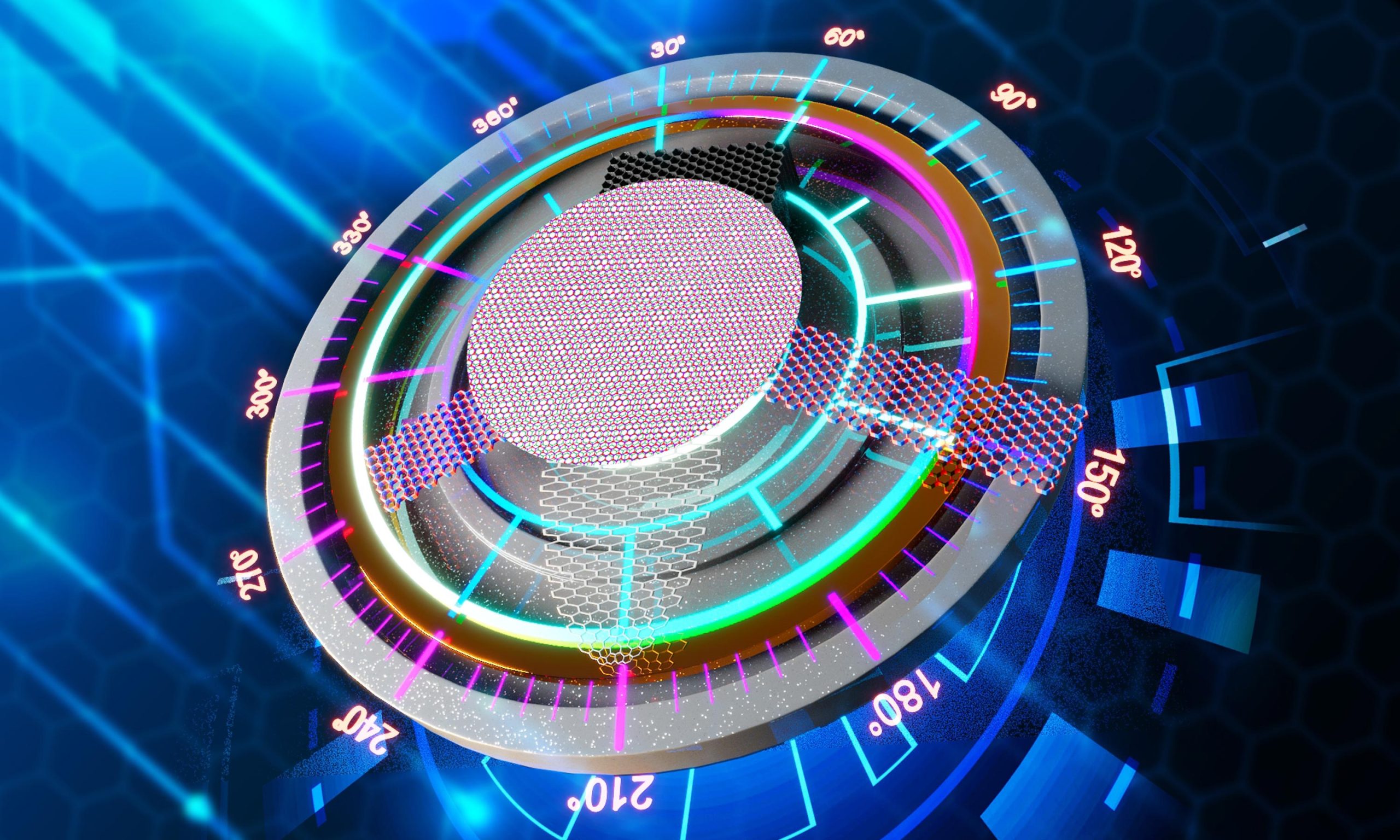
Physicists at the National University of Singapore have developed a technique to precisely control the alignment of supermoiré lattices, which are formed when two periodic structures are overlaid with a twist angle. By using a set of golden rules, the researchers have successfully achieved the controlled alignment of hBN/graphene/hBN supermoiré lattices, expanding the range of tunable material properties and potential applications. The technique involves a "30° rotation technique" and a "flip-over technique" to control the alignment of the layers. The researchers have also formulated three golden rules to guide the use of their technique. This advancement could accelerate the development of next-generation moiré quantum matter.

Quantum Sensors Find Superior Material to Diamonds
science-and-technology2 years ago

Quantum Sensors Find Superior Material to Diamonds

Hexagonal boron nitride (hBN) has the potential to surpass diamonds as the preferred material for quantum sensors, according to a new study. While diamonds have been widely used in quantum science due to their lattice structures and optical properties, they become ineffective at smaller sizes. hBN, on the other hand, shows promise in terms of quantum potential, particularly with boron vacancies. By manipulating and monitoring hBN, researchers have been able to stabilize the negatively charged boron vacancy, making it an ideal material for quantum systems. This discovery could lead to higher sensitivity and spatial resolution in quantum sensors and quantum information processing.

"Electron-induced Atom Ejection: Unveiling the Power of 2D Materials"
science-and-technology2 years ago

"Electron-induced Atom Ejection: Unveiling the Power of 2D Materials"

Physicists have discovered that a beam of electrons can remove single atoms from a two-dimensional sheet of hexagonal boron nitride (hBN) in a controlled manner, contrary to previous predictions. The researchers also found that a higher-energy version of the technique could selectively remove nitrogen atoms from the hBN lattice, which is unexpected as nitrogen is heavier than boron. The vacancies left behind by the missing nitrogen atoms could have applications in quantum computing, communication networks, and sensors. The researchers used aberration-corrected scanning transmission electron microscopy (TEM) to isolate the vacancies and found that operating the TEM in near ultrahigh vacuum conditions reduced lattice damage. This discovery opens up possibilities for manipulating other materials at the atomic level using electron beams.

Long-lasting quantum emitters using hexagonal boron nitride.
quantum-technology2 years ago

Long-lasting quantum emitters using hexagonal boron nitride.

Scientists at MIT, University of Texas, RIKEN center for Advanced Photonics, and the University of Oxford have discovered a way to improve the photostability of emitters in hexagonal boron nitride materials, which are crucial building materials for optical quantum technologies. The team found that photobleaching of hexagonal boron nitride vacancy emitters can facilitate photostability suited for quantum applications. They also identified a key to improve the photostability of emitters in hexagonal boron nitride materials that effectively shielded oxygen from the environment to optimize carbon substitution in the hexagonal boron nitride.