Researchers at the University of Tokyo have developed a low-pressure, electron-beam method to convert adamantane into defect-free nanodiamonds, opening new possibilities for advanced imaging, analysis, and quantum technology applications, challenging previous assumptions about organic molecule stability under electron irradiation.
Scientists at SLAC have developed an unprecedented high-current electron beam using laser shaping techniques, marking a major breakthrough in accelerator physics with wide-ranging implications for astrophysics, quantum chemistry, and future particle accelerators.
Scientists have finally solved the "Dolomite Problem" that has puzzled researchers for 200 years. Dolomite, a mineral found in ancient rock formations, has resisted attempts to grow it in the lab. However, a team of scientists has now successfully grown dolomite crystals by using an electron beam to dissolve and then saturate the crystal. This breakthrough not only solves a long-standing geological mystery but also has potential applications in manufacturing defect-free materials for semiconductors, solar panels, and batteries.
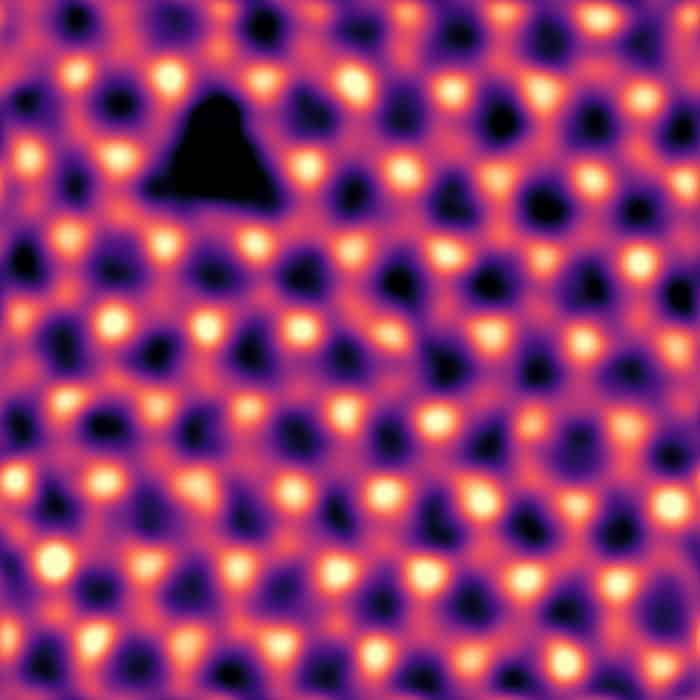
Physicists have discovered that a beam of electrons can remove single atoms from a two-dimensional sheet of hexagonal boron nitride (hBN) in a controlled manner, contrary to previous predictions. The researchers also found that a higher-energy version of the technique could selectively remove nitrogen atoms from the hBN lattice, which is unexpected as nitrogen is heavier than boron. The vacancies left behind by the missing nitrogen atoms could have applications in quantum computing, communication networks, and sensors. The researchers used aberration-corrected scanning transmission electron microscopy (TEM) to isolate the vacancies and found that operating the TEM in near ultrahigh vacuum conditions reduced lattice damage. This discovery opens up possibilities for manipulating other materials at the atomic level using electron beams.