
Tag

Solar Systems

All articles tagged with #solar systems

astronomy2 years ago

Reevaluating Solar System Formation: Massive Planet Challenges Size Limitations of Host Star

The discovery of a planet more than 13 times the mass of Earth orbiting an ultracool star challenges current theories of planet formation. Named LHS 3154b, the planet is the most massive known planet in a close orbit around an ultracool dwarf star. The finding raises questions about the formation of planets and stars, as the planet's mass exceeds what current models would predict for the amount of solid material in the planet-forming disk. The discovery was made using the Habitable Zone Planet Finder (HPF), an instrument developed by Penn State researchers.
astronomy2 years ago

Unveiling the Mystery of Tilted Planets in Pristine Solar Systems

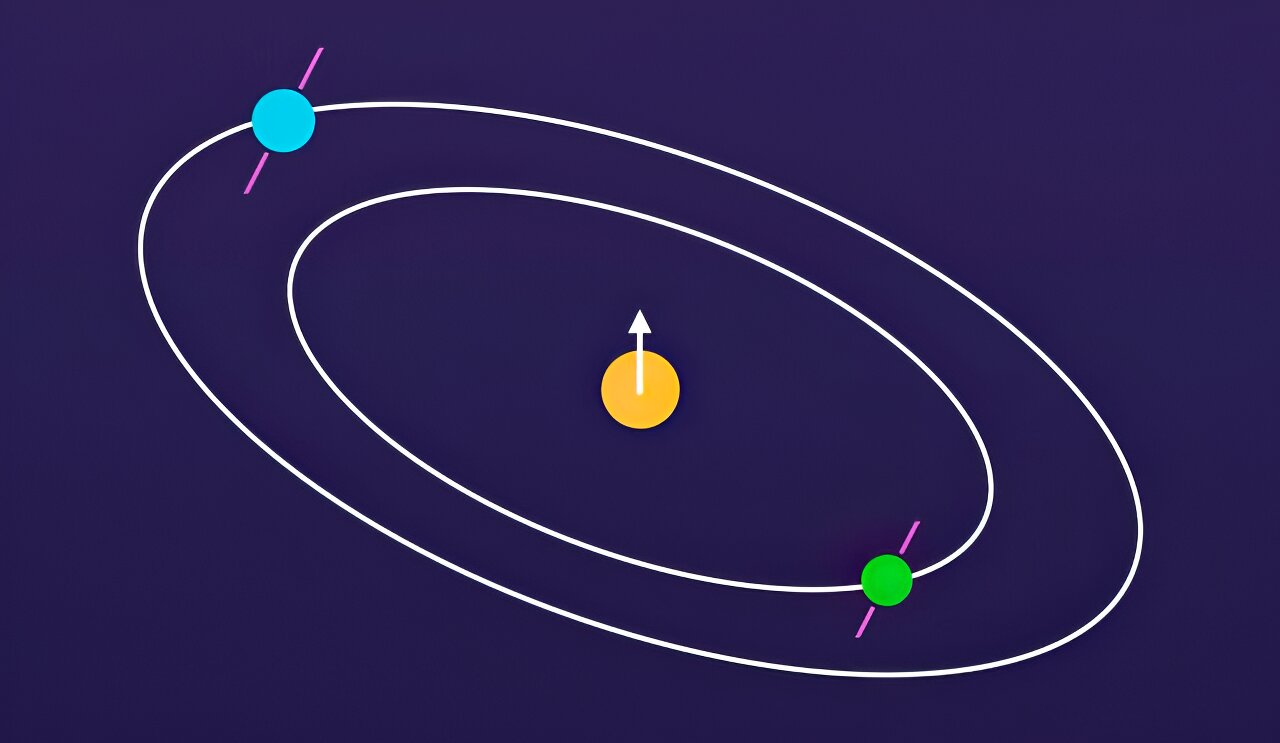
A new study led by Yale astronomers suggests that even in "pristine" solar systems, planets can exhibit a tilt in their orbits. Previous assumptions were that tilted orbits were the result of cosmic disturbances, but this study indicates that it may be a common occurrence. The researchers found that even in undisturbed solar systems, planets can have an orbital tilt of up to 20 degrees. This discovery provides valuable insights into early solar system development and suggests that Earth's slightly slanted orbit is not unusual. The study also contributes to understanding "hot" Jupiter solar systems and their extremely tilted orbits.

astronomy2 years ago

"Deadly Giants: The Life-Threatening Impact of Giant Planets in Alien Solar Systems"

Giant gas planets in other solar systems can disrupt the habitable zones of their Earth-like neighbors, making it unlikely for life to exist. The pull of massive planets can kick smaller planets out of their stable orbits, preventing them from remaining in the habitable zone where liquid water can exist. Computer simulations show that only a few areas within the habitable zone would not be affected by the gravitational pull of giant planets. Additionally, a planet in a nearby star system, GJ 357 d, previously thought to be in the habitable zone, is likely much larger than initially believed, making it unsuitable for hosting life as we know it. These findings highlight the rarity of the conditions necessary for life to exist in other solar systems.

science2 years ago

Predicting Solar System Instability with New Math

Mathematicians have proved for the first time that instability inevitably arises in a model of planets orbiting a sun. The new papers tackle a true n-body problem — showing that instability arises in a planetary system where three small bodies revolve around a much larger sun. Even though the size and shape of the orbits might spend a long time oscillating around fixed values, they will eventually change dramatically.