The article discusses the importance of critical thinking, scientific skepticism, and humility in understanding the world, highlighting Carl Sagan's work and the challenges of overcoming cognitive biases and magical thinking in human nature.
Physicist Nigel Goldenfeld discusses the "unreasonable" success of mathematics in describing the universe, the importance of asking the right scientific questions, and the concept of emergence, which allows new properties to arise in systems at different scales, simplifying the complexity of the universe. He also highlights the challenges in the "soft" sciences like biology and economics, where such simplifications are harder to achieve.
Prominent science writer John Horgan expresses frustration over the enigmatic nature of quantum mechanics, a fundamental yet perplexing aspect of our universe that even the greatest scientists struggle to fully understand. Despite its foundational role in modern technology, the theory's inherent uncertainties challenge our grasp of reality. Some, like Fred Hoyle, suggest that the universe's fine-tuning hints at a superintellect, pointing towards deism or theism, though such views remain controversial and often marginalized in scientific discourse.
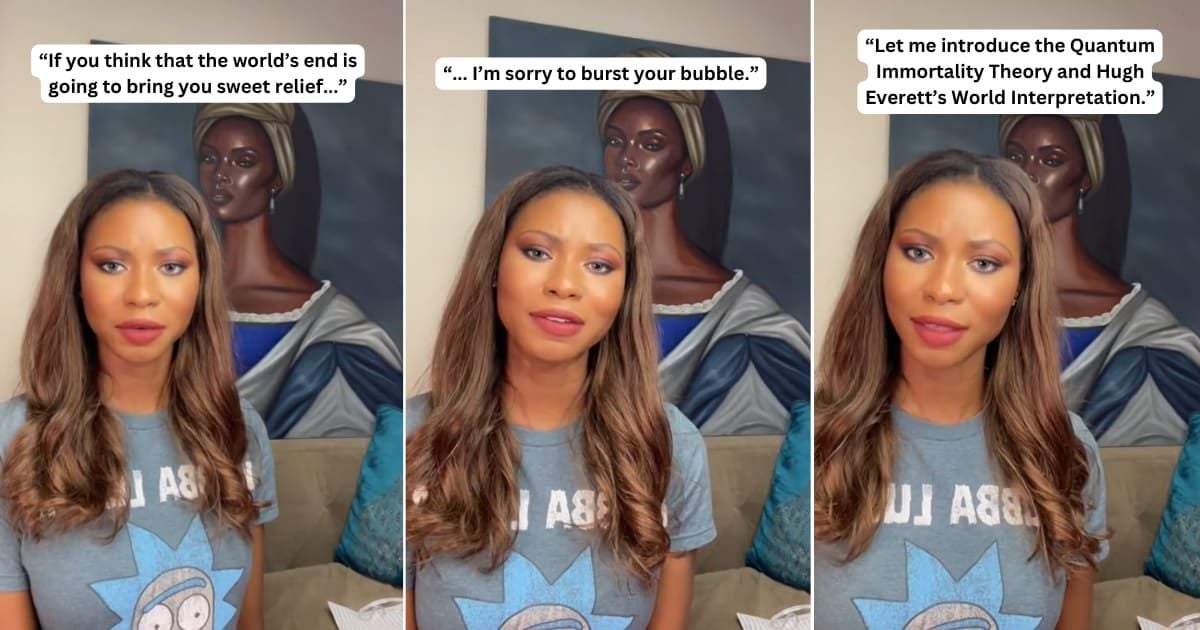
A woman named Joli has sparked a debate with her theory that we all live in a parallel universe and never truly die, citing the Quantum Immortality theory and Hugh Everett’s many-world interpretation. According to her, when a person dies in one universe, their consciousness shifts to a parallel universe where they survive, leading to a constant cycle of apocalypses and reality shifts. Her TikTok video has left people both baffled and intrigued, with some expressing mixed feelings about the concept.
The unorthodox concept of panpsychism suggests that everything in the universe, including the Sun, possesses consciousness. Biologist Rupert Sheldrake argues for the consciousness of the Sun and all other stars, proposing that consciousness may be present in self-organizing systems at various levels of complexity. While this idea challenges traditional views, it raises intriguing questions about the nature of consciousness and its potential implications for celestial bodies. However, scientific and philosophical arguments continue to challenge the concept of panpsychism, emphasizing the need for extraordinary evidence to support such extraordinary claims.
The book "The Blind Spot: Why Science Cannot Ignore Human Experience" argues that science has overlooked the essential role of human experience, leading to a crisis of meaning. It highlights the paradox of science portraying humans as insignificant in the universe while also being central to understanding reality. The blind spot in science is the neglect of direct bodily experience, which is essential for observation and understanding. The disconnect between science and human experience has led to challenges in comprehending matter, time, life, and the mind. The book calls for a reevaluation of how science incorporates human experience to avoid heading deeper into peril and confusion.
The age-old debate of whether math is discovered or invented continues to puzzle philosophers and mathematicians. Realism argues that mathematical objects are real and independent of human thought, while fictionalism suggests that math is a fiction, akin to characters in a story. The unreasonable efficacy of mathematics in explaining scientific phenomena poses a challenge to fictionalism, leading to ongoing philosophical debate. With various schools of thought and no definitive answer in sight, the nature of math remains a complex and intriguing mystery.
The article explores the concept of the mind being larger than the universe by using the analogy of a car using more gas than a gas can can hold. It discusses how the mind's capability can exceed the size of the universe by measuring the information required to generate a specific section of text, using Claude Shannon’s entropy. The authors argue that the entropy requirements to generate a modest piece of text like the Gettysburg Address exceed the storage capacity of the entire history of the multiverse, with implications for AI's ability to match the human mind.
Neuroscientist Christof Koch, a proponent of physicalism, now suggests that consciousness cannot be explained solely through physical processes and requires an additional postulation of "experience." He argues for a new understanding of consciousness and the mind, emphasizing the need for better metaphysics and philosophy. Koch also delves into the challenges of defining consciousness, suggesting that it may be beyond linguistic explanation and closer to us than words can convey. This shift in perspective prompts a reevaluation of the nature of consciousness and reality itself.
Ancient philosophers like Anaximander and Marcus Aurelius had intuitive insights into the interconnectedness and recycling of matter in the cosmos, envisioning a perpetual flow of material essence that forms and dissolves into different structures. Modern cosmology aligns with these ancient ideas, describing the emergence and dissolution of matter from atoms to galaxies as a constant ebbing and flowing process, ultimately portraying nature as the ultimate recycler.
Over 100 consciousness researchers have criticized the Integrated Information Theory (IIT) as pseudoscience, sparking a debate about the intersection of science and philosophy in understanding consciousness. IIT suggests that consciousness is more widespread than traditionally believed, but critics argue that its broad claims lack comprehensive empirical support. The theory combines scientific and philosophical perspectives, leading some researchers to question its scientific rigor. The controversy highlights the challenge of studying consciousness, which is not publicly observable, and the need for a partnership between science and philosophy to unravel its mysteries.
Over 100 consciousness researchers have accused the integrated information theory (IIT) of being pseudoscience, sparking a debate within the field. IIT, proposed by neuroscientist Giulio Tononi, aims to provide mathematical conditions for determining consciousness. Supporters of the theory argue that it expands the concept of consciousness, while critics claim that it lacks experimental support for its bold implications. An "adversarial collaboration" between IIT and the global workspace theory recently produced mixed results. The controversy highlights the challenge of studying consciousness, which involves both scientific experimentation and philosophical reflection. The debate underscores the need for a partnership between science and philosophy to unravel the mysteries of consciousness.
The search for a definitive explanation of consciousness in the brain continues to elude scientists, with no consensus on whether one may ever exist. While some propose theories that dissolve the conundrums of consciousness by rejecting the separation between subject and object, others suggest viewing the brain as a transducer for thought to the body. The debate between materialist and dualist approaches to understanding consciousness raises questions about the role of materialism in hindering scientific progress.
The article discusses the limitations of human sciences in answering questions beyond tangible discoveries and the philosophical implications of emerging sciences like neuroscience and string theory. The author argues that the scientific community is unable to answer fundamental questions about the universe and often disregards the possibility of God as the simplest explanation. The article also explores the views of neuroscientists Daniel Dennett and Sam Harris, who promote a worldview that is purposeless and devoid of morals or free will.