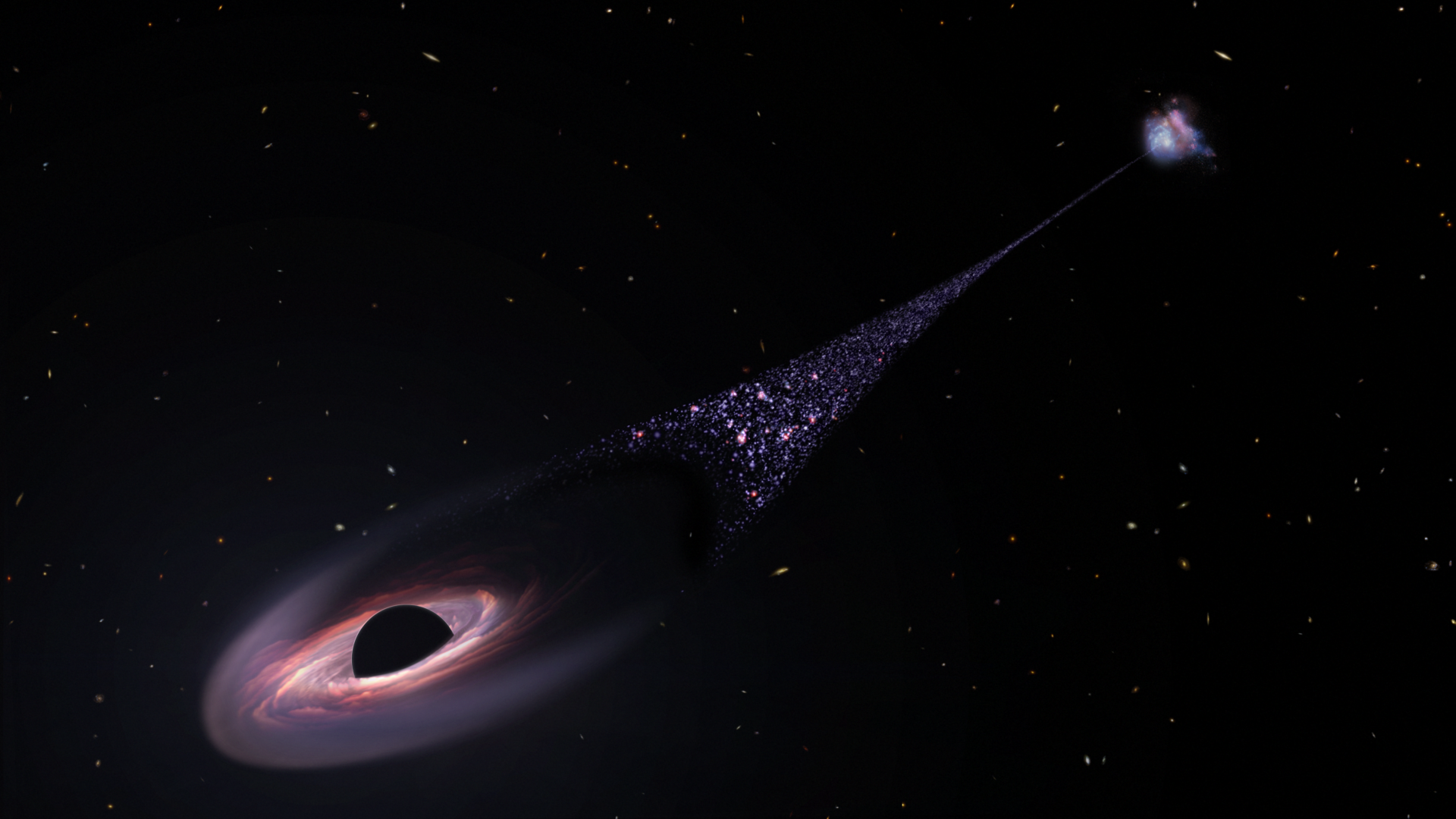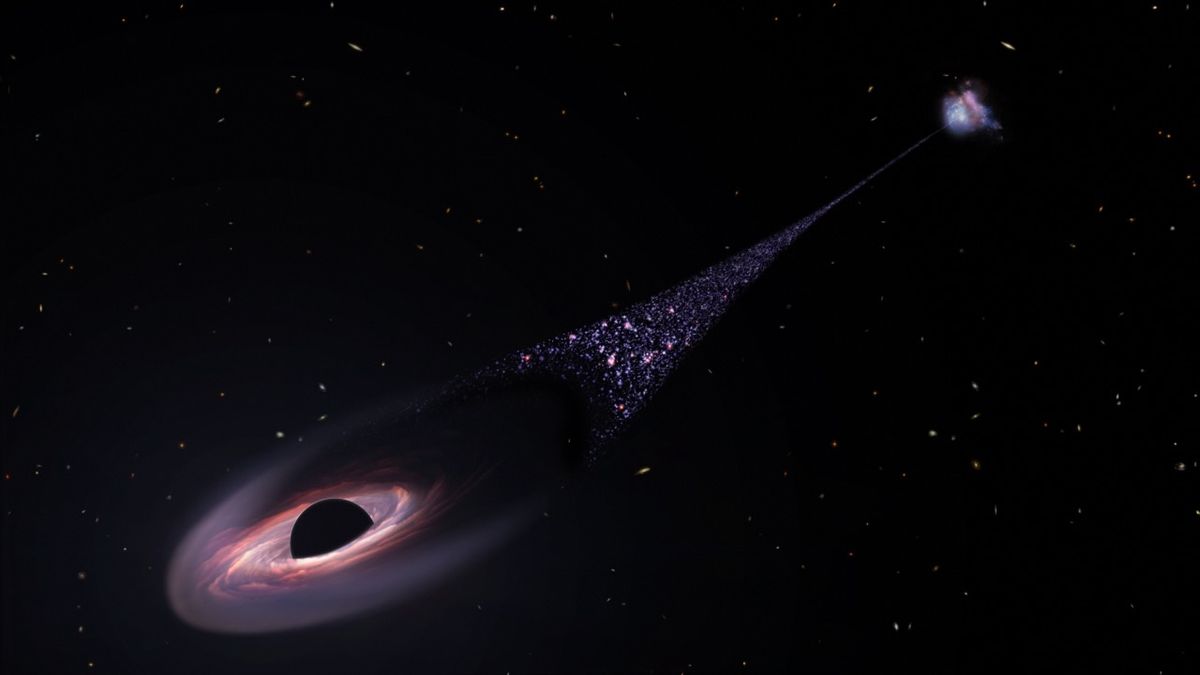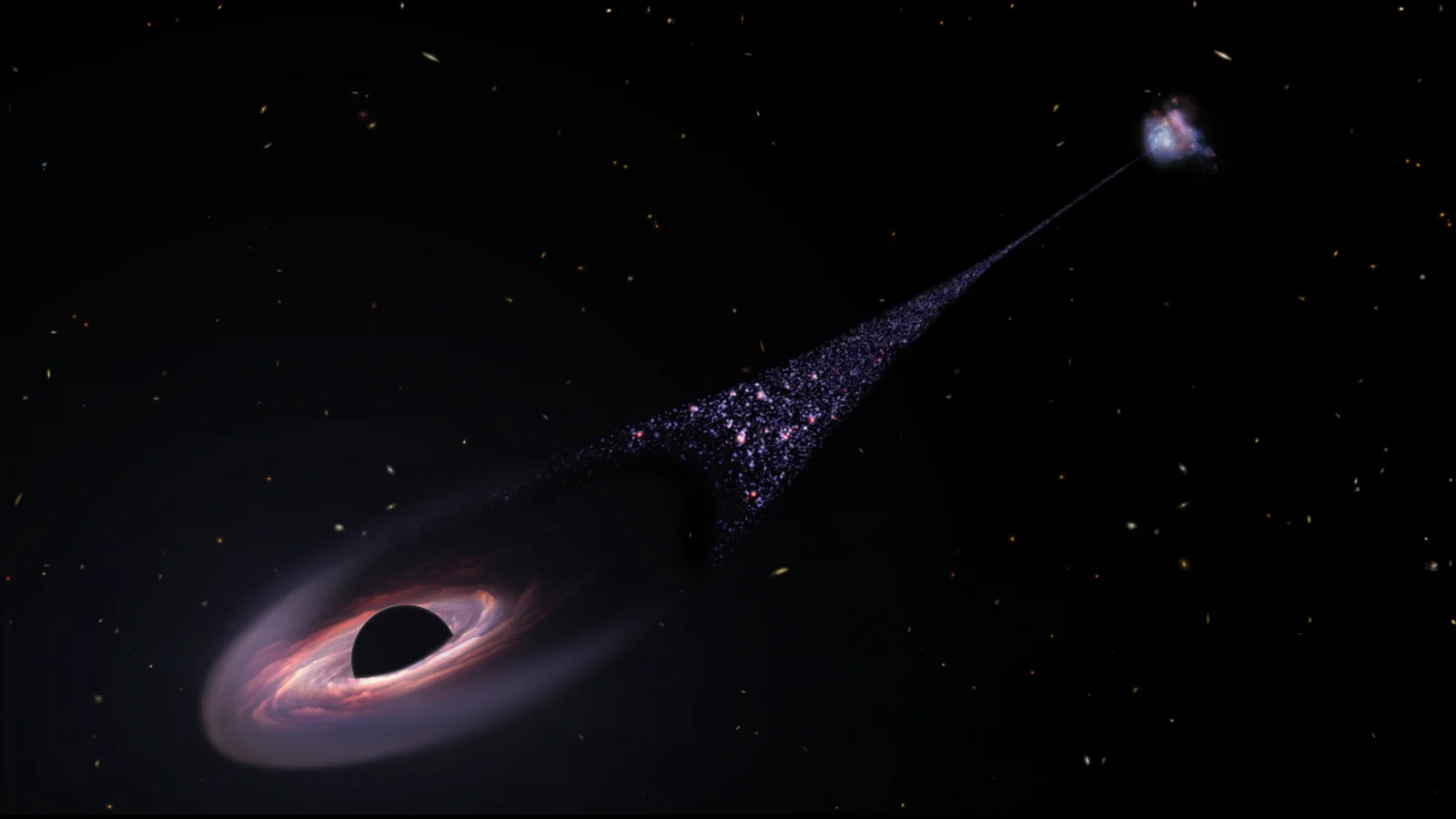
The James Webb Space Telescope has potentially confirmed the first observed supermassive black hole escaping its galaxy at 2.2 million mph, leaving behind a trail of young stars and creating a shockwave detectable in space, providing new insights into galaxy and black hole dynamics.
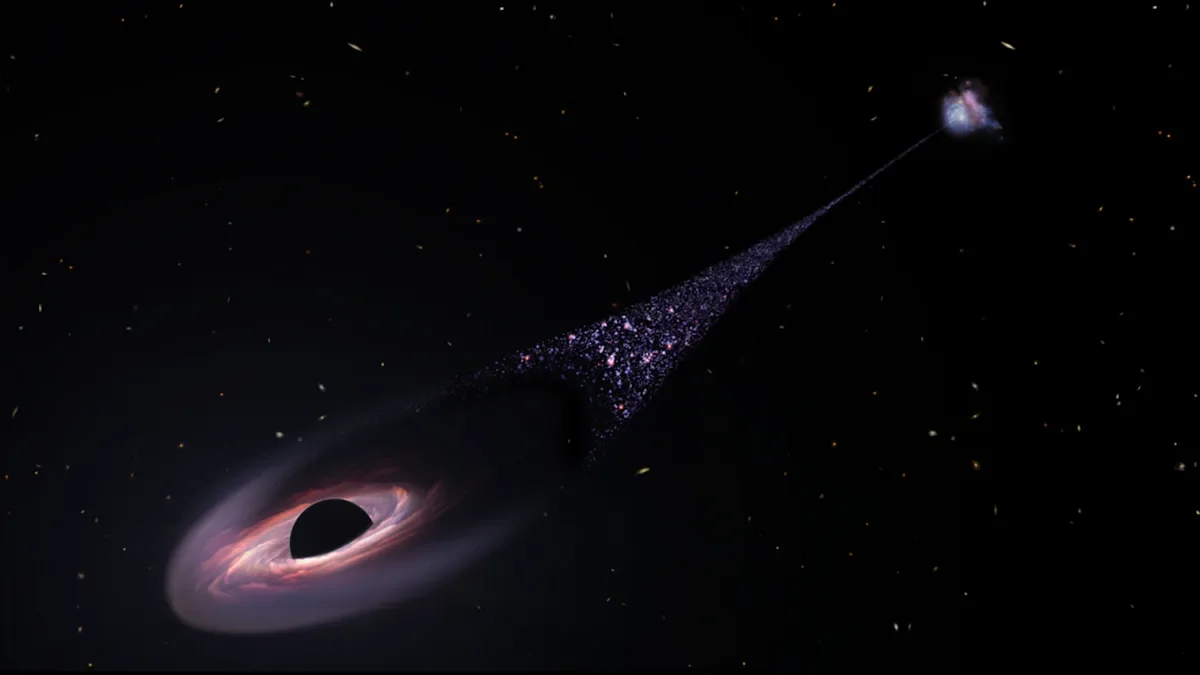
The James Webb Space Telescope has potentially confirmed the first observed case of a supermassive black hole escaping its host galaxy at 2.2 million mph, leaving behind a trail of young stars and creating a shockwave, providing new insights into galaxy and black hole dynamics.
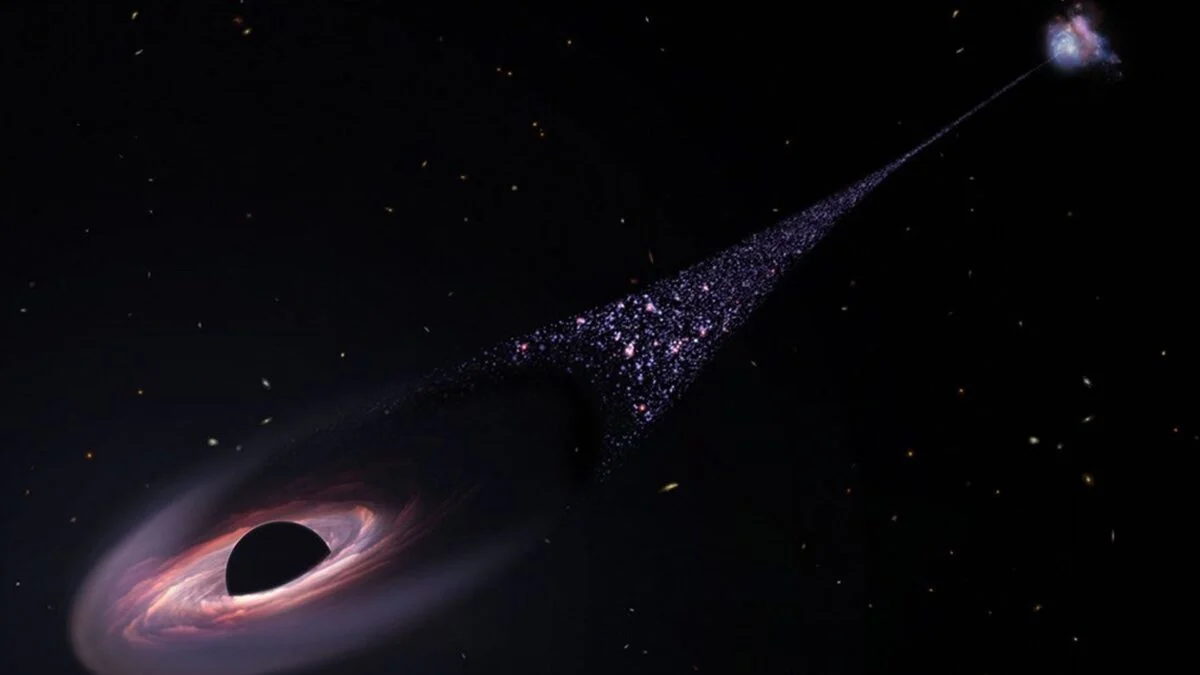
Astronomers using the Webb space telescope have observed the first known runaway supermassive black hole, which is traveling at 2.2 million mph and leaving a trail of gas that is forming new stars over 200,000 light-years long, likely ejected from its galaxy due to a galaxy merger or binary black hole interaction.
Astronomers have observed a supermassive black hole, RBH-1, escaping its galaxy at nearly 1,000 km/s, leaving a trail of newborn stars and a shock front, confirming long-standing theories about black hole ejections during galaxy mergers, with implications for galaxy evolution and future discoveries.
A supermassive black hole, ejected from its galaxy, is being trailed by a 200,000 light-year-long chain of infant stars, according to a new study. The Hubble Space Telescope identified the incredible sight, which is like nothing astronomers have spotted before. The black hole is traveling so fast that it would cover the distance between Earth and the moon in just 14 minutes. As it travels, the cosmic runaway is piling up gas in front of it, creating a corridor of infant stars. The next step for this research will be to search for evidence of binary black holes with NASA's James Webb Space Telescope and the Chandra X-ray Observatory.