
Meta, led by Mark Zuckerberg, is heavily investing in AI with its upcoming Prometheus project to compete with OpenAI, involving significant financial commitments, talent acquisition, and infrastructure development, raising both technological and ethical questions about the future integration of AI into daily life.
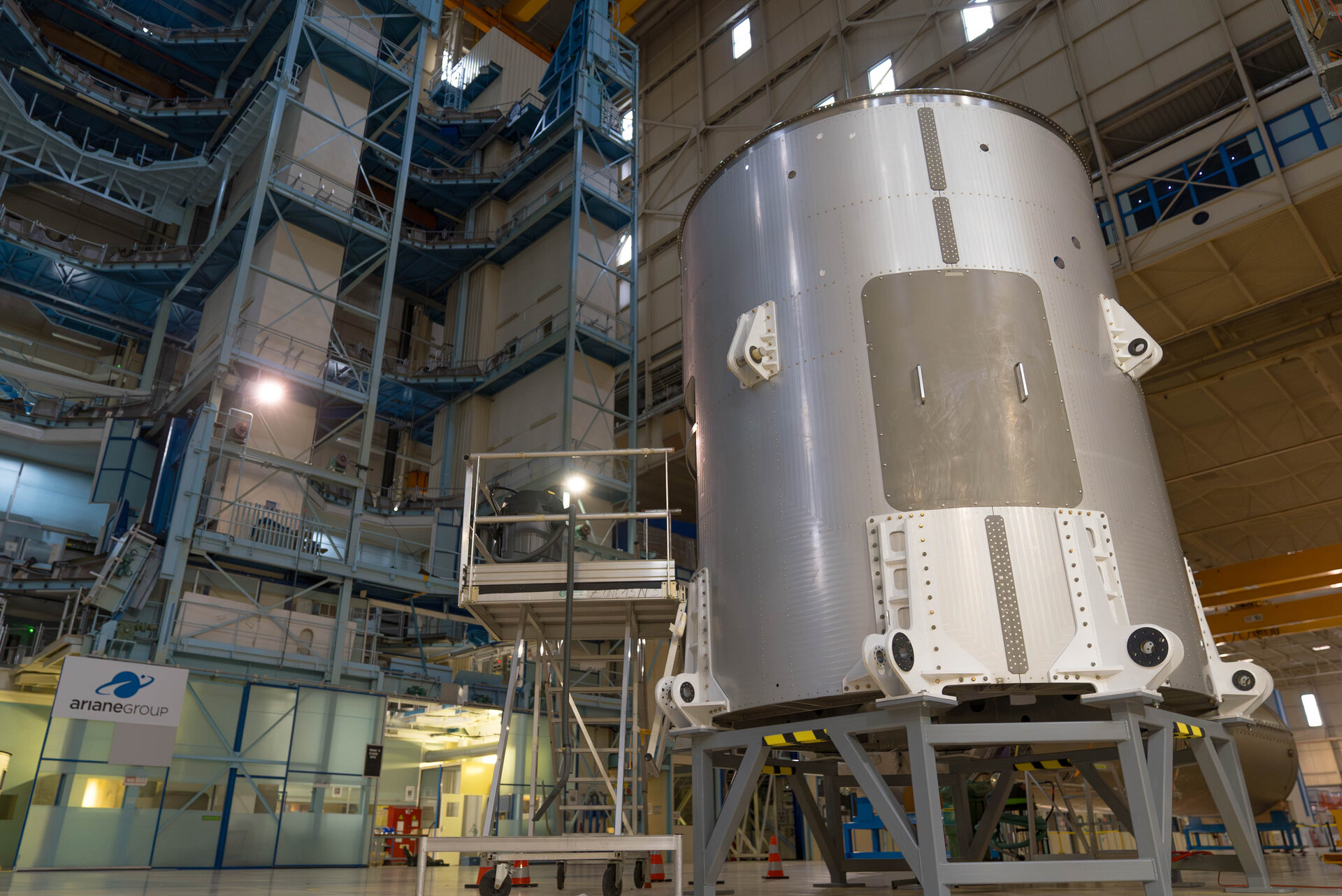
ESA's reusable rocket demonstrator, Themis, is undergoing assembly at ArianeGroup's facility in Les Mureaux, France. The rocket, equipped with the Prometheus engine, aims to demonstrate technologies for rocket stage recovery and reuse. The assembly includes installing landing legs, power systems, avionics, and a pressurization system. Themis will be transported to Sweden for its first test flight, marking Europe's initial demonstration of a vertical take-off and landing rocket with cryogenic propulsion.
The trailer for Fede Alvarez's upcoming film, Alien: Romulus, has prompted fans to re-evaluate the divisive entries in the Alien franchise, 2012's Prometheus and 2017's Alien: Covenant. The teaser offered a glimpse of the blood-splattered space station, Facehuggers, and a monstrous Xenomorph, sparking positive reactions and renewed appreciation for the Ridley Scott prequels. Scott, who directed the original Alien film, has endorsed Romulus as "f**king great," and the new film is set to release on August 16, 2024, with Cailee Spaeny leading the cast.
The development of a low-cost, reusable engine for European rockets, called Prometheus, has made significant progress with successful tests including full ignition and a 30-second burn with re-ignition. The engine, which burns liquid oxygen-liquid methane fuel, aims to enable reusability and reduce ground operation costs. Further testing will be conducted with two additional prototypes, and a modified test bed for liquid methane fuel will be installed in Germany. The engine is being developed in parallel with a reusable rocket stage called Themis, which is also undergoing testing.
ArianeGroup has successfully tested Prometheus, a 100-tonne thrust class engine designed for cost-effective, clean, and reusable space travel. Using liquid oxygen-liquid methane fuel and 3D printing, Prometheus aims to reduce costs and simplify handling. Mounted on a prototype reusable rocket stage called Themis, further tests will evaluate flight and landing capabilities. Prometheus and Themis are expected to be key components in future European launchers.
Europe has successfully conducted the first hot-fire test of its reusable Prometheus rocket engine, which is part of the Ariane Next launch program. The 100-tonne thrust engine, powered by oxygen and methane, completed a 12-second burn while integrated with the Themis first-stage demonstrator. The Prometheus engine is designed to be reusable up to five times and offers significant cost savings compared to the current Vulcain engine. The successful test marks a milestone in Europe's efforts to develop reusable launch vehicles and reduce the environmental impact of the space industry.
ArianeGroup has achieved full ignition of an early prototype of Prometheus, a reusable engine for European rockets, at its test facility in Vernon, France. The engine features extensive use of new materials and manufacturing techniques designed to reduce its cost to just a tenth of Ariane 5’s Vulcain 2. Prometheus burns liquid oxygen-liquid methane fuel, and a version using liquid hydrogen-liquid oxygen is also being developed. The engine is mounted in a prototype of a reusable rocket stage, called Themis, which is being developed in parallel with the engine.
State Street, Alphabet, Prometheus, Roblox, Moderna, and Enphase are among the stocks that are moving the most in the stock market today. State Street's shares rose after the company reported better-than-expected earnings, while Alphabet's shares fell after the company missed revenue estimates. Prometheus, Roblox, Moderna, and Enphase also saw significant movements in their stock prices.