Tag

Primordialblackholes

All articles tagged with #primordialblackholes

science1 year ago

Primordial Black Holes: Hidden Threats in Planets and Everyday Objects

A new theoretical study suggests innovative methods to detect primordial black holes, proposing that these elusive objects could leave signatures such as hollow planetoids in space or microscopic tunnels in earthly materials. The research, co-led by the University at Buffalo, highlights the potential of these low-cost methods to advance our understanding of dark matter, despite the low probability of detection. The study emphasizes the need for creative approaches in the field of astrophysics, as traditional methods have yet to yield direct evidence of primordial black holes.

science1 year ago

Could Black Holes Be Lurking in Everyday Objects?

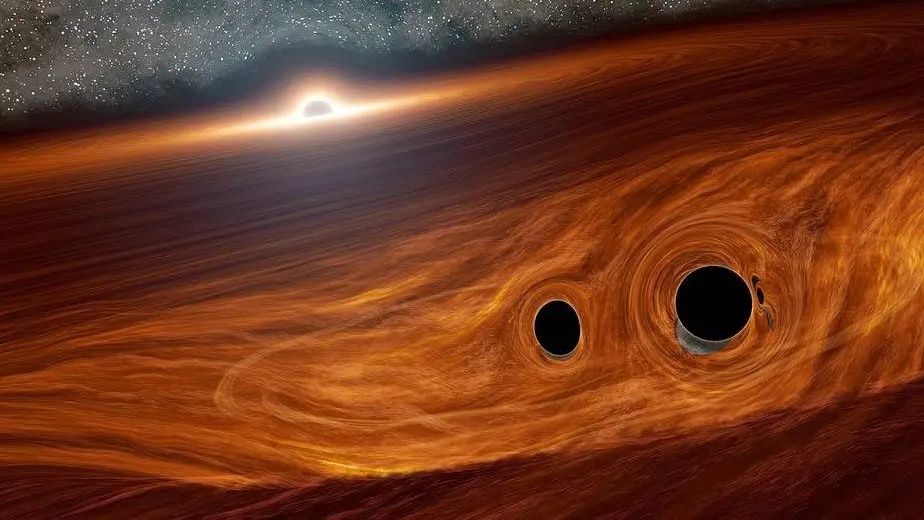
Scientists theorize that primordial black holes, potentially formed after the Big Bang, could be tunneling through Earth unnoticed. These tiny black holes might help explain cosmic mysteries like dark matter. Although the likelihood of detecting them is low, researchers suggest searching ancient structures for evidence. Discovering these black holes could advance our understanding of the universe and future energy harvesting technologies.

science1 year ago

Are Primordial Black Holes Lurking in Our Solar System?

Physicists propose that primordial black holes (PBHs), potentially formed in the early universe, could interact with planets by consuming their cores, leaving them hollow. This theory, if validated, could provide new insights into dark matter and challenge existing models of planetary formation. PBHs might pass through solid objects undetected, complicating their detection but offering a novel approach to studying dark matter's elusive nature.

science-and-astronomy2 years ago

"Debunking the Black Hole-Sun Conundrum: Scientists Explain"

Astrophysicist Matt Caplan and colleagues have proposed a theory that dark matter could be composed of atom-sized primordial black holes formed in the early universe. While it's highly unlikely that one of these black holes is inside the Sun, the researchers suggest that some stars, particularly in less massive environments like dwarf galaxies, might contain these black holes at their cores. These "Hawking stars," named after Stephen Hawking who theorized about primordial black holes, could potentially be identified by their unique red giant phase, which is accretion-powered rather than fusion-powered, making them puffier and dimmer. The team plans to use asteroseismology to observe candidate stars that may harbor these ancient black holes, offering a new avenue in the search for dark matter.

science-and-technology2 years ago

"Exploring the Possibility of Black Holes Within the Sun: A New Frontier in Dark Matter Research"

Researchers, including a team from the Max Planck Institute for Astrophysics, have proposed the existence of "Hawking stars," which are stars with small primordial black holes at their centers. These stars could potentially live as long as normal stars and might be indistinguishable from them at the surface level. The study suggests that such stars could provide insights into dark matter and the early universe. Asteroseismology could be used to detect these stars, and upcoming projects like PLATO may help in discovering them. The research opens up the possibility of using Hawking stars to test the existence of primordial black holes and their role in the composition of dark matter.