Scientists at Rice University have discovered a new method to destroy cancer cells using molecules that vibrate strongly when stimulated by near-infrared light. The researchers found that these molecules, known as molecular jackhammers, can rupture the cell membrane of cancerous cells, leading to their destruction. In lab cultures of human melanoma cells, the method had a 99 percent efficiency, and half of the mice with melanoma tumors became cancer-free after treatment. The molecular jackhammers are activated by near-infrared light, which can penetrate deeper into the body without damaging tissue. This breakthrough could offer a new approach to treating cancer using mechanical forces at the molecular scale.
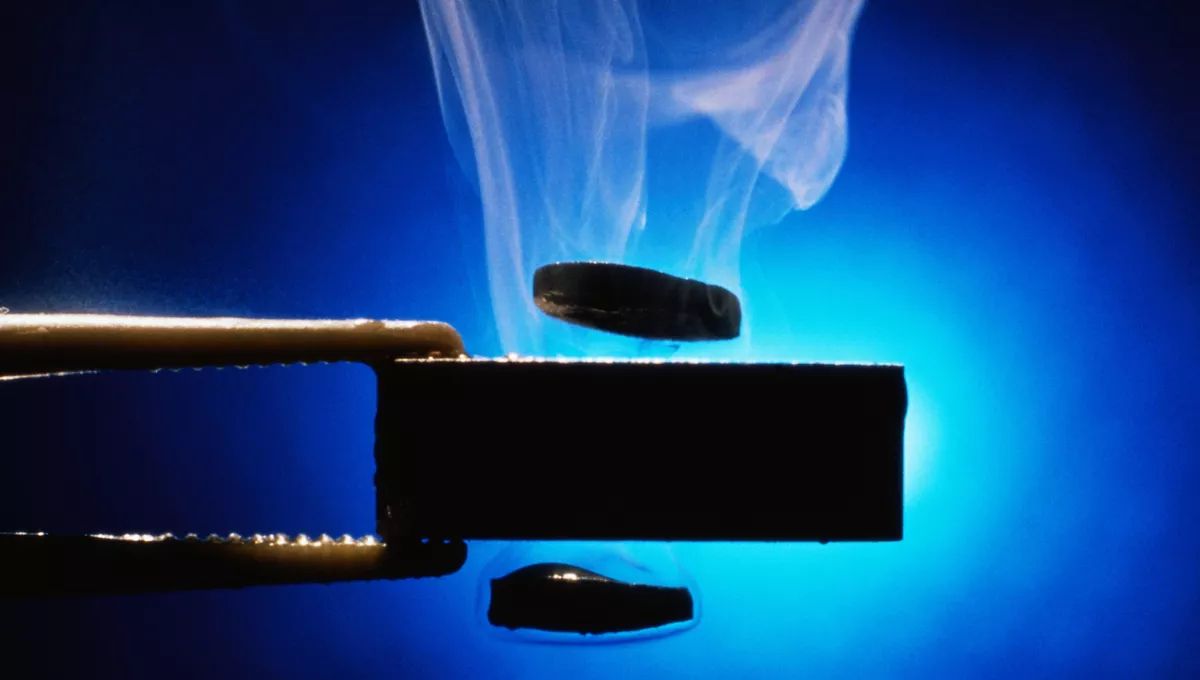
Scientists have discovered a "demon" particle, known as Pines' demon, inside a superconductor called strontium ruthenate. This chargeless particle, a plasmon, could help unravel the mystery of how superconductors work. Theorists believe that plasmons may play a role in facilitating superconductivity, and understanding this could lead to the development of room-temperature superconductors, which would revolutionize electricity transmission. The discovery of Pines' demon provides a potential avenue for exploring and improving superconductors, and further research in other metals may yield valuable insights.
Scientists have discovered an elusive "demon" particle, known as Pines' demon, inside a superconductor called strontium ruthenate. This chargeless particle, a plasmon, could help unravel the mystery of how superconductors work. Theorists believe that plasmons may play a role in facilitating superconductivity, and understanding this could lead to the development of room-temperature superconductors, which would revolutionize electricity transmission. The discovery of Pines' demon, nearly 70 years after it was first predicted, opens up new possibilities for studying and harnessing the potential of superconductors.
Physicists have accidentally discovered Pines' Demon, a quantum phenomenon predicted in 1956, in the material strontium ruthenate. Pines' Demon is a type of plasmon, a discrete unit of waves among rippling electrons, and its discovery in a 3D metal has important implications for material physics. The researchers found this phenomenon while studying the material with electron spectroscopy and believe that further research on multi-band metals could provide insights into the behavior of demons and their role in superconductivity.