Recent scientific research has discovered that peacock tail feathers contain microscopic structures capable of emitting laser light, illustrating divine wisdom and intricate natural engineering, which inspires appreciation of God's creation and ongoing scientific exploration.
Scientists have conducted experiments that provide further evidence of photonic time crystals (PTCs), materials in which the refractive index oscillates rapidly. By using lasers to rapidly change the refractive index in transparent conducting oxides, researchers observed significant shifts in light frequency and relaxation time. While the exact mechanisms behind these phenomena are not yet fully understood, the findings pave the way for observing PTCs at optical frequencies and exploring other time-boundary phenomena.
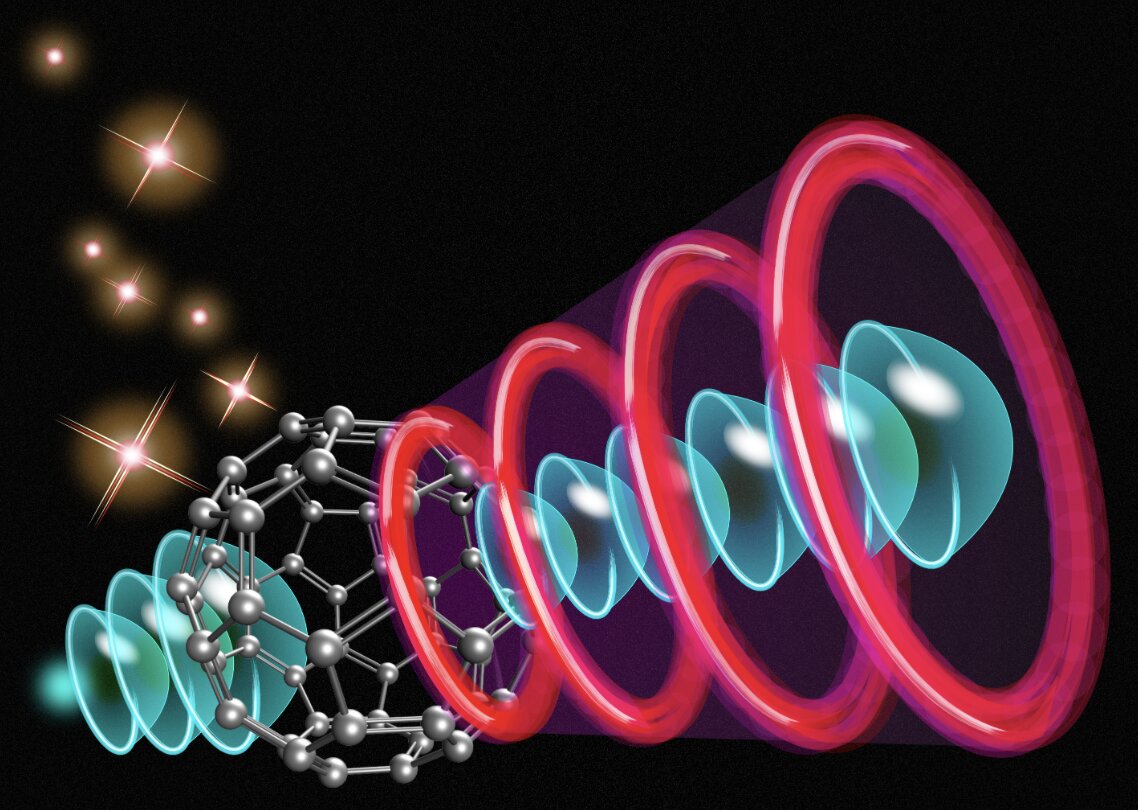
Researchers at University of Tokyo, JTS PRESTO, Ludwig Maximilians Universität and Kindai University have demonstrated the modulation of an electron source by applying laser light to a single fullerene molecule. The technique could enable the integration of ultrafast switches into a single fullerene molecule, paving the way for the development of better performing computers and microscopic imaging devices. The researchers also propose an integration scheme that would allow the integration of as many switches as desired without the need to increase the size of devices. The method could also be applied in the field of electron microscopy.
Researchers at the University of Arizona have published an article in Science Advances discussing the use of light-based optical computing to develop ultrafast electronics. The team used all-optical switching of a light signal on and off to reach data transfer speeds exceeding a petahertz, measured at the attosecond time scale. This new advancement would allow the encoding of data on ultrafast laser pulses, increasing the data transfer speed and opening a new realm of information technology.