GE Aerospace's stock is approaching record highs after beating Q3 earnings estimates, raising its 2025 outlook, and announcing new partnerships, with strong revenue growth and increased profit forecasts supporting its bullish momentum.
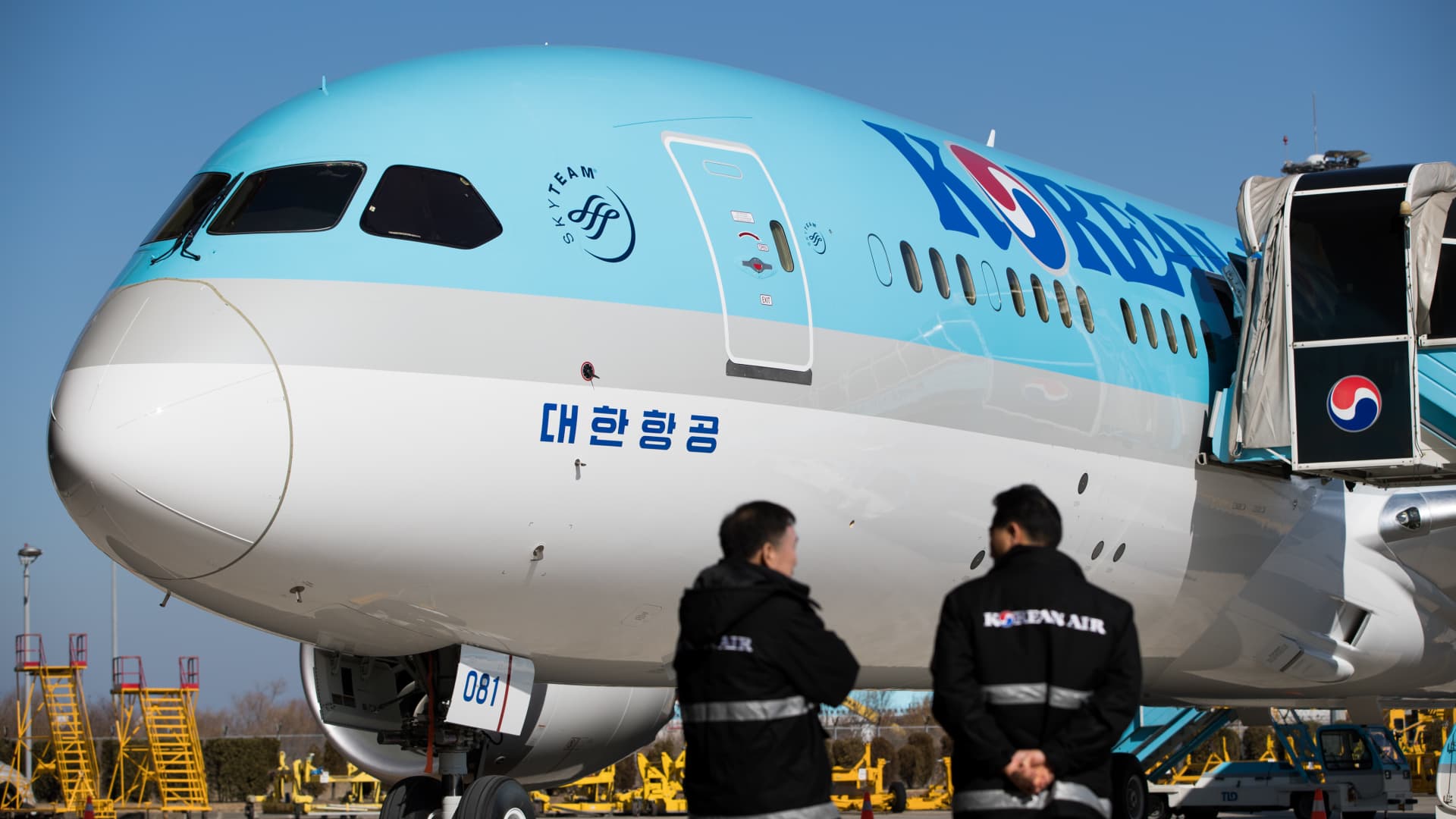
Korean Air announced its largest-ever order of 103 Boeing airplanes worth about $36.5 billion, including 787s, 777s, and 737 MAX 10s, along with a $13.7 billion deal with GE Aerospace for engines and services, aiming to expand its fleet and international destinations amid a broader trend of major aircraft orders during the Trump administration.
GE Aerospace's strong second-quarter results and raised guidance have led Wall Street analysts to increase their price targets, with some expecting shares to reach a record high of around $300, potentially making GE Aerospace worth about $340 billion, close to its 2000 market value peak.
GE Aerospace exceeded earnings expectations with a 38% increase to $1.66 per share and a 21% revenue rise to $11.02 billion in Q2, prompting the company to raise its 2025 outlook for revenue, operating profit, and earnings, and extend its long-term growth forecast through 2028, amid positive developments like resuming jet engine shipments to China.
Shares of GE Aerospace (NYSE: GE) traded up 5% as investors reevaluate the potential of the aircraft-focused part of the business following the breakup of General Electric. GE Aerospace, with exposure to popular aviation platforms and potential market share gains, faces near-term headwinds but offers long-term growth potential. Despite some analysts adjusting price targets downward, the stock is climbing back toward previous highs, making it an attractive opportunity for long-term focused investors.
Cincinnati gained a new public company as General Electric split into two entities, GE Aerospace and GE Vernova, with GE Aerospace becoming Cincinnati's newest public company, led by CEO H. Lawrence Culp Jr., and headquartered in Evendale.
Shares of GE Aerospace surged 6% following positive updates from Wall Street analysts, with Barclays initiating coverage with a $185 price target and an overweight rating, and Deutsche Bank adjusting its price target to $190, implying a 31% premium to the current price. Analysts are bullish on GE Aerospace's prospects due to the commercial aerospace recovery, aggressive production of LEAP engines, and potential market share gains from RTX.
General Electric's stock, now known as GE Aerospace, surged by 11.9% in March ahead of the successful spinoff of GE Vernova, a new aerospace and defense company. The spinoff has been well-received, with GE Vernova's market cap exceeding expectations. Investors are optimistic about GE Aerospace's potential for long-term growth, particularly due to its joint venture with Safran and the expected increase in engine production. Management's guidance suggests strong operating profit growth in the coming years, making the stock a potential candidate for long-term investment.
GE Aerospace, formerly known as GE Aviation, has officially become its own separate entity after being spun off from General Electric. The company expects to earn over $6 billion in operating profits, with projections to reach $10 billion by 2028, and is investing over $100 million into its Evendale plant. The move is expected to bring growth opportunities for local workers and the aviation legacy in Evendale, Ohio, and the company's stock will continue to trade under the "GE" ticker.
GE Aerospace, the aviation division of General Electric, forecasts operating profits to reach $10 billion by 2028 and plans to initiate a share buyback program and issue dividends to investors. This positive outlook has led to a 4% increase in the company's stock value. The resumption of dividend payments signals a promising turnaround for GE, which has been restructuring its business units, with the Aerospace division set to be spun off on April 2.
General Electric (GE) surpasses fourth-quarter 2023 earnings estimates but softens its forecast ahead of the split into GE Vernova and GE Aerospace in the first half of 2024, causing its stock to dip in pre-market trading. The company's revenue of $18.5 billion exceeded expectations, and adjusted EPS also outperformed. GE's upcoming investor day in March will provide more insight into the outlooks of the two new companies following CEO Larry Culp's transformation efforts.
GE Aerospace has completed testing with sustainable aviation fuel (SAF) on its 10th aircraft engine model, as part of its commitment to sustainable flights. The tests, conducted since 2016, included test flights operated with 100% SAF. Currently, GE Aerospace engines power three out of four commercial flights worldwide. The company aims to contribute to the aviation industry's growth in an environmentally-friendly way by developing more efficient products. The data from the tests will be sent to ASTM International and used by GE to assess the long-term impact of SAF on engines. Major U.S. airlines have committed to achieving net-zero carbon emissions by 2050.
GE Aerospace is developing a new type of hypersonic vehicle or missile that combines rotating detonation engine (RDE) combustors for a turbine engine with a dual-mode ramjet/scramjet. The RDE component aims to offer a more efficient approach to a turbine-based combined cycle propulsion system than traditional turbine engines. The project is being supported by DARPA, the Air Force Research Laboratory and the Missile Defense Agency. GE recently acquired Innoveering LLC, a small company that specialized in advanced hypersonic propulsion technology.
The House Armed Services Committee chairman Mike Rogers' markup of the FY24 defense policy bill would authorize about $588 million for the Adaptive Engine Transition Program (AETP), which the Pentagon had zeroed out in the upcoming fiscal year. The legislation would also authorize funding for the Engine Core Upgrade (ECU), the Pentagon's preferred approach to modernizing the F-35 Joint Strike Fighter's engine. The funding for AETP is specifically geared toward laying the groundwork for a sixth-generation aircraft like the Air Force's Next Generation Air Dominance fighter. The committee would mandate the military services to set requirements for key decisions like engine modernization and an upgrade for the F-35's power and thermal management system.