Scientists at Michigan's FRIB are experimentally recreating how heavy elements beyond iron are formed in stars, focusing on the intermediate neutron-capture process (i-process), which fills gaps in understanding of element formation like gold and platinum, using advanced isotope experiments to identify where and how these processes occur in stellar environments.
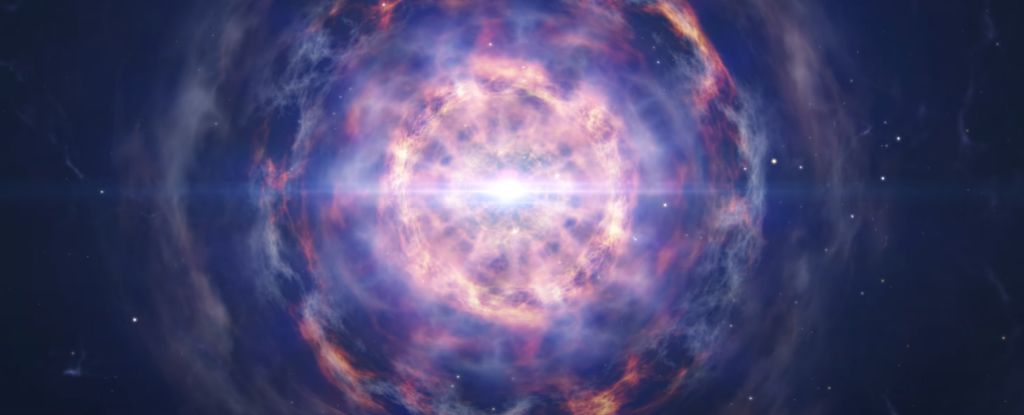
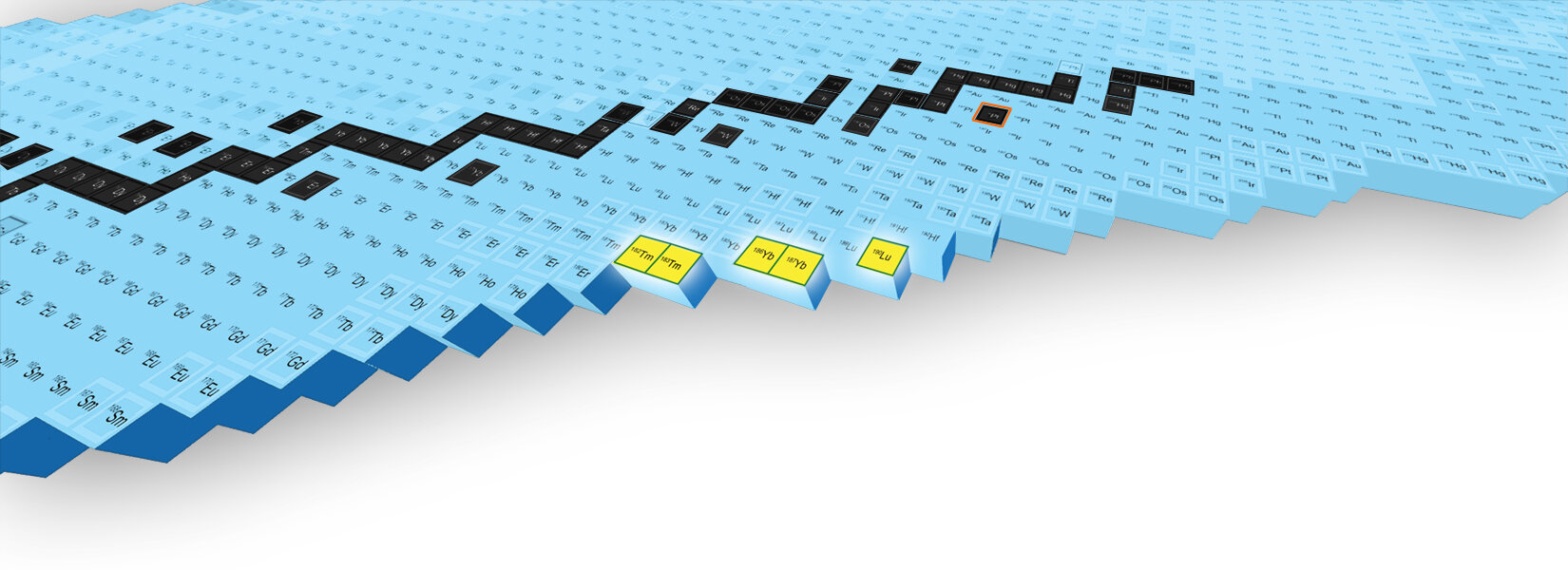
Physicists at Michigan State University have discovered new isotopes of rare-Earth elements thulium, ytterbium, and lutetium by breaking apart the nuclei of platinum using the Facility for Rare Isotope Beams (FRIB). This achievement will aid in understanding neutron-rich nuclei and the processes that forge new elements in neutron star collisions, potentially replicating the rapid neutron-capture process (r-process) responsible for creating heavy elements in the Universe. The discovery demonstrates the power of FRIB and its potential for advancing nuclear physics and astrophysics.
An international research team at the Facility for Rare Isotope Beams (FRIB) has successfully created five new isotopes, bringing them closer to understanding the natural processes that produce new elements in stars. These isotopes can help refine our understanding of fundamental nuclear physics and may provide insights into the creation of heavy elements like gold in neutron star collisions. The team's achievement opens up new opportunities for nuclear research and paves the way for further exploration into the unknown realms of nuclear science.
Researchers at Oak Ridge National Laboratory have discovered a long-lived excited state of radioactive sodium-32, which challenges our understanding of nuclear shapes and energy levels. The unexpected finding raises questions about how nuclei evolve and interact, and could have implications for our understanding of nuclear physics and the formation of elements. The discovery was made using data collected from the Facility for Rare Isotope Beams (FRIB) at Michigan State University, and further experiments are planned to determine the shape of the excited state.
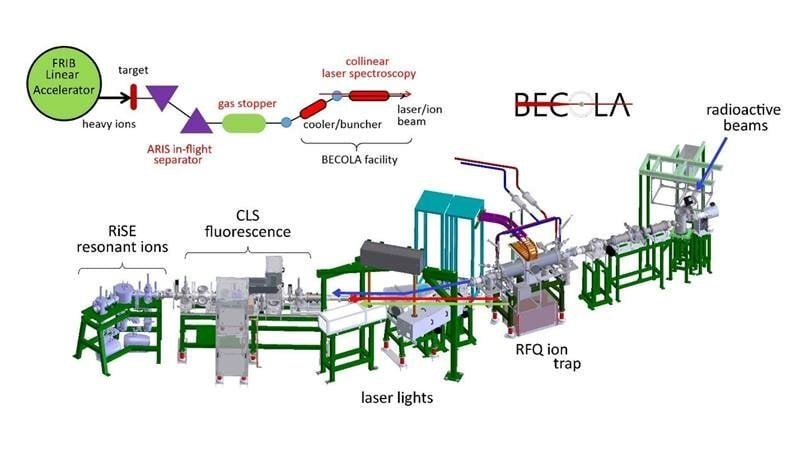
Scientists have used the BEam COoler and LAser spectroscopy (BECOLA) facility at the Facility for Rare Isotope Beams (FRIB) to measure nuclear charge distributions, providing insights into the "nuclear weak distribution." By relating the weak distribution to the distribution of electric charges in a nucleus, researchers found significant differences from previous model-based determinations. This finding helps explain a discrepancy between predictions from particle physics theory and experimental measurements of the fundamental quantity "Vud." Further measurements of nuclear charge distributions may provide additional insights into resolving this anomaly.