The article warns about the risks of being locked out of cloud storage accounts like Google, Dropbox, iCloud, and OneDrive, highlighting the importance of security measures to prevent losing access to valuable data, as illustrated by a Reddit story of a user losing 30 years of photos and work.
OpenAI has announced new features for ChatGPT, including a 'record mode' for note-taking and the ability to connect to cloud storage services like Google Drive and Dropbox, primarily targeting enterprise users with plans like ChatGPT Team and Enterprise, as part of its strategy to capture the growing enterprise AI market.
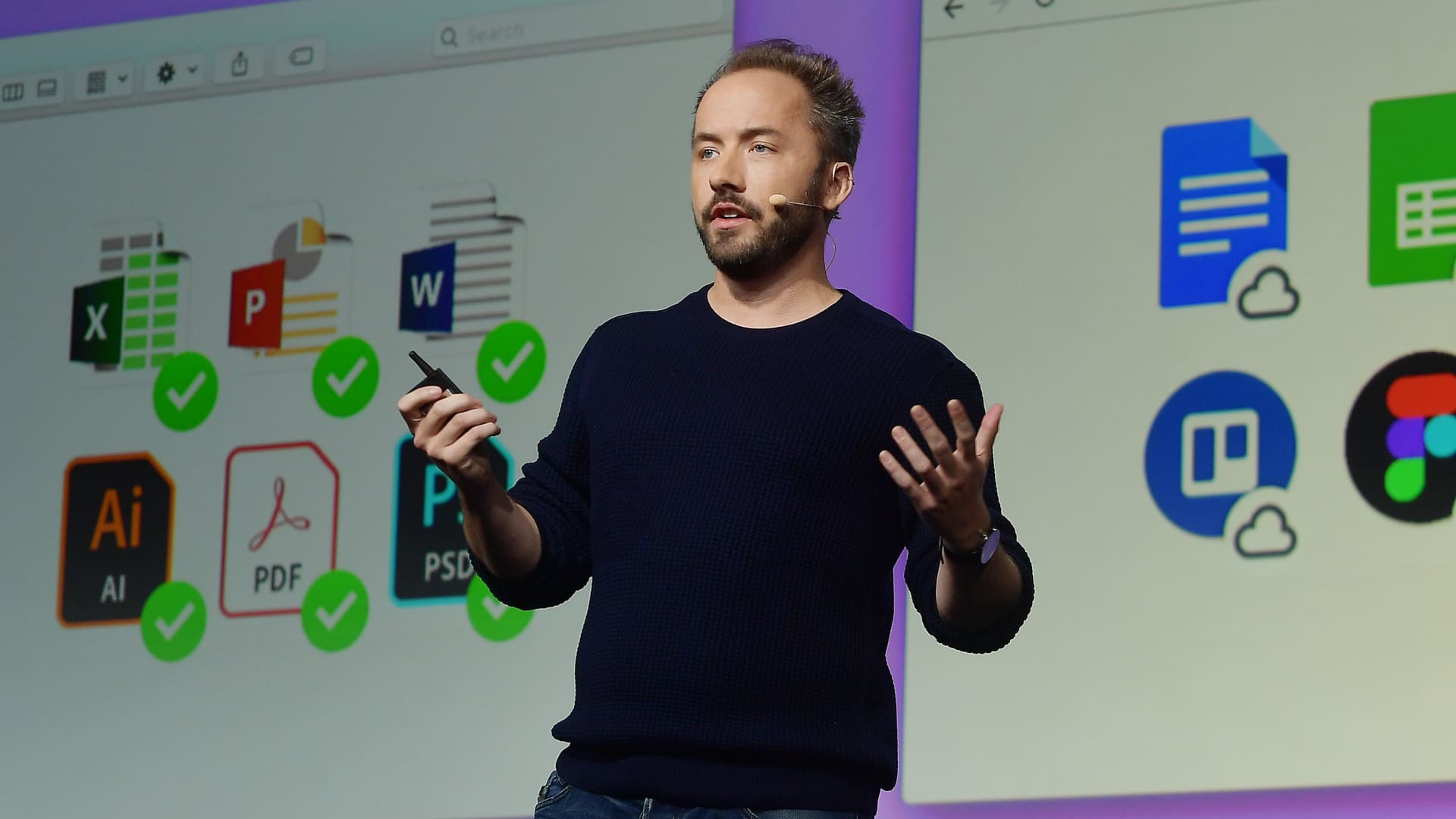
Dropbox CEO Drew Houston discusses the company's evolution from a simple cloud storage service to a platform-agnostic solution for organizing and sharing content across devices and browsers. Houston emphasizes the company's focus on AI and its commitment to helping people stay organized in a fragmented digital environment. He also reflects on the decision to transition to a mostly remote work model and shares insights on the competitive landscape, including a memorable encounter with Steve Jobs.
Dropbox (DBX) stock fell nearly 20% after reporting fourth-quarter results that missed analysts' expectations for billings, citing challenges with customer caution and price sensitivity. The company also faced headwinds related to decisions made to prevent abuse of its offerings, leading to declining customer growth. Despite exceeding revenue and EPS estimates, the market reacted negatively. Dropbox's shares are down 9.4% since the beginning of the year, trading 21.1% below its 52-week high, with investors showing concern over the company's performance.
Several stocks are making significant moves in premarket trading, including Super Micro Computer, Dropbox, and DoorDash, as investors react to various market developments and news.
A massive 26 billion record database containing leaked data from platforms like Dropbox, LinkedIn, Twitter, and government organizations has been discovered, posing a significant threat of identity theft and cyberattacks. While much of the data is not new and includes duplicate records from previous breaches, users are advised to update their security measures, change passwords, be vigilant against phishing attempts, and enable two-factor authentication. Tools like CyberNews' leak checker and Have I Been Pwned can help users identify if their email addresses have been compromised, and maintaining strong credentials hygiene is crucial for staying safe.
Dropbox is conducting an experiment involving AI tools, which grants OpenAI access to users' documents and files. Users can opt out by accessing the settings menu and toggling off the "Third-Party AI" option. This move has sparked concerns about user privacy amidst the increasing use of consumer-facing AI models. Additionally, it is advised to unshare all files, as Dropbox automatically opts them back in if shared with non-opted-out users.
Dropbox faced backlash after it was discovered that a new AI feature, enabled by default, shared user data with OpenAI for an experimental search feature. Dropbox clarified that data is only shared when the feature is actively used and is deleted within 30 days. Despite assurances, some users expressed concerns about data privacy and criticized the lack of clear communication. Dropbox CEO apologized for the confusion and emphasized that user data is not automatically sent to third-party AI services. The feature can be easily disabled in the account settings.
Dropbox users who have utilized the company's AI tools may have had their documents and files shared with OpenAI. While there is a valid reason for this collaboration, as Dropbox lacks its own chatbot, concerns about customer privacy have been raised. Dropbox AI customer documents pass through and are stored on OpenAI's servers for up to 30 days, but the data-sharing only occurs when users actively engage with the AI features. Users can turn off the "third-party AI" toggle in their account settings to prevent their files from being sent to OpenAI. However, files shared with other Dropbox users who are using AI features may still be sent to OpenAI servers.
Dropbox CEO Drew Houston has revealed that his company follows a 90/10 rule for remote work, with 90% of the year dedicated to remote work and the remaining 10% allocated to employee off-site events. Houston emphasized the importance of trust and treating employees like adults, stating that if people are trusted, they will behave responsibly. This approach contrasts with other business leaders who are pushing for a return to the office. While Dropbox's virtual-first work culture has its challenges, such as the loss of certain perks, Houston believes in giving employees options and a different social contract based on trust rather than control.
Dropbox CEO Drew Houston emphasizes that employees are not resources to control and should have options when it comes to remote work. Dropbox has fully embraced a distributed model since the pandemic and encourages employees to work remotely 90% of the time. The company has downsized its office space, redirected resources to benefit employees, and implemented flexible work hours. Houston believes that in-person connection is important but should be done in a way that allows employees to opt in rather than being forced. The company's approach to remote work has been successful in attracting talent from different locations and has been seen as a superpower for recruitment. Houston emphasizes trust over surveillance and believes that treating employees like adults leads to better productivity and efficiency.
Dropbox has launched two new AI-powered products, Dropbox AI and Dropbox Dash. Dropbox AI provides summaries and answers to questions about documents, while Dropbox Dash is a universal search bar that connects all of a user's tools, content and apps in one place. The company has pledged to protect customers' privacy and limit bias in its AI technologies. Dropbox AI is available in alpha for Dropbox Pro customers in the US, while Dropbox Dash is available on a waitlist.
Dropbox has launched a $50m venture fund, Dropbox Ventures, to support startups in the AI space. The fund will provide mentorship and financial support to build AI-powered products that "shape the future of work". Dropbox also announced new AI-powered features for its cloud storage product, including a universal search bar called Dropbox Dash and Dropbox AI, which summarises and extracts information from files stored in a Dropbox account. The company reaffirmed its commitment to building AI technologies "so that they're as fair and reliable as possible".
Dropbox is ending its native integration with Google Docs, Sheets, and Slides, and replacing files with shortcuts. Users have 30 days to migrate their Google Workspace files to Google Drive or they will be automatically converted to Microsoft Office files. Dropbox users who have utilized this Google functionality in the past should look out for an email with the subject line “[Action Required] Migrating your Google files,” which details the migration process. Some form of Google-Dropbox integration will remain after this migration.
Productivity apps like Dropbox, Droplr, Capito, Drafts, and Notion are transforming the way we work by simplifying file sharing and collaboration, streamlining email workflows, capturing and organizing thoughts, and providing an all-in-one workspace. These apps save time and boost efficiency, making them must-haves for anyone looking to enhance their workday experience.