
New Discoveries in Supermassive Black Hole Research.
TL;DR Summary
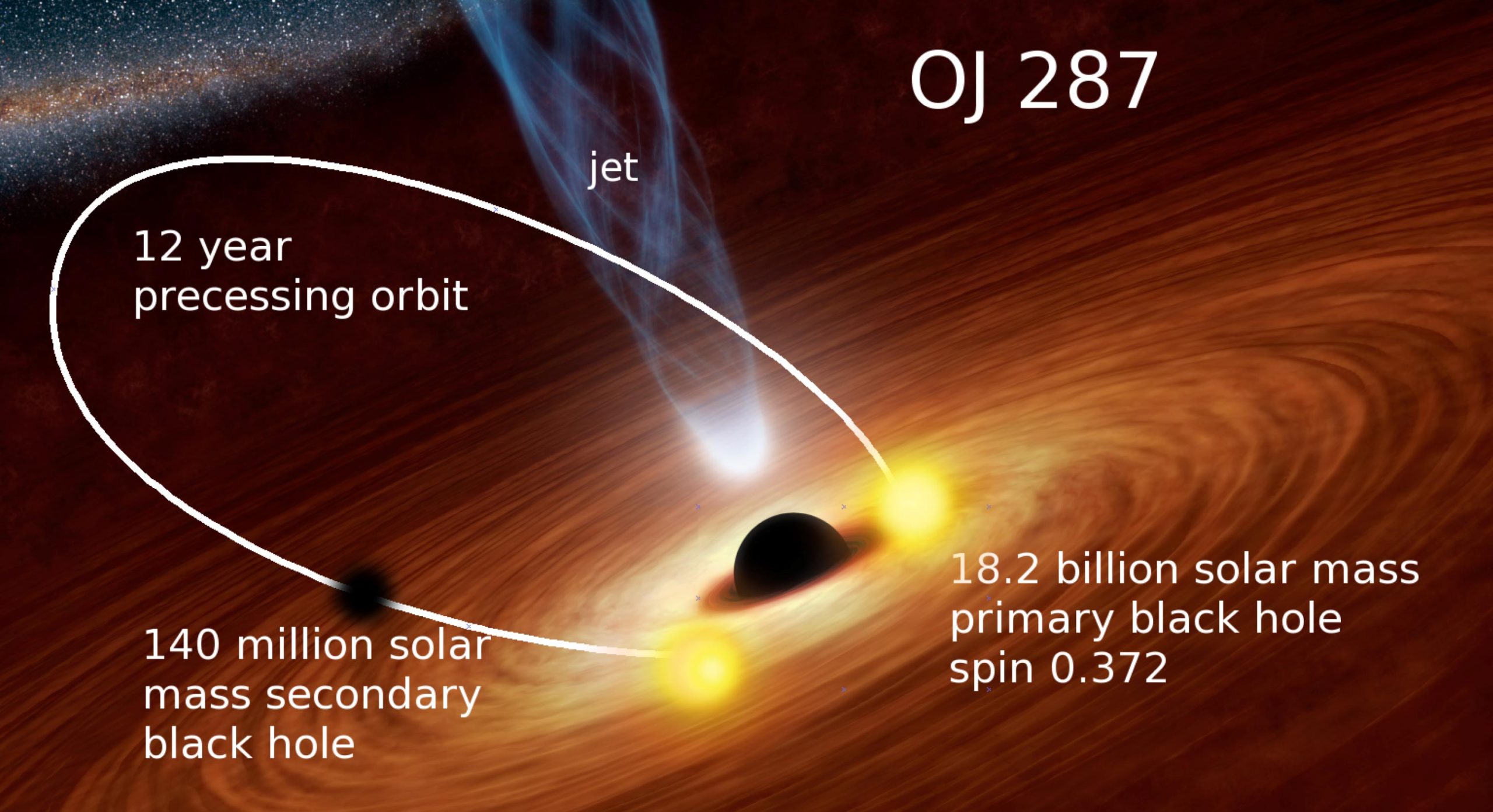
Astronomers have directly observed the second supermassive black hole in the binary system of OJ287, confirming the binary system hypothesis. The black holes are so close together that they merge into one dot, but the fact that it consists of two black holes becomes apparent by detecting two different types of signals. The secondary black hole was observed plunging through the accretion disk for the first time, producing a blue flash and new types of flares. These findings make OJ287 a prime candidate for further study of gravitational waves.
Topics:top-news#accretion-disk#astronomy#binary-system#gravitational-waves#oj287#supermassive-black-holes
- Flash of Light Brighter Than a Trillion Stars Leads to Supermassive Black Hole Breakthrough SciTechDaily
- Flare of light brighter than a trillion suns reveals location of rare double black hole galaxy Livescience.com
- First Observations Of Secondary Supermassive Black Hole Within Famous Double-Hole Quasar IFLScience
- First detection of secondary supermassive black hole in a well-known binary system Phys.org
- Webb Detects Small and Vigorous Black Hole in Early Universe Sci.News
Reading Insights
Total Reads
0
Unique Readers
0
Time Saved
7 min
vs 8 min read
Condensed
94%
1,531 → 89 words
Want the full story? Read the original article
Read on SciTechDaily