
Unveiling the Cosmic Symphony: Scientists Detect Gravitational Wave Background
TL;DR Summary
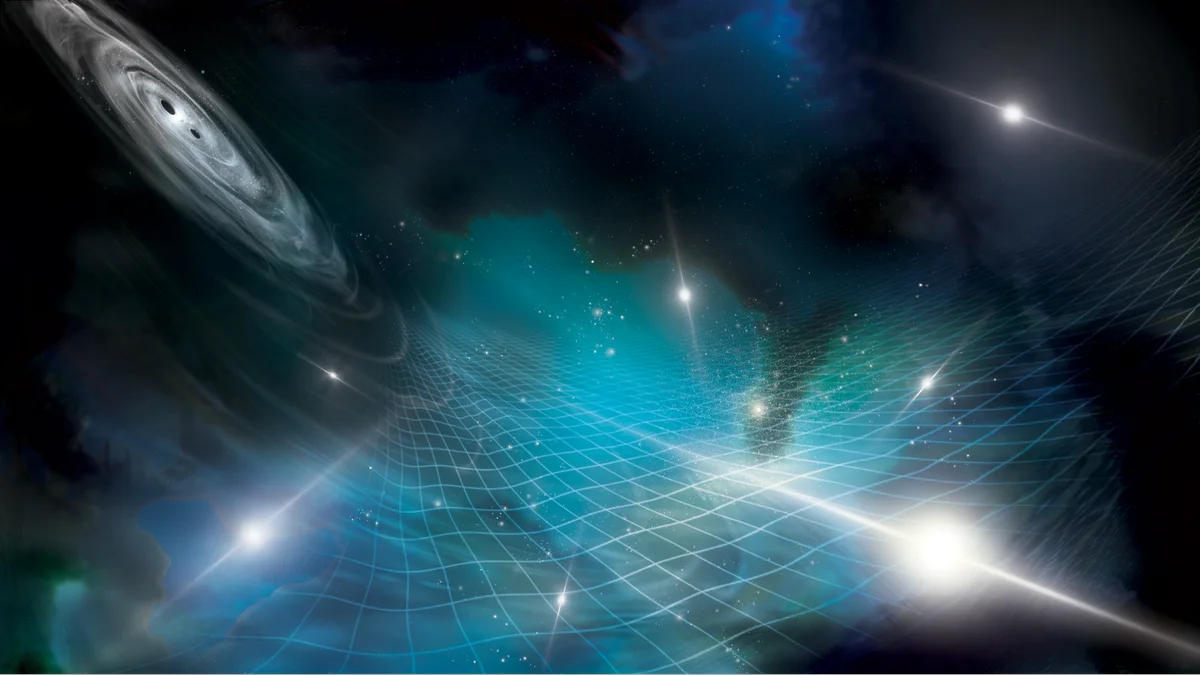
Scientists have made a historic breakthrough by detecting low-frequency gravitational waves, marking the first detection of this type. The waves are believed to originate from supermassive black hole binaries in the early universe. This discovery opens up a new window for studying how galaxies and their central black holes merge and grow over time. The detection was made possible by the North American Nanohertz Observatory for Gravitational Waves (NANOGrav), which used a pulsar timing array consisting of 68 pulsars within the Milky Way. The findings provide insights into the growth of supermassive black holes and the evolution of the universe.
Topics:science#early-universe#gravitational-waves#nanograv#pulsar-timing-array#science-and-technology#supermassive-black-holes
- The discovery of the gravitational wave background has scientists excited Space.com
- Galactic-scale detector picks up background distortions in spacetime New Atlas
- Probing the Universe's Secrets: Key Evidence for NanoHertz Gravitational Waves SciTechDaily
- Scientists have finally 'heard' the chorus of gravitational waves that ripple through the universe Phys.org
- Gravitational waves: How two Bend OSU students helped | Local&State The Bulletin
Reading Insights
Total Reads
0
Unique Readers
6
Time Saved
9 min
vs 10 min read
Condensed
95%
1,869 → 100 words
Want the full story? Read the original article
Read on Space.com