
JWST unveils early universe's secrets through distant observations.
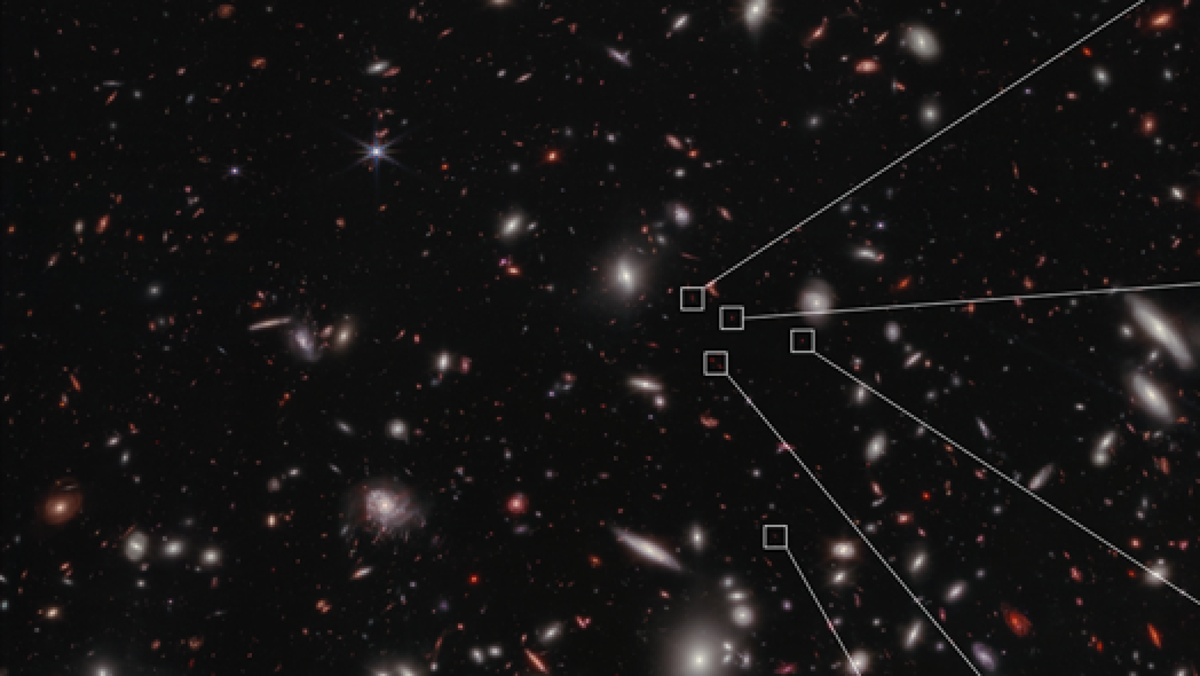
The James Webb Space Telescope has captured images of seven galaxies that make up the youngest protocluster ever seen by astronomers, just 650 million years after the Big Bang. The protocluster will eventually grow in mass and size by incorporating galaxies, forming a galactic cluster that resembles the Coma Cluster. The observation of these galaxies could help scientists better understand how the cosmos has evolved over its 13.8-billion-year existence. The team was able to determine that the galaxies are moving at over 2 million mph through a halo of dark matter, and the key to doing this was precise measurements captured by Webb's Near-Infrared Spectrograph.
- James Webb Space Telescope spots huge protocluster in early universe (photo) Space.com
- Webb observations of distant galaxy allow astronomers to probe the early Universe BBC Sky at Night Magazine
- JWST Sees a Galaxy Cluster Coming Together in the Early Universe Universe Today
- James Webb Space Telescope reveals rich chemistry of planet-forming disks for the 1st time Space.com
- Pillars of Creation Seen In 4K Via James Webb Space Telescope msnNOW
- View Full Coverage on Google News
Reading Insights
0
6
4 min
vs 5 min read
89%
921 → 105 words
Want the full story? Read the original article
Read on Space.com