
"Unveiling the Universe's Most Voracious and Dazzling Black Hole"
TL;DR Summary
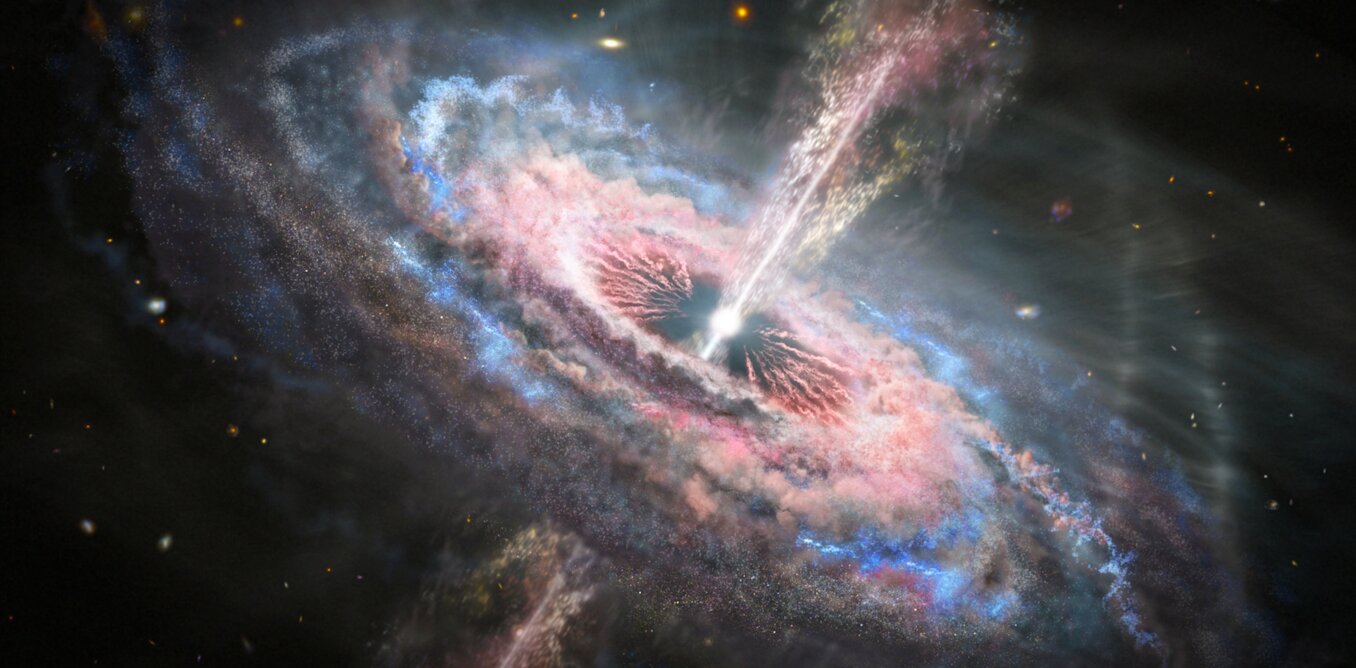
The European Southern Observatory's Very Large Telescope has discovered the brightest and fastest-growing quasar, challenging current understanding of galaxy formation in the early universe. The quasar, J0529-4351, has a black hole equivalent to 17 billion suns and is growing rapidly, raising questions about how it could have reached such size in less than two billion years after the Big Bang. This discovery prompts a reevaluation of early universe models and will be further studied using advanced instruments like Gravity+ and the Extremely Large Telescope.
- A black hole discovery could force us to rethink how galaxies came to be Phys.org
- Brightest quasar ever seen is powered by black hole that eats a 'sun a day' Space.com
- Astronomers Discover the Brightest Known Object in the Universe, Shining 500 Trillion Times as Bright as the Sun Smithsonian Magazine
- The accretion of a solar mass per day by a 17-billion solar mass black hole Nature.com
- Is This Black Hole the Hungriest and the Brightest? The New York Times
Reading Insights
Total Reads
0
Unique Readers
6
Time Saved
4 min
vs 5 min read
Condensed
91%
949 → 84 words
Want the full story? Read the original article
Read on Phys.org