
Unraveling the Mysteries of Black Hole Growth and Influence
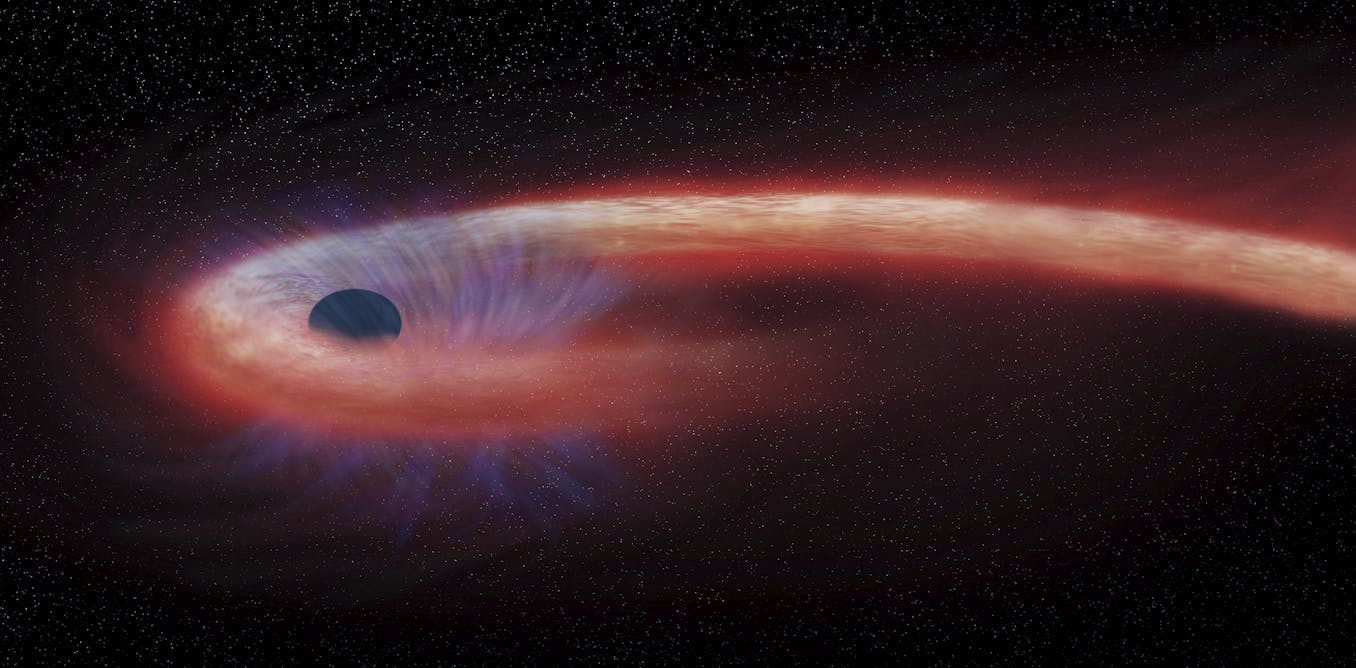
Black holes come in different sizes, with smaller ones called stellar mass black holes and larger ones known as supermassive black holes. Stellar mass black holes form when a massive star collapses under its own weight, while the origins of supermassive black holes are still a mystery. Black holes are usually invisible, but their presence can be detected by the way stars orbit around them. When a black hole is actively consuming gas, it can create a glowing ring of X-rays, optical light, and infrared light. The famous "white outlines" seen in movies depict the glowing ring of gases falling into a growing black hole. The best image of a real black hole's ring comes from the Event Horizon Telescope, showing the supermassive black hole at the center of the galaxy M87. Eventually, black holes exhaust their fuel and become invisible again.
- Why are some black holes bigger than others? An astronomer explains how these celestial vacuums grow The Conversation
- We Now Have Precise Math To Describe How Black Holes Reflect Our Universe ScienceAlert
- Black holes are changing our understanding of everything The Spectator
- Black holes for beginners: Dark stars explained by an astrophysicist Astronomy Magazine
- What happens at the center of a black hole? Astronomy Magazine
Reading Insights
0
7
4 min
vs 5 min read
84%
894 → 142 words
Want the full story? Read the original article
Read on The Conversation