
Exploring the Heart of Quasars through X-ray Imaging
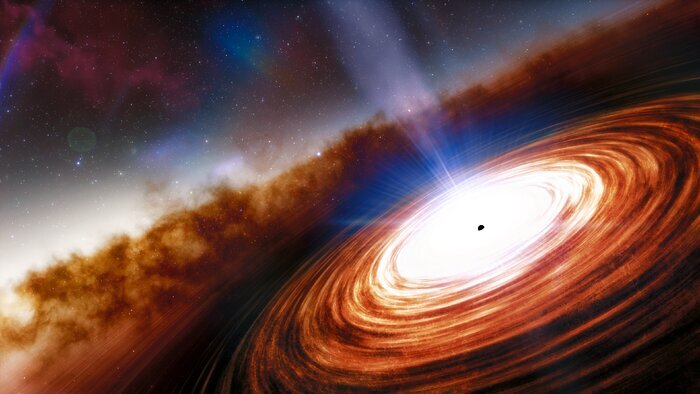
Researchers have observed the X-ray emission of the most luminous quasar seen in the last 9 billion years of cosmic history, known as SMSS J114447.77-430859.3, or J1144 for short. The study sheds light on the inner workings of quasars and how they interact with their environment. J1144 is much closer to Earth than other sources of the same luminosity, allowing astronomers to gain insight into the black hole powering the quasar and its surrounding environment. The team used data from several space-based observatories to measure the temperature of the X-rays being emitted from the quasar and found that the mass of the black hole at the quasar's center is around 10 billion times the mass of the sun, and the rate at which it is growing to be of the order of 100 solar masses per year.
Reading Insights
0
9
3 min
vs 4 min read
79%
647 → 137 words
Want the full story? Read the original article
Read on Phys.org