
Early Universe Witnesses Merger of Two Supermassive Black Holes.
TL;DR Summary
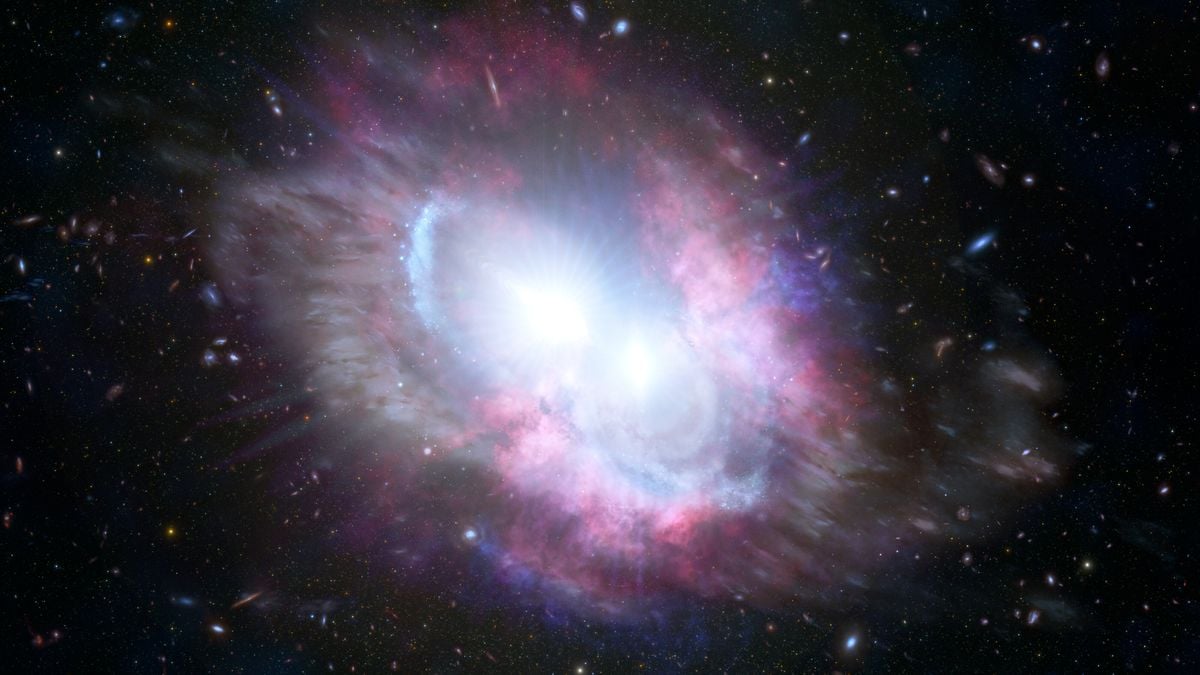
Astronomers have discovered two quasars lighting up the mutual heart of colliding galaxies during a period in the universe's early history known as "cosmic noon." The energetic quasars are powered by feeding supermassive black holes and are seen as they were just three billion years after the Big Bang, during a period of intense galactic growth and star formation. Such a closely bound pair of energetic quasars are characteristic of merging galaxies, which go on to form massive elliptical galaxies. By investigating such events, astronomers can learn more about the evolution of galaxies and how the universe took the shape we see today.
Topics:science#astronomers#astronomy#early-universe#galactic-mergers#quasars#supermassive-black-holes
Reading Insights
Total Reads
0
Unique Readers
1
Time Saved
4 min
vs 5 min read
Condensed
87%
816 → 103 words
Want the full story? Read the original article
Read on Space.com