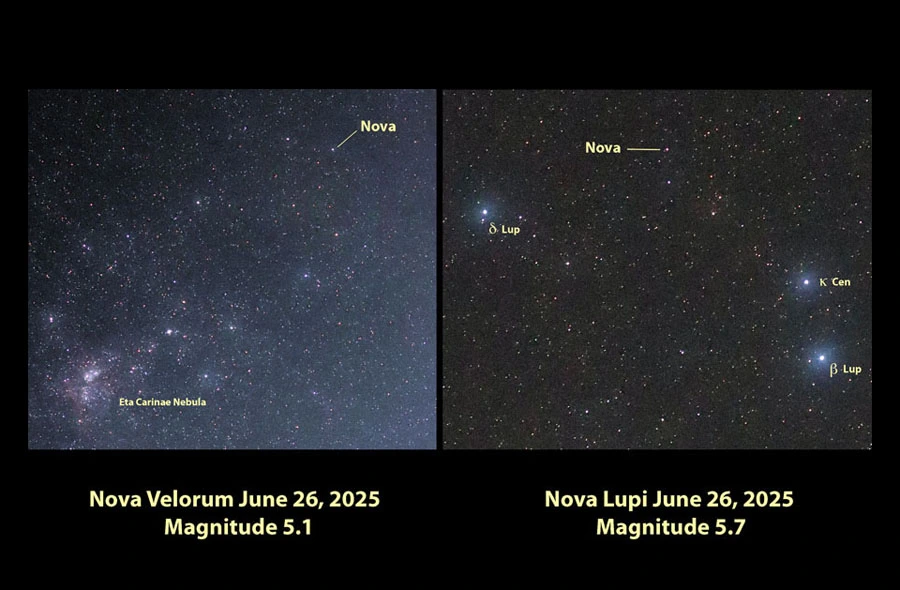
This summer, amateur astronomers can witness a rare event: two novae, V462 Lupi and Vela, visible to the naked eye simultaneously, offering a unique opportunity to observe these cosmic phenomena without optical aid.
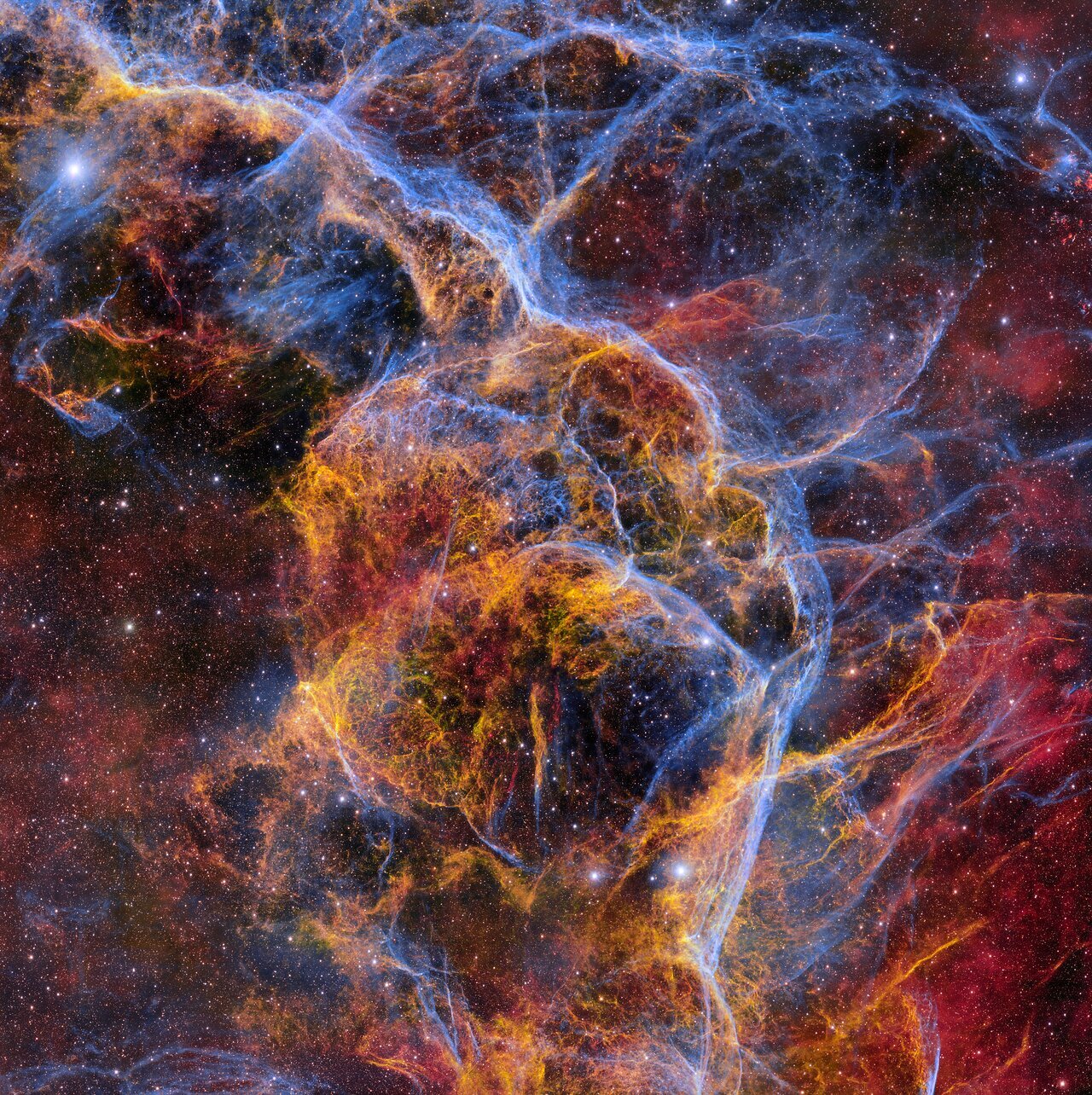
The Dark Energy Camera (DECam) has captured a 1.3-gigapixel image of the Vela Supernova Remnant, showcasing the remains of a massive star that exploded nearly 11,000 years ago. This colorful image, taken with state-of-the-art technology, reveals the intricate web-like filaments of the expanding nebula, which spans almost 100 light-years. The image also features the Vela Pulsar, the collapsed core of the star, now an ultra-condensed neutron star. DECam's capabilities allow for the creation of mesmerizing images of faint astronomical objects, offering a limitless starscape to explore.
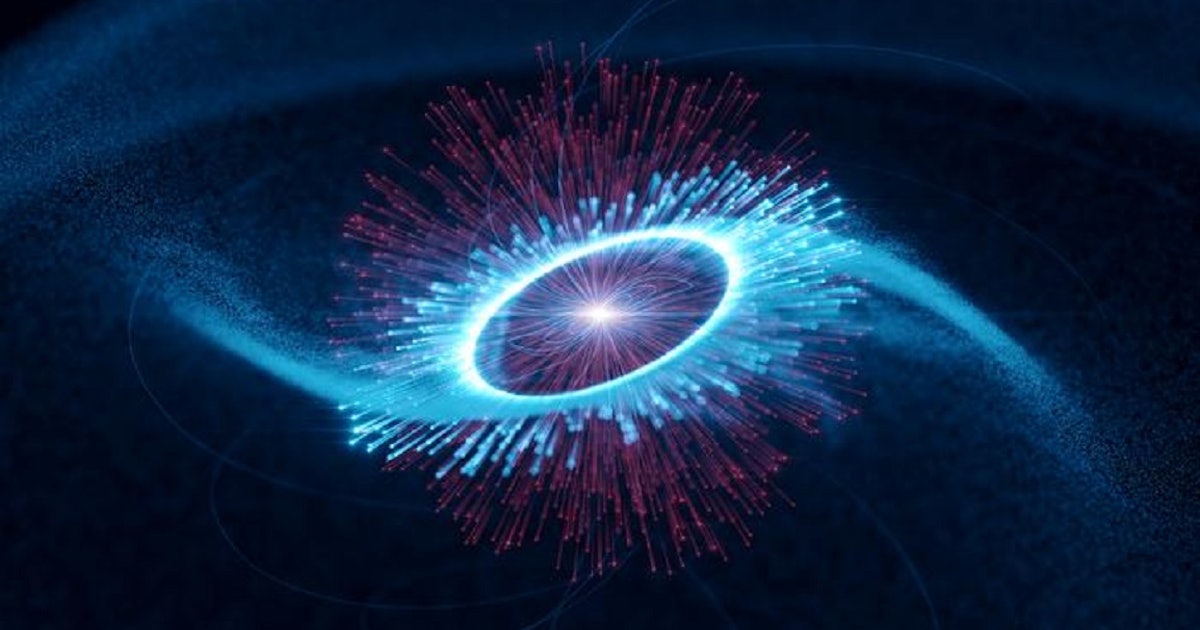
Astronomers have discovered that the pulsar Vela, located a thousand light years away, is emitting gamma rays with an unprecedented energy level of 20 trillion electron volts, making it the most powerful source of radiation known in the universe. However, scientists are unable to explain how the pulsar is producing such high-energy gamma rays, as the current understanding of its magnetic field and particle jets does not account for this phenomenon. Further research is needed to unravel this cosmic puzzle.