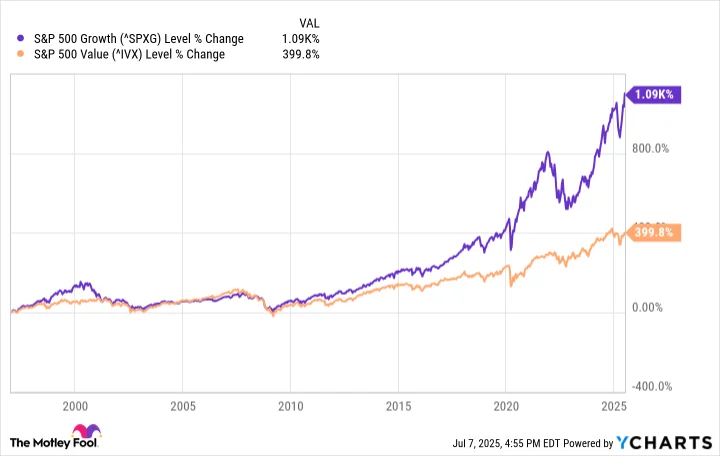
A shift from growth stocks to value stocks is expected to strengthen in the upcoming year, indicating a potential change in investment strategies and market dynamics.
The Dow Jones surpassing 48,000 reflects a market rotation from tech to value stocks, driven by concerns over AI sustainability and profit-taking, with potential implications for the market outlook into 2026 depending on economic data and Federal Reserve actions.
Jim Cramer suggests that despite the market's high levels, investors can find inexpensive stocks with strong growth potential across various sectors, including technology, financials, healthcare, and industrials, highlighting specific companies like T-Mobile, Dollar Tree, Capital One, Incyte, and Caterpillar.
The article discusses the rapid and unpredictable changes in financial markets driven by advancements in artificial intelligence, suggesting that investors might consider buying undervalued stocks during these turbulent times, while emphasizing the importance of patience and long-term perspective.
The article discusses recent positive trade deal developments involving the US, market gains driven by optimism, and highlights three undervalued stocks under $10—FinVolution Group, LexinFintech Holdings, and CommScope—that present attractive investment opportunities amid a recovering market and stable interest rates.
With growth stocks potentially losing their dominance, investors are encouraged to consider shifting some investments into value stocks, particularly through ETFs like Vanguard Value ETF, as market conditions suggest a possible reversal in the long-standing growth stock leadership.
Despite Nvidia's significant gains in market value, several billionaire investors are selling off their shares due to potential competition and market saturation concerns. Instead, they are investing in value stocks like PayPal, Bank of America, and Merck, which offer promising growth and stability.
Prominent billionaire investors have been selling Nvidia shares and investing in value stocks like PayPal, Bank of America, and Merck. Despite Nvidia's significant gains and AI's potential, concerns about competition and market saturation have led to this shift. PayPal shows strong user engagement, Bank of America benefits from higher interest rates and digital banking, and Merck's cancer drug Keytruda and Animal Health segment offer steady growth.
European markets opened lackluster ahead of the European Central Bank's rate decision, with expectations of a hold at the record 4%. UK house prices rose for the fifth consecutive month, indicating a return of cautious confidence in the real estate market. Foreign investors eye India's growth potential, but face barriers such as limits on foreign ownership and complex tax implications. Analysts favor value stocks amid expensive growth stocks, with a shift to more value-oriented names anticipated. European markets are expected to open flat to lower, with the ECB's monetary policy announcement and earnings reports from Continental, Lufthansa, ITV, Admiral Group, and Kier on the agenda.
The BNY Mellon Dynamic Value Fund, managed by Brian C. Ferguson, John Bailer, and Keith Howell, has a strong performance record and holds three standout value stocks: JPMorgan Chase, Medtronic, and Constellation Energy. Bailer believes these stocks are currently undervalued and offer good investment opportunities. The fund's approach combines intrinsic value, momentum, and strong quality fundamentals to avoid value traps. JPMorgan Chase is praised for its core strength and low valuation, Medtronic is seen as a high-quality stock with rising earnings estimates, and Constellation Energy is considered a renewable energy stock with low debt service.
Vanguard's Capital Markets Model research team suggests that investors consider switching from growth stocks to value stocks, as the relationship between the two is currently at an extreme level similar to that seen in 2020. Vanguard defines value stocks as those with lower prices, lower growth rates, and higher dividend yields. Historical data shows that value stocks tend to outperform during economic recoveries. With the Federal Reserve potentially engineering a soft landing and the economy expected to accelerate, an overweight to value stocks could help offset low broad-market returns in the next decade.
Joel Tillinghast, the manager of Fidelity Low-Priced Stock, has outperformed the S&P 500 and the Russell 2000 index since the fund's launch in 1989, with an annualized total return of about 13%. Tillinghast's strategy involves seeking undervalued small and mid-cap stocks that trade at a discount to their intrinsic value. He emphasizes the importance of long-term investing and considering a company's earnings potential over several years. Tillinghast also highlights the need for investors to have a clear advantage or special approach when choosing active funds over passive index funds. His advice for young investors is to take a long-term view, be patient, and carefully assess the price and value of investments.