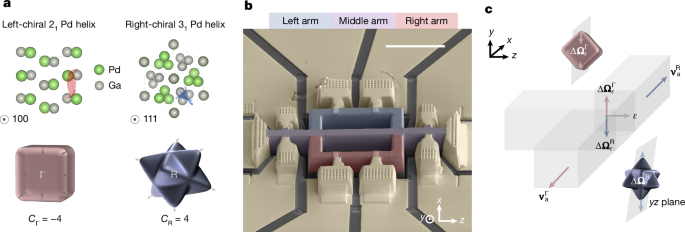
The article presents a novel mesoscopic device using quantum geometry to filter and control chiral fermions in topological states without magnetic fields, demonstrating their long-range phase coherence and potential for quantum electronic applications through nonlinear Hall effects and quantum interference measurements.
Scientists at Delft University of Technology have experimentally demonstrated the quantum spin Hall effect in magnetic graphene at room temperature without external magnetic fields, paving the way for practical, miniaturized quantum and spintronic devices that operate under ambient conditions.
Physicists at Rice University have made a breakthrough in quantum physics by demonstrating that unchangeable topological states, crucial for quantum computing, can intertwine with alterable quantum states in certain materials. This discovery bridges subfields of condensed matter physics and offers the potential for operations at significantly higher temperatures, promising functional applications. The study showed that electrons from d atomic orbitals can become part of larger molecular orbitals, leading to entanglement with other frustrated electrons and producing strongly correlated effects. This finding opens up possibilities for utilizing the efficient coupling of d-electron systems, even in the presence of flat bands, at higher temperatures.