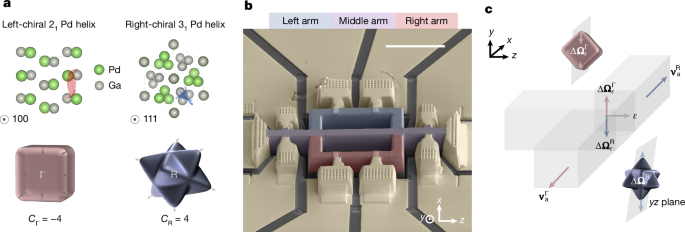
The article presents a novel mesoscopic device using quantum geometry to filter and control chiral fermions in topological states without magnetic fields, demonstrating their long-range phase coherence and potential for quantum electronic applications through nonlinear Hall effects and quantum interference measurements.

Scientists at UNIGE have discovered a hidden quantum geometry within materials that influences electron paths similarly to gravity bending light, opening new possibilities for advanced electronics and quantum technology. This finding, observed at the interface of specific oxides, challenges previous assumptions and could lead to breakthroughs in high-frequency electronics, superconductivity, and light-matter interactions.
Physicists have developed a groundbreaking method to map the full quantum geometry of materials, revealing the hidden landscape that governs the behavior of wave functions in quantum particles, which could accelerate discoveries in quantum materials and technologies.
Scientists from Columbia, Nanjing University, Princeton, and the University of Munster have presented the first experimental evidence of collective excitations with spin called chiral graviton modes (CGMs) in a semiconducting material, bridging the gap between quantum mechanics and Einstein’s theories of relativity. The discovery, published in Nature, could potentially connect high energy physics and condensed matter physics, shedding light on the mysterious nature of gravity. The research, which builds on the legacy of late Columbia professor Aron Pinczuk, marks a significant step toward a better understanding of the universe and its fundamental forces.
Researchers have presented the first experimental evidence of collective excitations with spin called chiral graviton modes (CGMs) in a semiconducting material, marking the first experimental substantiation of the concept of gravitons in a condensed matter system. The discovery was made in a type of condensed matter called a fractional quantum Hall effect (FQHE) liquid, and the ability to study graviton-like particles in the lab could help bridge the gap between quantum mechanics and Einstein's theories of relativity. The findings could potentially connect high energy physics and condensed matter physics, offering new understanding of quantum systems and materials.