Scientists have developed a new form of graphene that significantly enhances supercapacitors' energy and power density, potentially enabling faster charging and higher capacity energy storage for electric vehicles, electronics, and household devices, overcoming previous limitations of space efficiency and charge speed.

Researchers at Monash University have developed a new graphene-based material called multiscale reduced graphene oxide (M-rGO) that significantly enhances supercapacitors, enabling them to store energy comparable to batteries while offering rapid charging and high power output, with potential for commercial applications in electric vehicles and electronics.
Researchers at the University of Colorado have discovered a technique using supercapacitors that could allow smartphones to fully charge in just one minute. This method involves the efficient movement of ions, potentially enabling manufacturers to use lower-capacity batteries and free up space for other components. While the technology is still in the research phase, its rapid charging capability could significantly impact future smartphone designs.
Researchers from the University of Colorado Boulder have developed a new technique that could enable smartphones and other devices to be charged in just 60 seconds. This breakthrough, based on improved ion movement through supercapacitors, challenges traditional understandings of electrical currents and could revolutionize the efficiency and convenience of charging electronic devices and electric cars.
Researchers at the University of Colorado at Boulder have discovered a new understanding of ion behavior in supercapacitors, potentially enabling devices like laptops and phones to be charged in just 60 seconds. This breakthrough, led by engineer Ankur Gupta, could significantly enhance the energy density of supercapacitors, making them a viable alternative to lithium-ion batteries. However, further research is needed before this technology can be practically implemented.
Researchers at the University of Colorado Boulder, led by Ankur Gupta, have developed a model to predict ion movement in complex nanopore networks, potentially revolutionizing energy storage technology. This breakthrough could lead to faster-charging supercapacitors with extended lifespans, benefiting applications from vehicles to power grids and wearable devices. The model challenges traditional principles and significantly accelerates computational efficiency, enabling the simulation of thousands of interconnected pores within minutes.
CU Boulder researchers have discovered how ions move within a network of tiny pores, potentially leading to the development of supercapacitors that could charge devices like laptops in a minute. This breakthrough modifies Kirchhoff's law and could revolutionize energy storage for electronics, vehicles, and power grids.
Cambridge scientists have discovered that disordered carbon electrodes in supercapacitors can store significantly more energy than their neater counterparts. This breakthrough could enhance the energy storage capacity of supercapacitors, which charge quickly and last for millions of cycles, making them a valuable complement to traditional batteries. The finding could also help reduce reliance on fossil fuels by improving the efficiency of renewable energy storage.
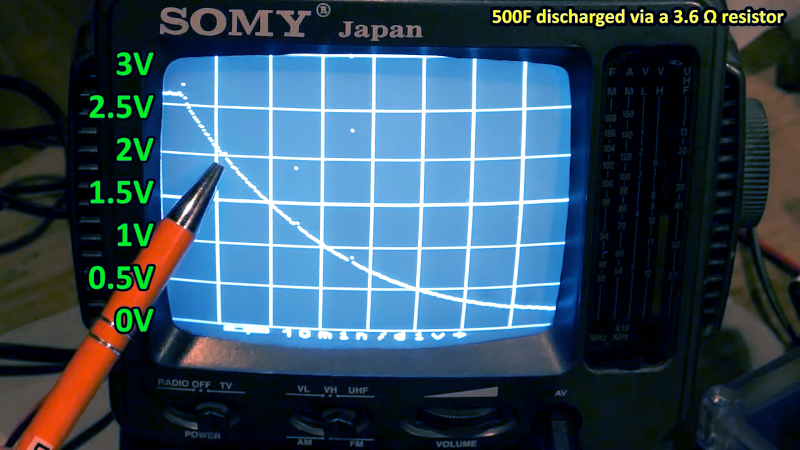
A DIY enthusiast used his homemade oscilloscope to examine the behavior of large-value supercapacitors, including a 500 F capacitor. Supercapacitors achieve high capacitance values and are ideal for low-current backup applications. The homemade test equipment, including the oscilloscope, power supply, and battery analyzer, is the real star of the video. Supercapacitors are useful for weight, heat, or long-term capacity loss problems.