Tag

Semiconductor Materials

All articles tagged with #semiconductor materials

science-and-technology2 years ago

"Surprising Discovery Unveiled in the Development of Polymer-Based Semiconductors"

Researchers at the University of Illinois Urbana-Champaign have discovered unexpected results while studying the development of polymer-based semiconductors that can harness the power of chirality. Chirality, a non-superimposable mirror image, is a natural strategy used to build complexity in structures. The team investigated modifications to a non-chiral polymer and found that slight tweaks caused major changes in the material's phases. The findings highlight the need to consider complex mesophase structures to uncover unknown properties that can lead to advancements in optical, electronic, and mechanical properties. Potential applications include solar cells, quantum computing, and 3D imaging techniques.


technology2 years ago

"Breakthrough Discovery: World's Fastest Semiconductor Unveiled, Revolutionizing Computer Chip Speeds"

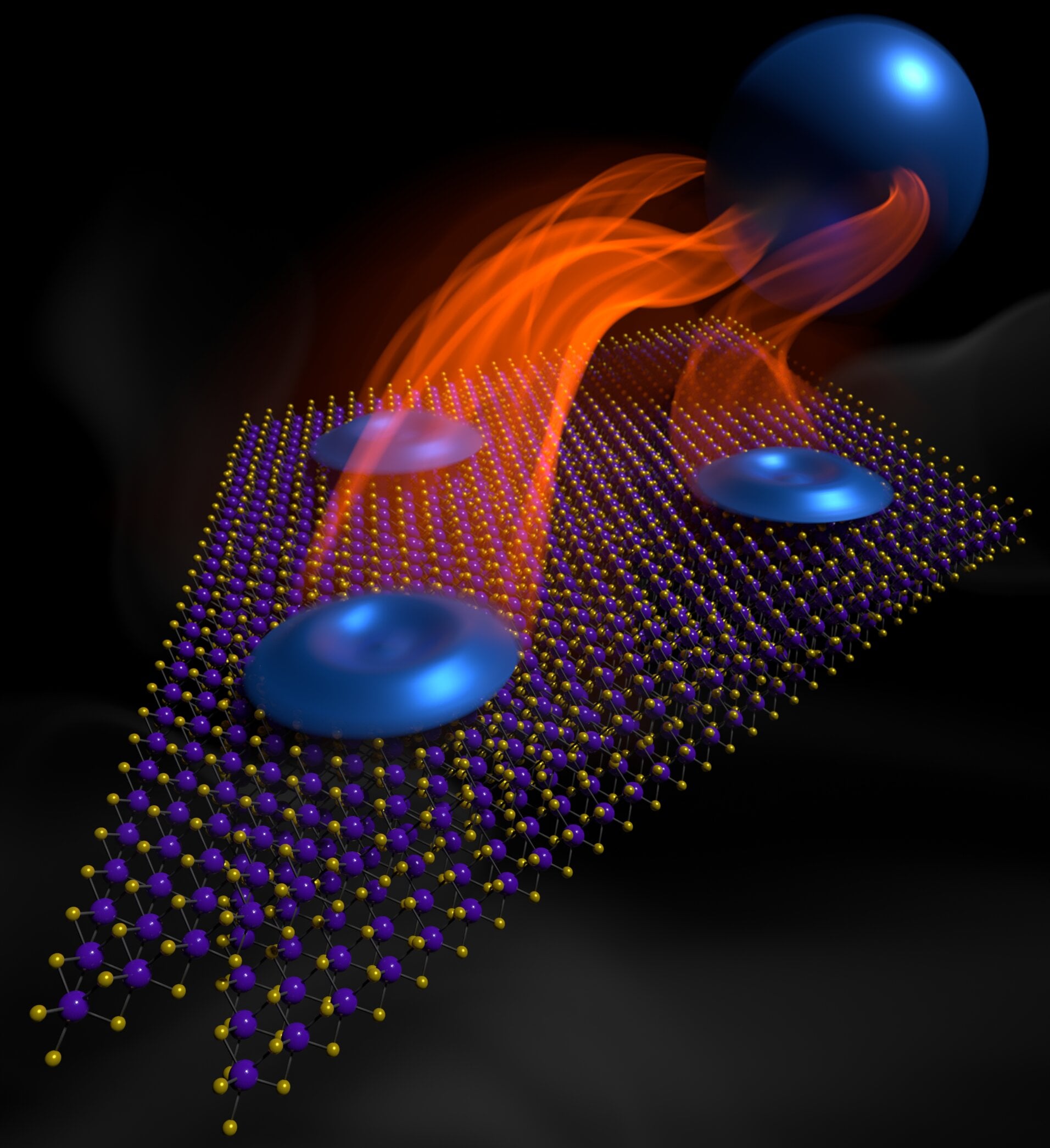
Chemists have accidentally discovered a new material called Re6Se8Cl2, which could potentially make computer chips twice as fast as those made with silicon. Unlike silicon, Re6Se8Cl2 slows down electrons when they encounter phonons, resulting in a more direct path for electron movement. However, the rarity and cost of rhenium, a key ingredient in Re6Se8Cl2, make it impractical for mass production. Nevertheless, researchers are now exploring other materials with similar properties to develop faster computer chips.

science-and-technology2 years ago

Decoding the Crucial Role of Auger-Meitner Effect in Electron Energy Loss

Researchers at UC Santa Barbara have uncovered the role of the Auger-Meitner effect in explaining the efficiency loss in blue or ultraviolet light-emitting diodes (LEDs) caused by defects or impurities. The Auger-Meitner effect allows an electron to transfer its energy to another electron, resulting in a higher-energy state. The researchers developed a methodology that conclusively established the crucial role of the Auger-Meitner process, showing trap-assisted recombination rates in gallium nitride LEDs that were more than a billion times greater than previously considered. This understanding could help improve the efficiency of semiconductor light emitters and other wide-band-gap materials affected by defects.

quantum-computing2 years ago

"Magnetic Toggle-Switch Advances Quantum Computing Capabilities"

Researchers at the University of Washington have made a significant advancement in developing fault-tolerant qubits for quantum computing by detecting signatures of "fractional quantum anomalous Hall" (FQAH) states in experiments with flakes of semiconductor materials. FQAH states can host anyons, which can be used to make "topologically protected" qubits that are stable against any small, local disturbances. The team built an artificial lattice with exotic properties using two atomically thin flakes of the semiconductor material molybdenum ditelluride (MoTe2) to host FQAH states. The team hopes to discover an even more exotic version of quasiparticles called "non-Abelian" anyons, which could be used as topological qubits.

business2 years ago

Japan's $6.4bn JSR deal boosts chip supply chain

Japan Investment Corp (JIC), a government-backed fund, has agreed to buy semiconductor materials maker JSR Corp for $6.4 billion in an effort to boost Japan's competitiveness in the chip industry. JIC plans to launch a tender offer in late December offering a 35% premium to Friday's closing price to take JSR private. The move raised expectations of sector consolidation, driving shares in peer Tokyo Ohka Kogyo 10% higher, while Sumitomo Chemical and Shin-Etsu Chemical each rose 2%.

science-and-technology2 years ago

"Artificial Photosynthesis: Key to Space Colonization?"

Artificial photosynthesis, using semiconductor materials and metallic catalysts, could be crucial for space exploration and colonization by efficiently producing oxygen and recycling carbon dioxide. These devices could reduce reliance on heavy and unreliable systems currently used on the International Space Station. The devices could operate at room temperature at pressures found on Mars and the Moon, and could be used directly in habitats using water as the main resource. The insights gained from designing and fabricating these devices could also help meet the green energy challenge on Earth.