Tag

Precision Measurements

All articles tagged with #precision measurements

quantum-physics2 years ago

"Breakthrough: Robust and Ultra-Sensitive Topological Quantum Device Developed by Quantum Physicists"

Quantum physicists from Dresden and Würzburg have developed a semiconductor device made of aluminum-gallium-arsenide that exhibits exceptional robustness and sensitivity due to a topological skin effect, shielding it from external perturbations and enabling unprecedented precision measurements. This breakthrough paves the way for high-precision quantum modules in topological physics and holds potential for applications in the semiconductor industry. The device, measuring about 0.1 millimeters in diameter, demonstrates the topological skin effect at a microscopic scale in a natural semiconductor material for the first time, making it highly suitable for sensor engineering and amplifiers with minuscule diameters.

science-and-technology2 years ago

Unprecedented Daily Measurements: Charting Earth's Rotation Shifts

Researchers at the Geodetic Observatory Wettzell have achieved unprecedented accuracy in measuring Earth's rotation using an advanced ring laser. This enhanced technology allows for daily high-quality data capture, which is crucial for determining Earth's position in space, improving climate research and models, and understanding weather phenomena like El Niño. The ring laser system has been continuously improved to provide precise measurements down to 9 decimal places, with the ability to capture current data every three hours. The independent and highly precise laser system eliminates the need for reference points in space, making it a valuable tool for identifying and compensating for systematic errors in other measurement methods.

science-and-technology2 years ago

"Breaking Boundaries: LIGO Shatters Quantum Limit"

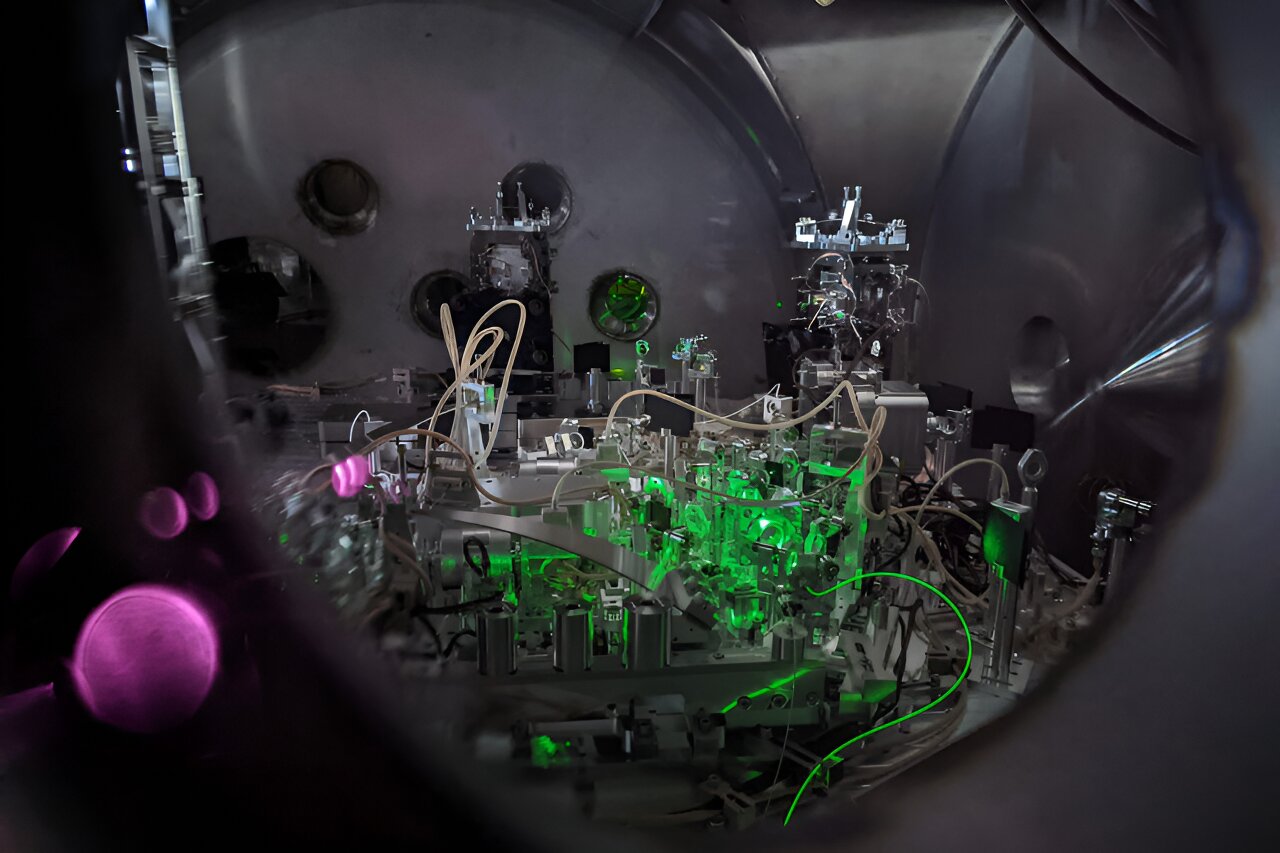
Researchers at LIGO have made a significant advance in quantum squeezing technology, allowing them to measure undulations in space-time across the entire range of gravitational frequencies detected by LIGO. This new "frequency-dependent squeezing" technology improves LIGO's sensitivity and enables it to probe a larger volume of the universe, potentially detecting 60% more mergers than before. The development has implications for astronomy, quantum technologies, and fundamental physics experiments. The technology involves squeezing light to make more precise measurements, but there is a tradeoff as it introduces noise at lower frequencies. LIGO's new frequency-dependent squeezing cavity addresses this issue by selectively moving the quantum noise into different features of light depending on the frequency range of gravitational waves.

science-and-technology2 years ago

"Breaking Boundaries: LIGO Shatters Quantum Limit"

The Laser Interferometer Gravitational-Wave Observatory (LIGO) has developed a new quantum technology called "frequency-dependent squeezing" that allows it to surpass the limits imposed by quantum physics and make more precise measurements of gravitational waves. By manipulating light in different ways depending on the frequency of the waves, LIGO can reduce quantum noise and improve its sensitivity across the entire range of gravitational frequencies. This breakthrough technology is expected to increase LIGO's ability to detect mergers between black holes and neutron stars by about 60 percent, opening up new possibilities for studying exotic cosmic events. The advancements in squeezing also have implications for future quantum technologies and fundamental physics experiments.