
Tag

Pandax

All articles tagged with #pandax

science1 year ago

Dark Matter Experiments Unveil 'Ghostly' Neutrino Fog

For the first time, two dark matter experiments, XENON in Italy and PandaX in China, have detected a 'neutrino fog,' a dense cloud of neutrinos, using liquid xenon detectors. This discovery, involving coherent elastic neutrino-nucleus scattering (CEvNS), complicates the search for dark matter as neutrinos can create background noise that mimics dark matter signals. Despite this challenge, experts believe the impact of this 'neutrino fog' on dark matter research is manageable. The findings are published in Physical Review Letters.

physics1 year ago

Unveiling the Mysteries of the Neutrino Fog

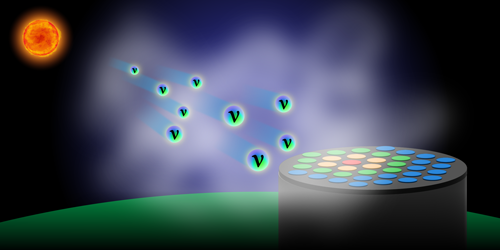
Two dark matter experiments, PandaX and XENON, have detected signals from solar neutrinos, known as the "neutrino fog," which could complicate future dark matter searches. These experiments, using liquid xenon detectors, observed coherent elastic neutrino-nucleus scattering (CEvNS) events, a process predicted to mimic dark matter signals. While the neutrino fog poses a potential challenge, it is not expected to significantly impact dark matter searches for at least a decade. The findings also open new avenues for neutrino research and standard-model testing.

science2 years ago

"China Unveils World's Largest Underground Dark Matter Lab"

China has opened the world's deepest and largest underground laboratory, the China Jinping Underground Laboratory-II, at 7,874 feet below a mountain in Sichuan Province to study dark matter. The facility aims to shield experiments from cosmic radiation and features upgraded equipment, including the Particle and Astrophysical Xenon Experiments (PandaX) with improved sensitivity. Scientists hope the new lab will provide insights into the elusive nature of dark matter, which makes up an estimated 95% of the universe.

physics2 years ago

Advancements in Dark Matter Research: From Ionization Signals to Neutrino Detectors

The PandaX experiment, located at the China Jinping Underground Laboratory, has set new constraints on the search for light dark matter using ionization signals. By focusing on the ionization signal (S2) in dual-phase xenon detectors, the researchers were able to reduce the energy threshold and derive constraints for light dark matter particles. Although no significant excess was observed, the constraints delineate a mass range for various types of dark matter interactions. These findings provide the most stringent constraints yet and could inform future searches for light dark matter using dual-phase xenon detectors. The PandaX experiment continues to collect data and improve its sensitivity in the search for dark matter.