

Tag

Neuroprosthesis

All articles tagged with #neuroprosthesis

health2 years ago

Revolutionary Spinal Device Alleviates Parkinson's Disease Freezing Gait

A spinal cord neuroprosthesis, which delivers electrical stimulation to nerve cells in the spine, has shown promising results in reducing gait freezing in a man with Parkinson's disease. The device, developed by scientists at the Swiss Federal Institute of Technology in Lausanne, targets the nerve cells responsible for controlling leg movements and has led to significant improvements in the patient's ability to walk. The technology, which combines electrical stimulation with deep brain stimulation, may offer a new therapeutic approach for individuals with Parkinson's disease experiencing gait problems. Further research is needed to test the technique in more patients.

health2 years ago

Revolutionary Spinal Implant Restores Mobility for Parkinson's Patients

A man with Parkinson's disease, who had difficulty walking and was confined to his home, has regained his mobility thanks to a spinal implant. The device stimulates his leg muscles with electrical impulses, allowing him to climb stairs, go shopping, and walk independently for almost four miles. The implant works by stimulating weakened sensory fibers in the legs, bypassing the region of the brain affected by Parkinson's. While the treatment is still in the early stages of development, researchers are hopeful that it could provide a new therapy for mobility problems in Parkinson's patients. Further testing will be conducted in the next 18 months.

science-and-technology2 years ago

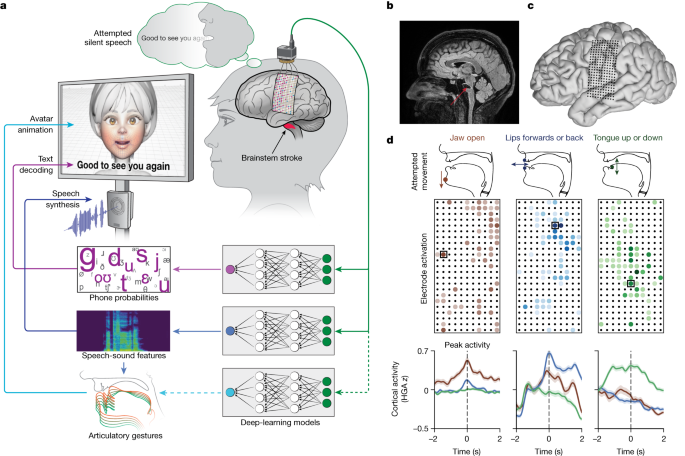
Revolutionary Neuroprosthesis Empowers Speech and Communication

Researchers have developed a high-performance neuroprosthesis that can decode speech and control an avatar. The neuroprosthesis, tested on a paralyzed individual with anarthria, uses brain-computer interface technology to translate neural activity into synthesized speech. The study demonstrates the potential for individuals with severe speech impairments to communicate effectively using this technology. Data relevant to the study are available upon request, and the code to replicate the findings can be found on GitHub.