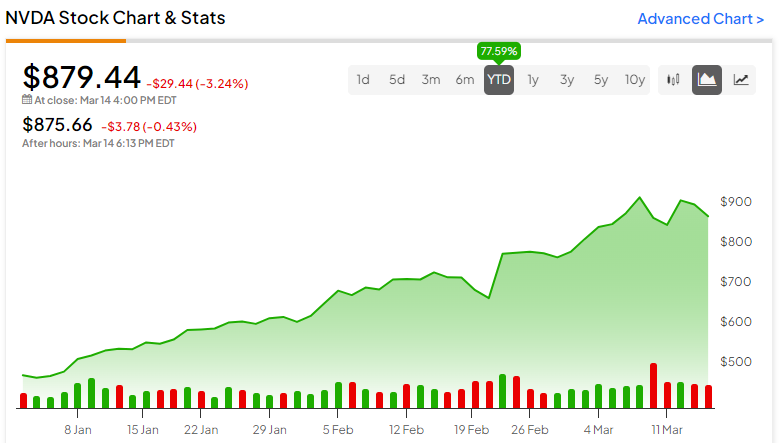
Nvidia's stock is trading at high multiples despite potential cyclical risks, with the company's rapid profit growth and high margins possibly nearing a peak. Increased competition and potential economic weakness could impact Nvidia's future earnings, while the semiconductor industry's surge in investment and competition pose additional challenges. Analysts remain bullish on the stock, but some caution that Nvidia's position may resemble Intel's during the dot-com bubble, with potential for a similar downturn in the future.
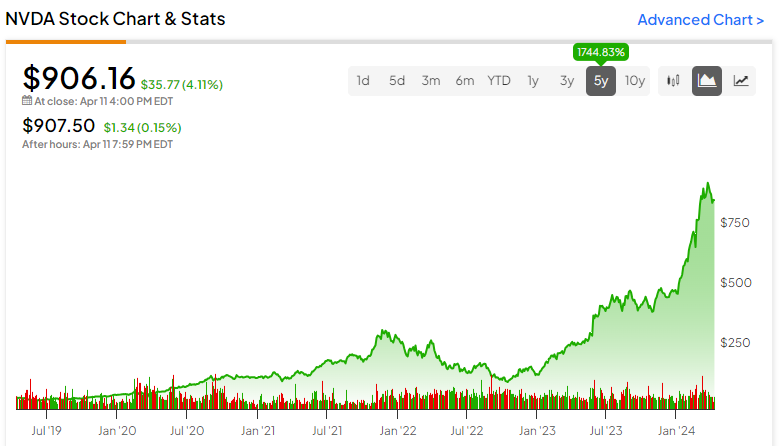
NVIDIA's stock has surged by 75% in the past three months, prompting a closer look at the company's financial health, particularly its Return on Equity (ROE) which stands at 69%. The high ROE and substantial net income growth over the past five years indicate efficient reinvestment of profits and strong growth potential. However, future earnings growth is expected to slow down, and the company's future ROE is forecasted to decrease, suggesting a potential decline in performance.
Nvidia's stock (NASDAQ:NVDA) has surged in value, driven by a blowout Q4 earnings report and optimistic future guidance. The company's dominance in AI and impressive long-term growth trajectory have led to favorable analyst ratings and a potential stock split. Despite concerns about overvaluation, the stock's forward P/E ratio and historical valuation suggest it may still be undervalued, making it an attractive investment opportunity for those interested in the AI market.
NVIDIA Corporation's stock price has surged, trading close to its 52-week high, leading to questions about whether it's still a bargain. Analysis suggests that the stock is currently expensive based on its price-to-earnings ratio compared to the industry average, indicating potential overvaluation. While the company's future earnings are expected to double, shareholders may consider selling if they believe the stock should trade below its current price, while potential investors may want to wait for a price drop. It's important to consider the risks and other factors before making any investment decisions.