Fermilab's precise measurement of the muon's magnetic 'wiggle' aligns closely with the Standard Model, suggesting no new exotic physics is involved, though the muon's behavior continues to be a key probe for potential new particles or forces.
Physicists used antimatter, supercomputers, and giant magnets to resolve a 20-year-old mystery about the muon's magnetism, which could have indicated new physics related to dark matter. Recent experiments and simulations have clarified the discrepancy, but the question of potential new particles like the dark photon remains open, offering clues about dark matter.
The discrepancy between the theoretical and experimental values of the muon's magnetic moment has puzzled scientists for decades, potentially indicating interactions with unknown particles or forces. Recent research using advanced quantum simulations has shed light on these discrepancies, offering insights into the fundamental properties of muons and their interactions in particle physics. The study identified the origin of the discrepancies and provided new insights into the muon's magnetic moment, which could contribute to the investigation of dark matter and other aspects of new physics.
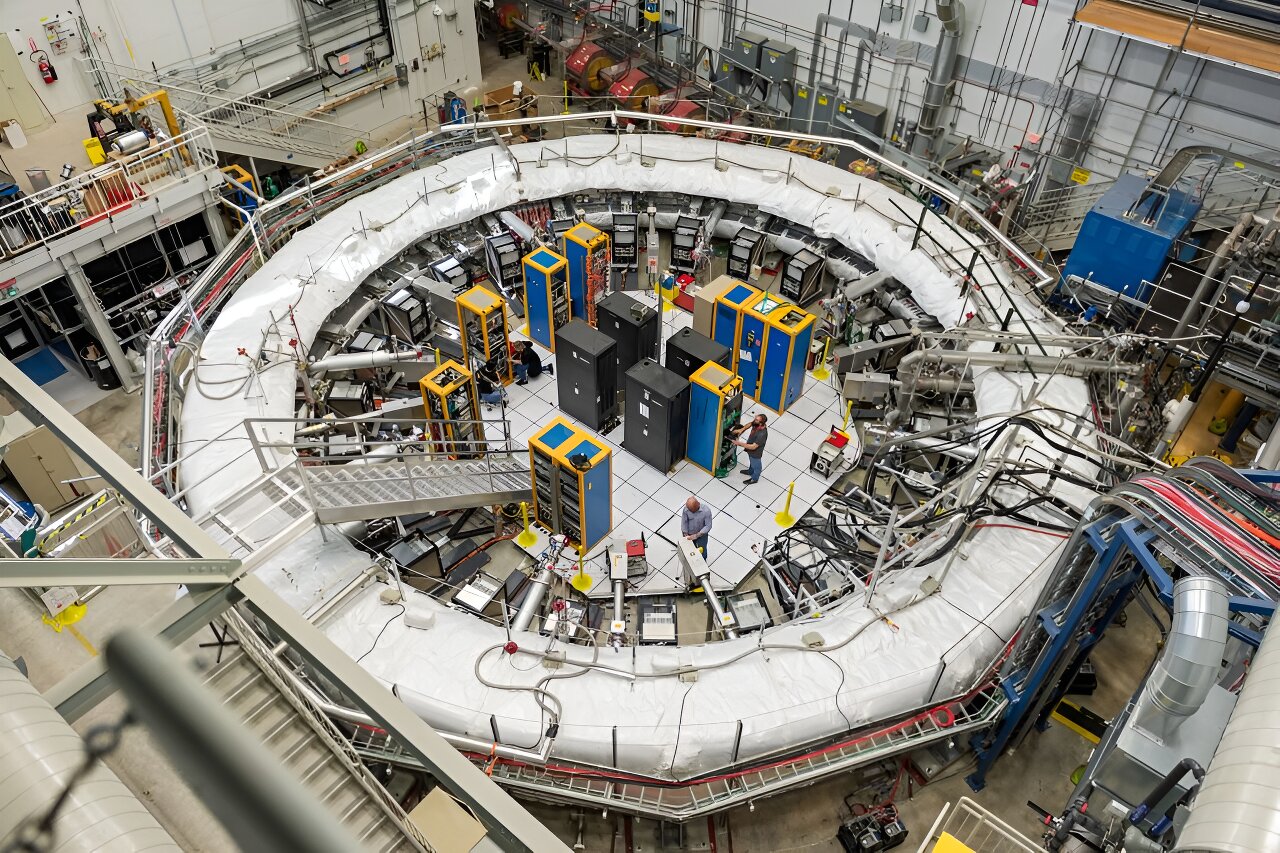
The Muon g-2 collaboration at Fermilab has achieved the world's most precise measurement of the magnetic moment of the muon, reducing the error by over a factor of 2 compared to their previous measurement. The measurement is consistent with previous results and aims to explore potential physics beyond the Standard Model. The researchers are analyzing their final data set, which will include six years of data, to confirm whether the difference is a statistical fluke or caused by physics beyond the Standard Model.
The discovery of the muon, an unstable particle with the same charge but hundreds of times the mass of an electron, revolutionized particle physics. In the early 1930s, anomalies in the periodic table and beta decays led to the hypothesis of the neutrino and the discovery of the positron. Physicist Victor Hess's experiments with an electroscope in a hot air balloon flight in 1912 revealed the existence of cosmic rays and paved the way for the detection of muons. Muons, which are produced by cosmic ray showers, were found to be real and relatively common. The muon's existence challenged the understanding of matter and led to the discovery of multiple generations of particles. Additionally, the muon demonstrated the effects of time dilation predicted by Einstein's theory of relativity. Controlling and manipulating muons could unlock new frontiers in experimental particle physics and potentially lead to the discovery of a fifth fundamental force of nature.

Researchers at the University of Tokyo have developed a new navigation system called the muometric positioning system (muPS) that tracks subatomic particles called muons, which are created by collisions between cosmic rays and particles in Earth’s atmosphere. Unlike GPS, muPS works underground, indoors, and underwater. The system requires a receiver and multiple reference detectors positioned above it to triangulate the location of the receiver. The team demonstrated a wireless version of the tech, but the current accuracy is between 2 meters and 25 meters, with a range of up to 100 meters, which is still far from practical. Incorporating chip-scale atomic clocks (CSAC) into muPS could enable real-time measurements at one-meter accuracy.