
Tag

Mpoa

All articles tagged with #mpoa

neuroscience4 hours ago

Parenting circuits double as prosocial engines in mice

New work in mice shows that the medial preoptic area (MPOA) circuits governing parenting also drive prosocial allogrooming toward stressed peers, via overlapping neuronal ensembles and an MPOA–to–VTA pathway that modulates dopamine release in the nucleus accumbens. Activity‑dependent labeling reveals MPOA ensembles active during parenting are required for allogrooming, while MPOA neurons activated during prosocial acts are needed for pup grooming, suggesting shared neural substrates and that offspring‑care circuits may scaffold broader adult prosocial behavior.
Environment tunes male caregiving via Agouti signaling in the hypothalamus
science14 days ago

Environment tunes male caregiving via Agouti signaling in the hypothalamus

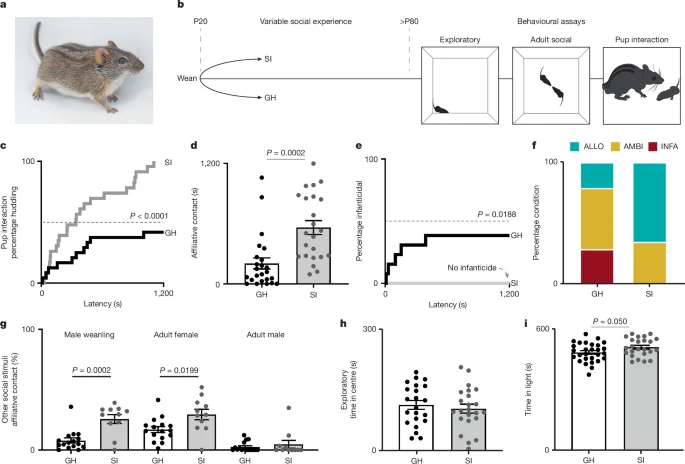
In African striped mice, postweaning social isolation increases male alloparental care while high-density group housing raises infanticide. Brain activity in the medial preoptic area (MPOA) correlates with care variation, and Agouti signaling protein (ASIP) expression is higher in infanticidal males and negatively linked to caregiving. Causally, overexpressing Agouti in the MPOA suppresses paternal care and promotes infanticide, implicating ASIP acting on MC4R receptors to gate caregiving. SnRNA-seq shows Agouti is differentially enriched across MPOA neuron types, not due to changes in cell composition, and Agouti integrates long-term socio-environmental cues rather than hunger. Overall, paternal care relies on conserved maternal/paternal circuits, with Agouti as an environmental switch that biases these circuits toward care or aggression through melanocortin signaling.

The Neuroscience of Maternal Infanticide in Females.
neuroscience2 years ago

The Neuroscience of Maternal Infanticide in Females.

A new study in mice has identified a middle-brain region called the principal nucleus of the bed nucleus of stria terminalis (BNSTpr) that is linked to the control of emotions and likely prompts females to kill their young. The study showed that chemically blocking the BNSTpr prevented infanticide nearly 100% of the time, while artificially activating the brain region caused both mothers and females without offspring to kill pups in nearly all trials. The investigation also revealed that the BNSTpr appears to work in opposition to a brain region called the medial preoptic area (MPOA), itself known to promote mothering behavior.