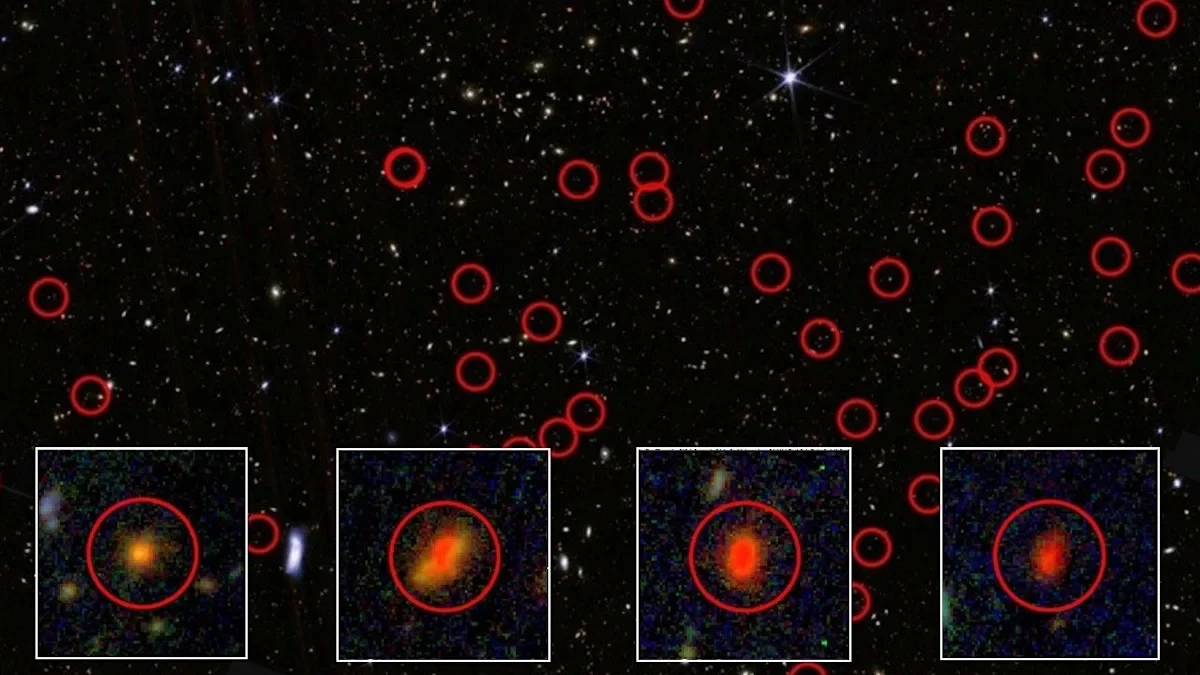
Astronomers using the JWST have found evidence supporting the existence of 'monster stars' of 1,000 to 10,000 solar masses in the early universe, which likely served as seeds for supermassive black holes, explaining their rapid formation less than a billion years after the Big Bang.
Astronomers using the James Webb Space Telescope have found evidence of 'dinosaur-like' supermassive stars in the early universe, which likely collapsed into black holes and contributed to the formation of supermassive black holes observed today, based on unique chemical signatures in a distant galaxy.
Astronomers using the James Webb Space Telescope have found evidence of 'dinosaur-like' supermassive stars in the early universe, which likely collapsed into black holes and contributed to the formation of supermassive black holes observed today, based on chemical signatures in a distant galaxy.
A new study published in Astronomy & Astrophysics reveals that the weird composition of globular clusters may be the result of being baked by gigantic “monster stars” when the universe was young. These monster stars, 5,000 to 10,000 times the size of the Sun, quickly fused material into increasingly enriched matter, then spread that matter throughout the molecular cloud in a heterogeneous manner, which explains why some stars in a cluster will have significantly higher or lower concentrations of certain elements. The James Webb Space Telescope has confirmed high proportions of nitrogen in a globular cluster located 13.3 billion light-years away, which could only have been formed in the core of a supermassive star.