Google warns against creating 'bite-sized' content for large language models (LLMs) as it may harm search rankings, emphasizing that content should be focused on human readers rather than trying to game the system with artificial content segmentation, which may not be effective long-term.
Google's Danny Sullivan advises content creators not to optimize their content into bite-sized chunks specifically for large language models (LLMs), emphasizing that content should be written for users first. He warns that strategies tailored for current LLMs may not work in the long run as search systems evolve, and focusing on human-centric content is the best approach for sustainable success.
The article discusses how AI and large language models are transforming web development and programming, making it more accessible, faster, and different in nature. While some find joy in the process of coding, others appreciate the efficiency and problem-solving capabilities AI offers, leading to a shift in what makes programming fun and fulfilling. The overall tone suggests a positive outlook on AI's role in enhancing productivity and creativity in tech.
The article discusses the decline of StackOverflow, attributing it to factors like poor moderation, the rise of alternative answer sources such as Reddit and Discord, and the impact of large language models (LLMs) which can now provide instant answers, potentially replacing traditional Q&A platforms. It reflects on how these changes have affected the quality and accessibility of technical knowledge and questions about the future of such platforms.
The article discusses how the rise of large language models (LLMs) is shifting enterprise software interfaces from traditional APIs and SDKs to natural language-based interactions, enabled by the Model Context Protocol (MCP). This transition allows users to specify outcomes rather than functions, simplifying integration, reducing onboarding time, and increasing productivity, while also requiring new architectural, security, and organizational considerations.
Originally Published 2 months ago — by Hacker News
The article discusses building and composing AI agents using large language models (LLMs), emphasizing the benefits of modular, specialized agents over monolithic ones, exploring local model deployment to reduce costs, and sharing practical insights and challenges in developing effective AI tools and systems. It highlights the simplicity of creating agents, the importance of tool integration, and the ongoing debate about the economics and reliability of AI inference in production.
Recent developments and expert opinions suggest that achieving Artificial General Intelligence (AGI) with current Large Language Models (LLMs) is unlikely in the near future, as fundamental challenges like distribution shift remain unresolved and recent AI advancements have fallen short of expectations.
Originally Published 2 months ago — by Hacker News
The article discusses how AI tools like Claude are transforming developer documentation and context management by enabling rapid iteration, reducing costs, and improving task-specific usefulness. It explores theories behind improved documentation practices, the role of incentives, and the potential future of automated, structured representations. The conversation also covers the significance of tool calling, MCP protocols, and the evolving landscape of AI-assisted development, emphasizing that these innovations are reshaping how developers create, maintain, and utilize documentation and skills in software engineering.
Originally Published 3 months ago — by Hacker News
The article explores why large language models (LLMs) seem to 'freak out' over the seahorse emoji, which is a real Unicode character. It discusses how LLMs internally represent and predict such emojis, often leading to loops or hallucinations due to their probabilistic nature and training data, and highlights the complex technical and conceptual reasons behind these behaviors.
Originally Published 3 months ago — by Hacker News
The article discusses how AI, particularly large language models (LLMs), tends to strengthen senior developers more than juniors because juniors often lack the experience to recognize hallucinations and rely too heavily on AI, leading to less effective learning. In contrast, seniors use AI as a powerful tool to accelerate their work, improve code quality, and re-ignite their passion for coding, ultimately making them more productive and capable.
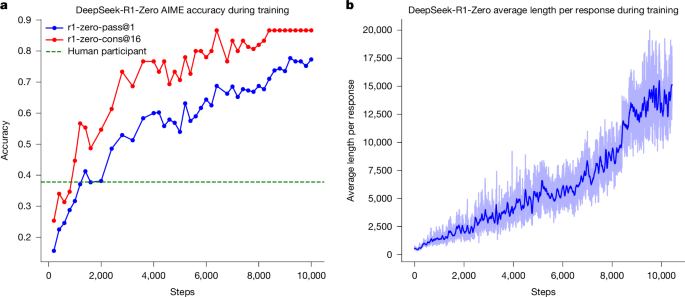
DeepSeek-R1 enhances reasoning in large language models through reinforcement learning, enabling autonomous development of complex reasoning strategies without heavy reliance on human-labeled data, and demonstrating superior performance on various benchmarks.
Paradigm has developed an AI-powered spreadsheet with over 5,000 AI agents in each cell, allowing users to automate data collection and processing with various AI models. The company recently launched publicly after a successful beta, raised $5 million in seed funding, and aims to redefine workflows with AI, positioning itself as more than just an AI-enhanced spreadsheet. It competes indirectly with other AI tools in the spreadsheet space and plans to expand its capabilities.
The IOCCC returned after four years with a record 23 high-quality obfuscated C code entries, showcasing human mastery over AI analysis, with some entries using Unicode and creative tricks. Judges emphasized human skill over AI, and the contest celebrated its tradition with a modernized presentation, including videos and live announcements. The event highlighted the ongoing challenge of AI in understanding complex code and will continue in December 2025.
Originally Published 5 months ago — by Hacker News
The article discusses the current state and future prospects of AI, highlighting that leading models like GPT-5 and others are becoming more similar in performance, challenging the winner-take-all narrative. It explores the limitations of LLMs, the potential impact of AGI, societal and economic implications, and the importance of domain-specific AI tools over true general intelligence. The conversation also covers voice interfaces, memory in AI, and the risks associated with advanced AI development, emphasizing that while AGI may not be imminent, AI's transformative potential is undeniable.
Originally Published 5 months ago — by Hacker News
The article discusses the realistic impact of AI, particularly large language models, on software engineering productivity, emphasizing that while AI can significantly aid in coding and debugging, claims of 10x improvements are often exaggerated. It highlights the current limitations, such as AI's tendency to hallucinate or produce incorrect code, and suggests that AI's true value lies in assisting discovery, learning, and automating tedious tasks rather than replacing skilled engineers entirely.