Tag

Documentation

All articles tagged with #documentation

Anthropic Enhances Claude with Skills for Autonomous Enterprise Collaboration

Originally Published 2 months ago — by Hacker News

The article discusses how AI tools like Claude are transforming developer documentation and context management by enabling rapid iteration, reducing costs, and improving task-specific usefulness. It explores theories behind improved documentation practices, the role of incentives, and the potential future of automated, structured representations. The conversation also covers the significance of tool calling, MCP protocols, and the evolving landscape of AI-assisted development, emphasizing that these innovations are reshaping how developers create, maintain, and utilize documentation and skills in software engineering.


A Beginner's Perspective on Your Developer Tutorial

Originally Published 3 months ago — by Hacker News

The article emphasizes the importance of having less experienced users test documentation by attempting to follow it without help, to identify gaps and improve clarity. It discusses common issues with technical docs, such as lack of context, missing units, and assumptions about prior knowledge, and advocates for iterative testing, clear audience targeting, and practical exercises like screen sharing and recording to enhance understanding. The author also highlights the value of observing real users' struggles to refine documentation and improve onboarding processes, ultimately aiming for self-serve, accessible, and effective technical resources.

AI Scribes Revolutionize Healthcare Documentation and Reduce Burnout

Originally Published 1 year ago — by STAT

Featured image for AI Scribes Revolutionize Healthcare Documentation and Reduce Burnout
Source: STAT

AI scribes are being increasingly adopted in healthcare to alleviate the documentation burden on clinicians, enhancing patient interactions by using ambient listening and generative AI to create progress notes. However, they also introduce new challenges, such as the need for clinicians to review and edit AI-generated text, and may reinforce the culture of excessive documentation. While AI scribes can reduce after-hours work and burnout, the root causes of documentation practices need to be addressed to truly improve efficiency and care quality.

"Massive Leak Unveils Google's Search Algorithm Secrets"

Originally Published 1 year ago — by 9to5Google

Featured image for "Massive Leak Unveils Google's Search Algorithm Secrets"
Source: 9to5Google

Internal Google documents detailing how Search ranks and displays web results were accidentally published on GitHub and later removed. The leak, publicized by Rand Fishkin of SparkToro, includes over 2,500 pages of API documentation. SEO experts believe the data contradicts Google's public statements about Search. Google has not commented on the leak.

"Unclaimed Property: Are You Missing Out on Money in Colorado, Rhode Island, and Connecticut?"

Originally Published 1 year ago — by FOX 31 Denver

Featured image for "Unclaimed Property: Are You Missing Out on Money in Colorado, Rhode Island, and Connecticut?"
Source: FOX 31 Denver

Colorado holds over $1.5 billion in unclaimed property, with $677,064,160 returned since the program began in 1987. Residents, schools, hospitals, small businesses, and corporations can search for their unclaimed property on the state's website and file a claim by providing necessary documentation such as a photo ID and social security number. Once the claim is submitted, it can be tracked using a claim number, and if a letter is received from the State of Colorado Department of the Treasury Unclaimed Property Division, the process is similar.

"Claiming Your Share: Uncovering Unclaimed Property in Colorado"

Originally Published 1 year ago — by FOX 31 Denver

Featured image for "Claiming Your Share: Uncovering Unclaimed Property in Colorado"
Source: FOX 31 Denver

Colorado holds over $1.5 billion in unclaimed property, with $677,064,160 returned since the program began in 1987. Residents, schools, hospitals, small businesses, and corporations can search for their unclaimed property on the state's website and file a claim by providing necessary documentation. The process includes verifying the address, gathering required documents, and tracking the claim using a claim number.

"Building a Rights-Based Approach to Regulating AI Development"

Originally Published 2 years ago — by Tech Policy Press

Featured image for "Building a Rights-Based Approach to Regulating AI Development"
Source: Tech Policy Press

A rights-based approach to regulating AI development is proposed, which requires AI developers to provide documentation proving they have met goals to protect people's rights throughout the development and deployment process. The approach involves four pillars of AI development: data collection, model training, model evaluation, and deployment. Each pillar affects rights and should give rise to regulatory artifacts. The article focuses on the third pillar, "Model Evaluation & Analysis," and discusses the use of "Model Cards" as a transparency artifact. By prioritizing rights-oriented goals and requiring regulatory artifacts, governments can incentivize innovation while minimizing negative impacts of AI.

Escalating Tensions: Russian Bombings and Nuclear Threats Shake Ukraine

Originally Published 2 years ago — by The New York Times

Featured image for Escalating Tensions: Russian Bombings and Nuclear Threats Shake Ukraine
Source: The New York Times

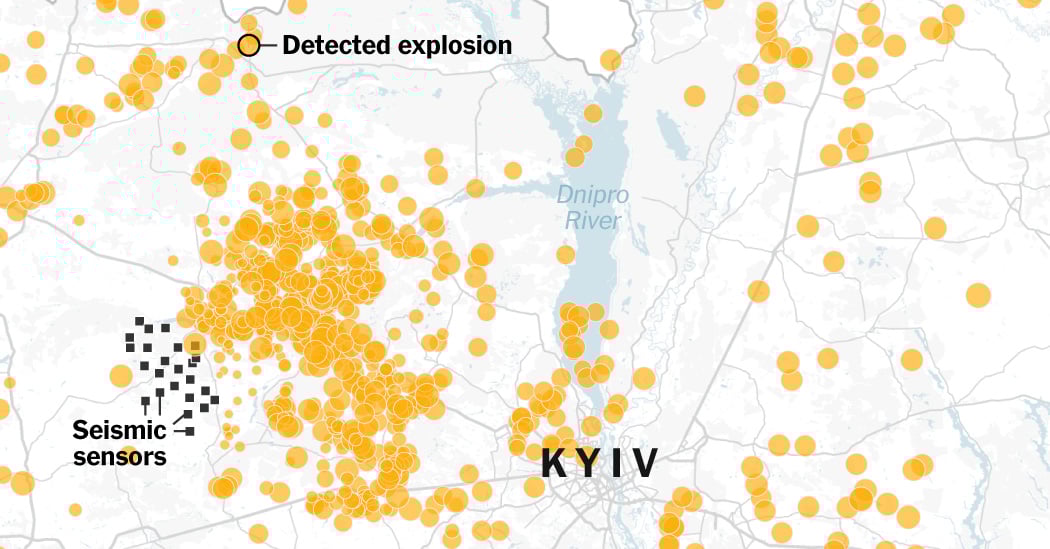
Researchers in Norway and Ukraine have developed a new tool to systematically document Russian attacks in Ukraine by using seismic sensors to track the explosions that shook the earth. By studying data from dozens of earthquake sensors around Kyiv, researchers estimated the position and strength of each explosion, providing objective measurements that can verify what happened during the war. Seismic detections can track blasts at any time, picking up hundreds of attacks that were not previously reported and providing a more comprehensive view of the conflict. This technique could be used in future conflicts to document human rights violations and guide post-war cleanup efforts.

Uncovering Russian Soldiers' Graffiti: A Glimpse into Ukraine's Counteroffensive

Originally Published 2 years ago — by Hyperallergic

Featured image for Uncovering Russian Soldiers' Graffiti: A Glimpse into Ukraine's Counteroffensive
Source: Hyperallergic

The Ukrainian cultural nonprofit Mizhvukhamy has created an open archive called Wall Evidence to document graffiti and inscriptions left by Russian soldiers during the occupation of Kyiv, Kharkiv, and Kherson regions. The archive aims to preserve these findings for future research and analysis, as well as provide insights into the identities and actions of Russian soldiers. The collected data includes apologies, nationalistic pride, and bloodthirsty messages, shedding light on the intentions of ordinary Russian soldiers. The archive may also serve as evidence for war crime allegations in the future.

A.I. Streamlines Medical Paperwork for Now.

Originally Published 2 years ago — by The New York Times

Featured image for A.I. Streamlines Medical Paperwork for Now.
Source: The New York Times

Generative A.I. technology is being used in health care to ease the burden of documentation that takes doctors hours a day and contributes to burnout. The latest A.I. is summarizing, organizing, and tagging the conversation between a doctor and a patient. Companies developing this kind of technology include Abridge, Ambience Healthcare, Augmedix, Nuance, and Suki. Physicians and medical researchers say regulatory uncertainty, and concerns about patient safety and litigation, will slow the acceptance of generative A.I. in health care, especially its use in diagnosis and treatment plans.

Eliminating 'Pajama Time' for Improved A.I. Diagnosis.

Originally Published 2 years ago — by The New York Times

Featured image for Eliminating 'Pajama Time' for Improved A.I. Diagnosis.
Source: The New York Times

Generative A.I. technology is being used to ease the burden of documentation that takes doctors hours a day and contributes to burnout. Companies developing this kind of technology include Abridge, Ambience Healthcare, Augmedix, Nuance, and Suki. Physicians and medical researchers say regulatory uncertainty, and concerns about patient safety and litigation, will slow the acceptance of generative A.I. in health care, especially its use in diagnosis and treatment plans.