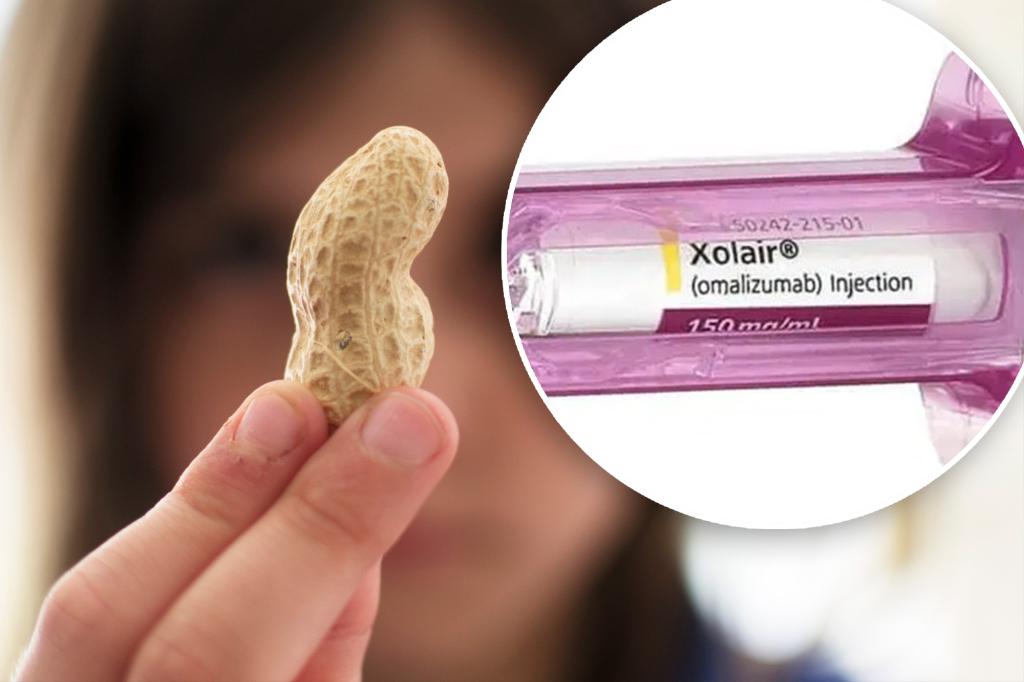
The FDA has approved Xolair, also known as omalizumab, as a new drug to reduce severe allergic reactions to certain foods in adults and children over the age of 1, potentially redefining the treatment of food allergies. While it won't eliminate food allergies, it aims to reduce the risk of harmful allergic reactions from accidental exposure. Developed by Genentech, Xolair has shown promise in helping patients tolerate foods they are allergic to over time, with the most common side effects being reactions at the injection site and fever. This approval marks a significant advancement in managing food allergies for the estimated 20 million Americans affected.

The FDA has approved Xolair, a drug developed by Genentech, to help reduce severe allergic reactions caused by accidental exposure to certain foods such as milk, eggs, walnuts, and peanuts. This is the first medication approved by the FDA to protect against multiple food allergies, but it is not a cure and does not allow patients to consume allergens freely. The drug, administered by injection every two or four weeks, has shown promising results in helping some people tolerate foods they are allergic to, according to a study sponsored by the National Institute of Allergy and Infectious Diseases. However, it comes with potential side effects and a high cost, ranging from $2,900 to $5,000 a month.
Marc Tessier-Lavigne, a prominent neuroscientist and former Stanford president, has retracted a significant Alzheimer's research paper from Nature after a decade of resistance. The retraction follows the discovery of image anomalies and biostatistical errors, although Tessier-Lavigne denies falsification of data. This is his fourth retraction in recent months, amidst a Stanford-sponsored investigation confirming a pattern of falsified research in labs he oversaw. The paper, once thought to be a breakthrough in Alzheimer's treatment, was also used by Genentech in negotiations to increase the company's valuation during its acquisition by Roche. Concerns about the research's reproducibility and integrity have been ongoing since 2012, with recent developments leading to the retraction.
Genentech has entered into a molecular glue partnership with Orionis BioSciences, a biotech company based in Boston and Ghent, Belgium, for the discovery and optimization of small molecule molecular glues targeting undisclosed targets in cancer and neurodegeneration. Genentech will pay Orionis $47 million upfront and has committed to over $2 billion in potential downstream milestones. Genentech will take over the preclinical and clinical development of the drug candidates.
Nathan Traller's daughter Nathalie was diagnosed with a rare form of cancer that had no treatment protocol. After enrolling in a clinical trial and advocating for access to immunotherapy drugs, Nathalie became the first pediatric ASPS patient to take the drug. Although Nathalie passed away at 16, her advocacy work led to the FDA approval of the drug that helped her, and a pediatric clinical trial. Her tenacity also changed how clinical trials include people under 18. Nathalie's legacy lives on in the hope that other families facing an ASPS diagnosis will have access to a treatment protocol.
Mubadala's venture group is focusing on protein degradation, a new modality in drug discovery, after Rami Hannoush's meeting with UCSF's Jim Wells. FDA advisors unanimously recommended accelerated approval for Biogen's ALS drug tofersen, despite it failing its Phase III study. Genentech is halting commercial manufacturing at its California headquarters and laying off several hundred employees. A new study finds that patient influencers are sharing prescription drug experiences along with health information. Novartis is calling off a UK-based trial for Leqvio in the primary prevention of cardiovascular events in patients with high cholesterol.