2025 was a tumultuous year marked by tech giants reaching trillion-dollar valuations, a surge in prediction markets, a challenging year for Bitcoin, rising costs in streaming services, and significant developments in AI infrastructure and investments, alongside ongoing trade tensions and billionaire rivalries.
Mastercard's policy on lawful transactions is ambiguous, allowing for vague discretion that can lead to censorship of certain industries like NSFW games. The article advocates for legal reforms to classify payment networks as common carriers, ensuring non-discrimination and transparency, while criticizing current profit margins and regulatory failures. It discusses the complexities of international law, the limitations of current payment infrastructure, and the need for government-led public services to ensure access and privacy, emphasizing that private companies often externalize costs and restrict access based on political or reputational risks.
The U.S. Department of the Treasury has issued a request for public comment on the uses, opportunities, and risks of AI in the financial services sector. This initiative aims to understand AI's impact on consumers, investors, and financial institutions, and to gather recommendations for enhancing legislative and regulatory frameworks. The Treasury seeks diverse perspectives to promote inclusive and equitable access to financial services through AI innovations. Comments are open for 60 days and will be publicly available on regulations.gov.
JPMorgan Chase is set to launch Chase Media Solutions, a business that will provide companies with the financial data of its 80 million clients for targeted marketing purposes. The new venture aims to leverage transaction data to allow brands and agencies to precisely target customers based on their purchase history. This move comes after JPMorgan Chase's acquisition of Figg, a card-linked marketing platform, and is positioned as a step towards bringing value to both business clients and banking customers.
Wall Street investors are seeking the next wave of artificial intelligence (AI) winners beyond the US, focusing on emerging markets for better value and growth potential. Asian AI giants offer better value and faster growth compared to their US peers, with Taiwanese and South Korean chip companies leading the $1.9 trillion rebound in emerging markets this year. Investors are eyeing traditional electronics manufacturers morphing into AI leaders and companies in non-tech sectors adopting AI to enhance earnings. Despite the potential, there are risks tied to the US market and the possibility of AI stocks lagging behind if stock-market gains broaden out.
BlackRock, the asset management giant, has launched a real-world asset tokenization fund on the Ethereum network, represented by the blockchain-based BUIDL token and backed by cash, U.S. Treasury bills, and repurchase agreements. The fund will provide daily yield to token holders via blockchain rails and is supported by companies like Securitize, BNY Mellon, Anchorage Digital Bank NA, BitGo, Coinbase, and Fireblocks. BlackRock also made a strategic investment in Securitize, signaling its focus on digital assets. This move follows a trend of traditional finance giants entering the tokenization field, as blockchain-based tokens of traditional investments are becoming more prevalent.
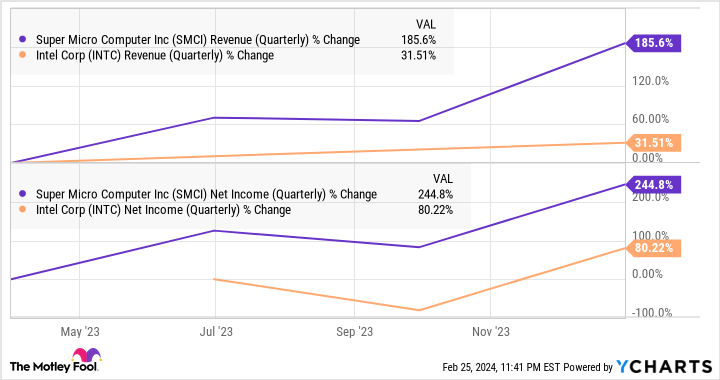
Super Micro Computer's stock has surged 776% in the past year, outpacing Intel's 71% gains, leading to speculation about its potential to surpass Intel's market cap by 2027. Super Micro's revenue and earnings growth, driven by booming demand for AI chips, has propelled its market cap from $5 billion to over $48 billion, with expectations of reaching $25 billion in annual revenue by 2026. While Intel's AI-related revenue pipeline stands at over $2 billion, Super Micro's revenue from selling AI server solutions exceeds half its total revenue, indicating a faster growth pace. Despite this, Intel is likely to remain the bigger company by 2027, but Super Micro's potential for sustained growth makes it an attractive investment option.
Data is a valuable resource in the 21st century, and companies like Palantir Technologies and Snowflake help organizations analyze and apply it. While both companies show strong financials and growth potential, the PEG ratio suggests that Palantir may be a better buy at its current share price compared to Snowflake, which is considered overvalued by some. However, both companies are seen as strong long-term investments, with Palantir being the winner for potential investment at the current price.
The Fintech 50 list for 2024 in the "Wall Street and Enterprise" category features nine startups, including Addepar and Trumid, as well as four fraud prevention companies. These startups are helping financial institutions work more efficiently and effectively, with a focus on preventing fraud and leveraging artificial intelligence. Notable newcomers include DataSnipper, which uses AI to streamline auditing and accounting processes, and Merge, which offers cloud-based accounting integration. Meanwhile, Carta, a previous mainstay, has been replaced by Pulley, a cap table management firm.
Tech-heavy stock indexes like Nasdaq and Japan's Nikkei are close to all-time highs, despite a temporary setback due to the U.S. inflation update. The U.S. annual consumer price inflation is expected to decrease to a near 3-year low of 2.9%, leading to steady rates and bond markets. The AI and tech frenzy, along with a softening yen, propelled Japan's Nikkei to a 34-year high, with SoftBank and chip developer Arm Holdings contributing to the surge. Meanwhile, the Nasdaq surpassed its record closing high from November 2021, but Tesla's stock fell amid a price war with Chinese rivals. Bitcoin reached its highest level since December 2021, and in Europe, sterling rose while British stocks and bonds fell after weak UK pay growth data.
The current bull run in technology stocks, particularly those associated with artificial intelligence, is expected to continue due to a strong U.S. economy and potential interest rate decreases. Three tech stocks to consider buying this month are Arm Holdings, which reported strong financial results and forward guidance due to AI demand; Alphabet, which is rebranding its main AI chatbot and launching a paid subscription version; and Nintendo, which raised its forecast for sales of its flagship Switch console amid strong demand and reported better-than-expected financial results.
McKinsey & Company projects the semiconductor market to reach $1 trillion by 2030, with AI being a key growth driver. Three top stocks to consider for investment are Advanced Micro Devices, which is making strides in AI chips for servers and PCs; Applied Materials, a provider of semiconductor fabrication equipment and services; and Broadcom, a major chipmaker with a strong focus on AI and infrastructure software. These companies are well-positioned to benefit from the semiconductor market's growth, with Broadcom also offering a dividend yield of nearly 1.7%.
AI stocks rallied on Thursday as investors reacted to the strong performance and forecast of Arm Holdings, a company deeply integrated in the AI space. Super Micro Computer, C3.ai, Taiwan Semiconductor, Symbotic, and SoundHound AI all saw significant stock price increases. Arm's robust results and forecast, along with CEO's bullish comments on AI, fueled investor enthusiasm. The article also discusses the potential impact of AI on various companies and the importance of delivering revenue and profits in the AI sector.
The market capitalization landscape has shifted towards tech giants like Apple and Microsoft, with the potential for Nvidia and Amazon to join the $3 trillion club by 2030. Nvidia's dominance in AI and cloud computing, along with the growing demand for generative AI, positions it for significant growth. Amazon's e-commerce sales, cloud computing leadership, and adoption of generative AI also set the stage for potential future growth, making both stocks compelling options for investors eyeing the AI sector.
Microsoft's Q4 earnings are expected to be driven by cloud computing, AI, and gaming, with a focus on the recent acquisition of Activision and the performance of Copilot 365. Meta Platforms is anticipated to deliver strong results due to growth in digital advertising, particularly in emerging markets like Brazil, and increased spending from companies outside of China. Both companies are expected to report positive numbers and provide optimistic outlooks for the future.