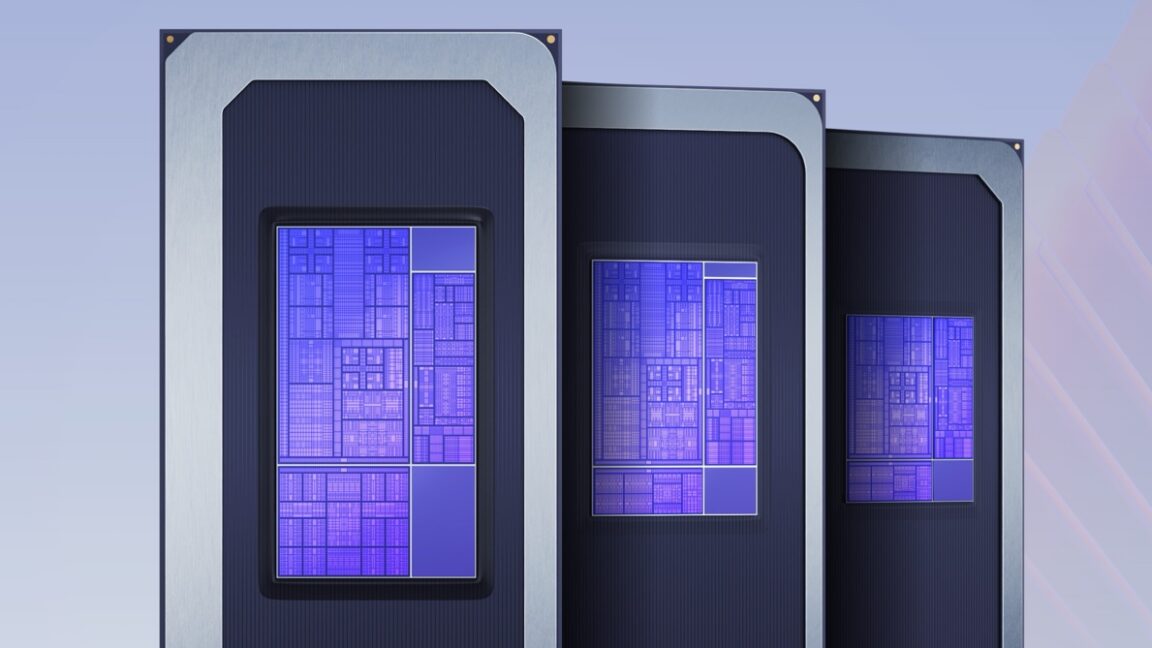
Intel's new Panther Lake CPUs, built on the 18A process, are set to challenge AMD's dominance in the handheld gaming PC market with significant improvements in gaming performance and battery life, potentially disrupting the current market leader and opening a new revenue stream for Intel.
Qualcomm announced new Snapdragon X2 Elite and Plus chips for Windows laptops, with the first devices expected by the end of Q1 2026. The X2 Elite targets high performance, while the Plus offers a more budget-friendly option with significant CPU and power efficiency gains, supporting up to 128GB RAM and promising multi-day battery life. These chips aim to compete with Intel and AMD, with improved AI and gaming support, though gaming performance may be limited compared to high-end GPUs.
A YouTuber successfully ran Battlefield 6 on a 12-year-old AMD FX-9590 CPU, achieving 30-40 FPS despite being CPU-limited, demonstrating that older hardware can still handle modern games at lower settings, especially on supported platforms with features like Secure Boot.
Intel is launching its next-generation Panther Lake laptop chips, which aim to simplify its lineup by replacing the Lunar Lake and Arrow Lake series. These chips are expected to offer up to 10% better single-core and 50% better multi-core CPU performance, with a GPU that's roughly 50% faster, and reduced power consumption. The new architecture consolidates features across three chips tailored for different laptop types, marking a return to a more unified and straightforward product line. Systems with these chips are expected to ship by the end of the year, signaling a potential return to form for Intel in the laptop CPU market.
AMD asserts that x86 architecture is on par with ARM in energy efficiency and overall performance, challenging the recent hype around ARM's dominance in mobile and Windows platforms, and highlighting advancements in AMD and Intel solutions that maintain x86's relevance in consumer hardware.
AMD's Ryzen 9 9950X CPU has been tested with a 5.5 GHz all-core overclock at 253W and an unlimited power profile consuming 320W. The tests, conducted by Anandtech forum member Igor_kavinski, show significant performance improvements, with the CPU achieving up to a 40% performance boost over Intel's Core i9-14900K and a 38% improvement over AMD's Ryzen 9 7950X at stock configurations. The results highlight the efficiency and power of AMD's upcoming Ryzen 9000 "Zen 5" Desktop CPUs, expected to launch later this month.
The PlayStation 5 Pro's 10% CPU performance boost over the base model is unlikely to significantly improve performance in CPU-bound titles or enable 40 FPS modes, with developers needing more CPU overhead for a 33% boost. While the new console's better CPU may offer improved stability for 40 FPS modes, it's unlikely to be widely implemented due to limited demand. Despite questions about its necessity, a known AMD leaker suggests there are reasons for Sony to release the mid-generation system, dispelling myths about untapped potential in the PlayStation 5. The PlayStation 5 Pro has yet to be officially announced.
Benchmark results for Apple's new M2 Ultra chip show up to 20% faster CPU performance compared to the M1 Ultra chip, making it the fastest chip Apple has ever released. The new Mac Pro with the M2 Ultra chip is expected to have around 2× faster overall CPU performance than the fastest Intel-based Mac Pro with a 28-core Xeon W processor, at a lower starting price. The Mac Studio and Mac Pro are available to order now and will launch on June 13.