Tag

Computational Efficiency

All articles tagged with #computational efficiency

"MIT Unveils Breakthrough in AI Image Generation, Making Process 30 Times Faster"

Originally Published 1 year ago — by Livescience.com

Featured image for "MIT Unveils Breakthrough in AI Image Generation, Making Process 30 Times Faster"
Source: Livescience.com

MIT scientists have developed a technique called "distribution matching distillation" (DMD) that accelerates popular AI image generators by condensing a 100-stage process into one step, making them up to 30 times faster. This advancement results in smaller, leaner AI models that can generate high-quality images more quickly, reducing computational time and costs. The new approach, detailed in a study uploaded to arXiv, has the potential to significantly impact industries where efficient image generation is crucial.


Unraveling the Mystery of Spiral Signals in the Human Brain.

Originally Published 2 years ago — by Yahoo Life

Featured image for Unraveling the Mystery of Spiral Signals in the Human Brain.
Source: Yahoo Life

Mysterious spiral signals have been discovered in the human brain, which could help to organize complex brain activity. The signals appeared as swirling spirals of brain waves across the outer layer of the brain and were discovered in functional magnetic resonance imaging (fMRI) brain scans of 100 young adults. The exact purpose of these vortices is unknown, but their discoverers think the spiral signals might be used to link different parts of the brain and help process information faster. These vortices may even be impaired by brain diseases such as dementia, and could serve as inspiration for advanced computers that emulate the complex processes of the human mind.

Spiral Brain Waves and Cognitive Function: A Correlation

Originally Published 2 years ago — by Neuroscience News

Featured image for Spiral Brain Waves and Cognitive Function: A Correlation
Source: Neuroscience News

Researchers have discovered swirling spiral patterns of brain signals on the human cortex that play a crucial role in organizing brain activity and cognitive processing. These spirals facilitate intricate interactions for computational efficiency and allow for flexible reconfiguration of brain activity during various tasks involving natural language processing and working memory. The study's findings were obtained from functional magnetic resonance imaging (fMRI) brain scans of 100 young adults, which the researchers analyzed using methods typically employed to understand complex wave patterns in turbulence.

Efficient and Accurate Description of Electron Interactions Without Supercomputers

Originally Published 2 years ago — by Phys.org

Featured image for Efficient and Accurate Description of Electron Interactions Without Supercomputers
Source: Phys.org

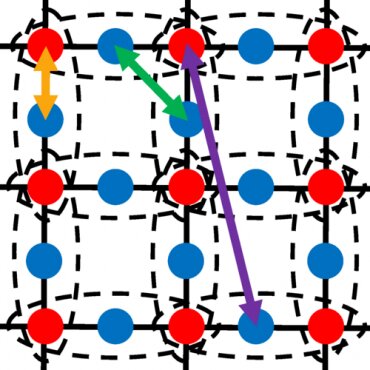
Researchers have developed an efficient and highly accurate method to describe interacting electron systems for crystalline materials, a long-standing challenge in condensed matter physics. The method, called bond-dependent slave-particle cluster theory, treats two or three bonded atoms at a time and connects the clusters together in a novel way to describe the entire system. Compared to literature benchmark calculations, the new method is three to four orders of magnitude faster and can be run on a student laptop. The researchers look forward to applying this method to more complex and realistic materials problems in the near future.