Scientists in Switzerland are using human-derived brain organoids as biological processors for computing, aiming to create energy-efficient alternatives to silicon chips, with potential applications in AI and medical research, while addressing ethical and technical challenges.
Scientists in Switzerland are developing biocomputers using lab-grown mini-brains called organoids derived from human stem cells, aiming to create energy-efficient, living servers that mimic aspects of AI learning, though challenges like maintaining organoid health and understanding their activity remain.
Researchers are developing the world's first "living processor" using human brain organoids, which could significantly reduce the energy demands of large artificial neural networks. The project, led by Swiss startup FinalSpark, is in its early stages and aims to achieve this ambitious goal through international collaboration. The platform allows universities to conduct long-term experiments on biological neural networks, with the potential to revolutionize energy-efficient computing.
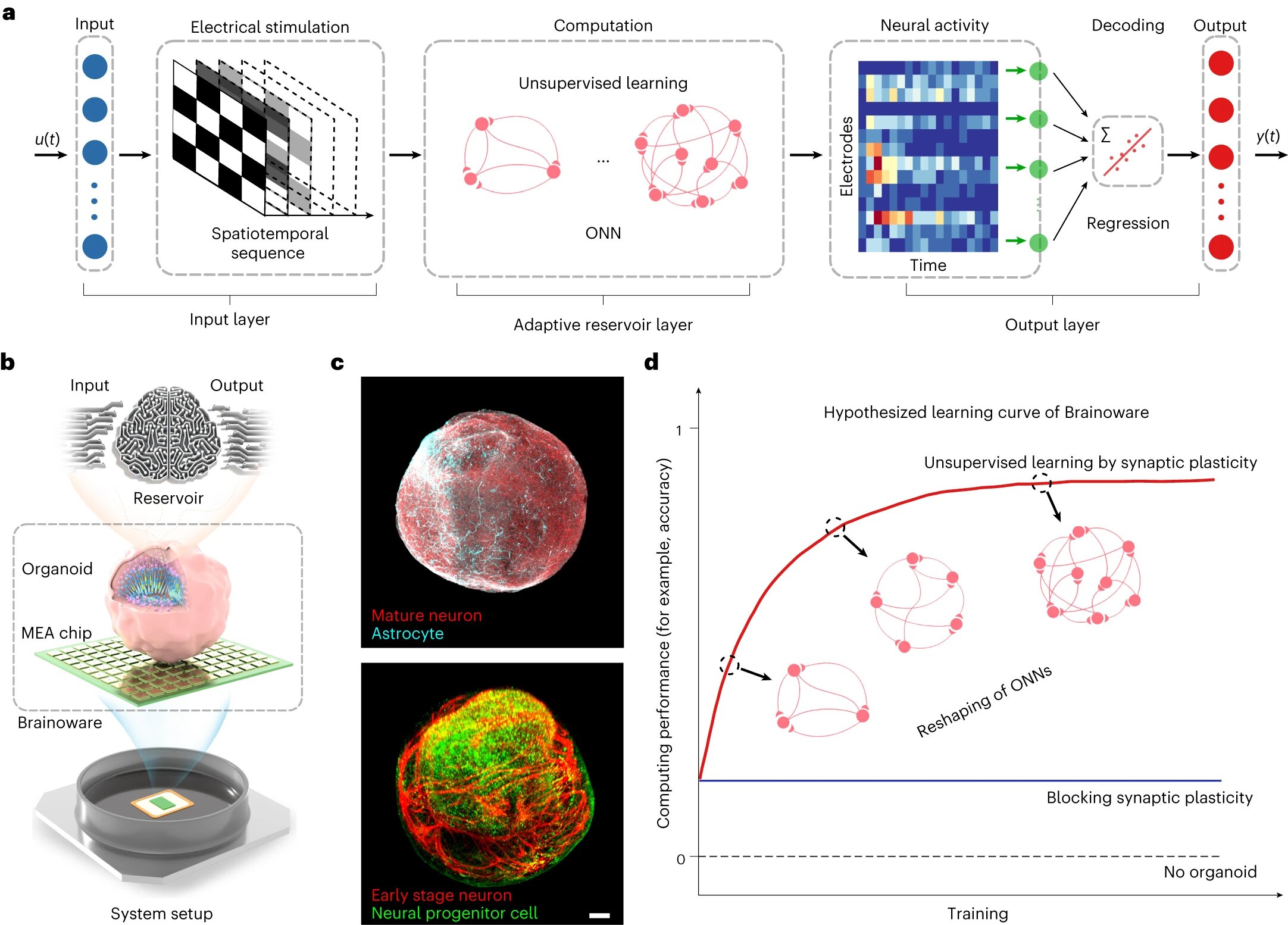
Researchers have connected clusters of lab-grown brain cells to a computer and achieved elementary speech recognition and math problem-solving. The brain cells, grown from specialized stem cells, formed a nanometer-wide organoid that was connected to a circuit board. After training, the system, called Brainoware, was able to distinguish between different voices and predict mathematical constructs with high accuracy. This breakthrough demonstrates the potential of using brain-inspired neural networks for advancing artificial intelligence capabilities. Biocomputing systems like Brainoware offer energy efficiency and could be used for studying neurological diseases and decoding brain wave activity. However, challenges remain in maintaining the health and nourishment of organoids and addressing neuroethical concerns.
Researchers have developed a hybrid system called Brainoware, which combines human brain cell networks (organoids) with a computer chip, demonstrating capabilities in processing, learning, and memory. The system achieved basic speech recognition skills by decoding audio clips of Japanese vowels, improving its accuracy to about 78% with training. While the system is less accurate than artificial neural networks, this research opens new possibilities in biocomputing and showcases the potential of brain organoids in complex computational tasks.
Scientists are using brain-like tissue in their research on "biocomputing," a field that aims to develop computers that can process information in a way similar to the human brain. This advancement could potentially lead to more efficient and powerful computing systems in the future.