Tag

Atlas Collaboration

All articles tagged with #atlas collaboration

physics2 years ago

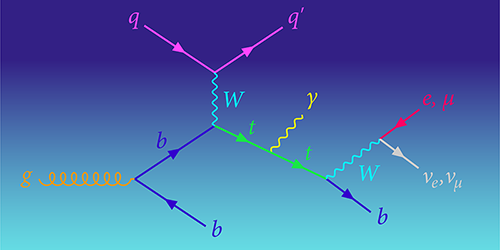
"Unveiling the Elusive Connection: A Groundbreaking Discovery of a Single Top Quark and Photon"

The ATLAS Collaboration at CERN's Large Hadron Collider has observed the coincident production of a single top quark and a photon in proton-proton collisions. This observation provides valuable insights into the electroweak interaction of the top quark, the heaviest known fundamental particle. The measurement suggests a higher rate of production than predicted by the standard model, indicating potential deviations and the possibility of new particles. Further analysis and data collection will help uncover the properties of these events and their implications for physics beyond the standard model.

science2 years ago

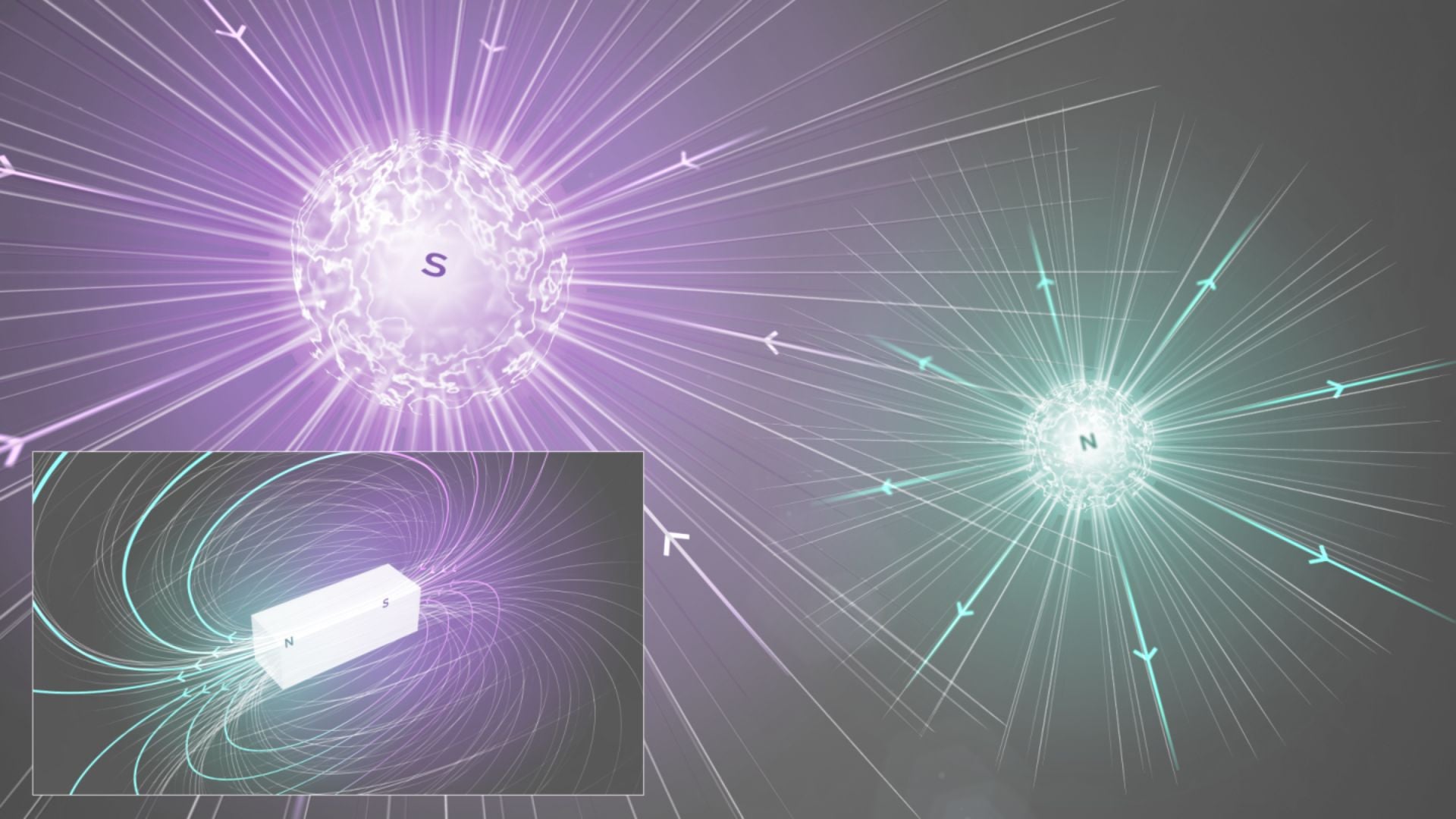
"Unraveling the Mystery: CERN's Quest for Monopoles Persists"

Researchers at CERN's ATLAS Collaboration continue their search for magnetic monopoles, an elusive particle, using the largest general-purpose particle detector at the Large Hadron Collider. The collaboration, consisting of thousands of scientists and support staff, aims to detect phenomena that have not been observed before, and has previously made significant discoveries such as the Higgs boson.

physics2 years ago

Uncovering Dark Matter through Semi-Visible Particle Jets and Laser Experiments.

The ATLAS Collaboration has conducted the first search for semi-visible jets, a potential signature for the presence of dark matter particles. These are hypothesized to occur when two protons interact, generating an intermediate particle that then transforms into two jets. The search sets the first limits on this specific semi-visible-jet production scenario, paving the way for more nuanced dark matter searches in the future.

physics2 years ago

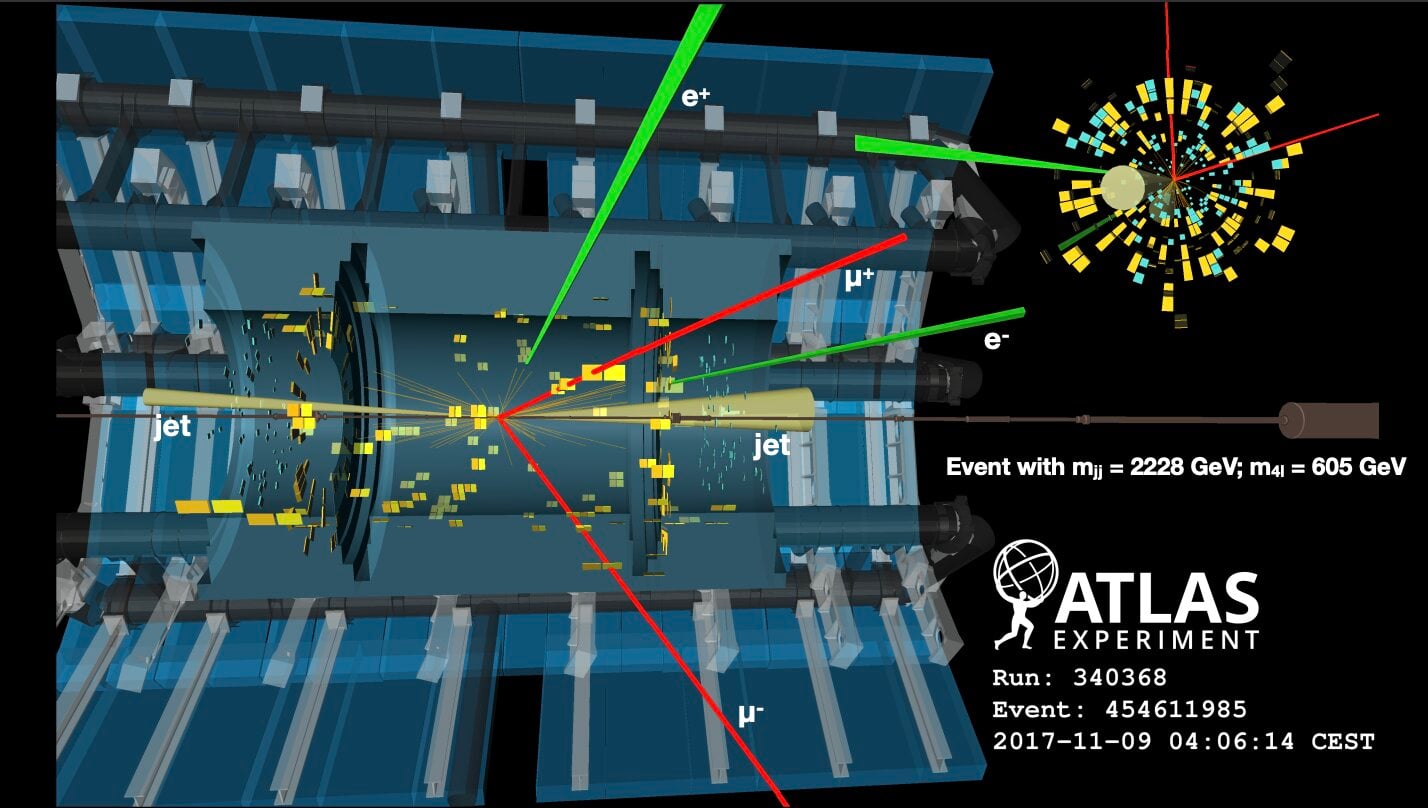
ATLAS Collaboration Witnesses Electroweak Production of Jets and Z-Boson Pair.

The ATLAS collaboration at CERN has observed the electroweak production of two Z bosons and two jets, a rare process that could contribute to the understanding of standard model (SM) particle physics. This observation confirms the consistency of the experimental results with the mechanism predicted by the SM and marks the start of a new era in precision studies of such rare processes in the electroweak sector. The observation could motivate further investigations of a mechanism called electroweak symmetry breaking (EWSB) that can result from vector-boson scattering (VBS).